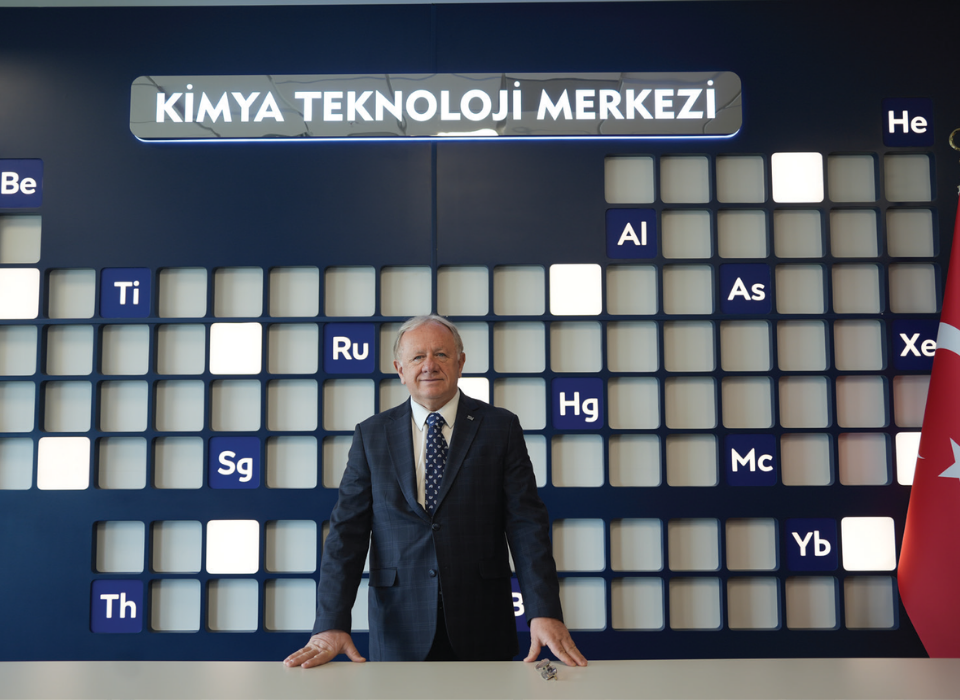
The Chemical Technology Center, launched with an investment of TRY 165 million, will reduce foreign dependency and become a hub of innovation by carrying out 39 tests that could not previously be performed in Turkey. İKMİB (İstanbul Chemicals and Chemical Products Exporters' Association) Chairman Adil Pelister discussed this significant investment, which was realized under the leadership of İKMİB.
With an investment of TRY 165 million, the Chemical Technology Center will conduct 39 tests previously impossible in Turkey, reducing import dependency and becoming the heart of innovation. Adil Pelister, Chairman of İKMİB (Istanbul Chemical Substances and Products Exporters Association), explained this important investment, which came to life under İKMİB's leadership.
When and how did the idea of establishing the Chemical Technology Center emerge?
The Chemical Technology Center was born as a visionary project that we, as İKMİB, put forward as a new idea in light of our forward-looking thoughts, one that would carry our sector into the future and add value to our country. During our work with the Chemical Sector Platform in 2019, we first articulated this innovative idea as İKMİB, and it was a technology center that, with our future projections regarding our sector, built tomorrow from today. Because we needed a technology center that would provide test and certification services with our local and national capabilities on these lands, sign firsts in this field in Turkey, serve as an incubator for innovative products in the chemical field, and particularly specialize in chemistry technology. Starting from 2020, we began discussions with public institutions. During this period, particularly with our Ministry of Trade and our Ministry of Industry and Technology, we received strong support that significantly strengthened our idea and vision. From 2021 onwards, we set out with a series of discussions and feasibility studies such as land allocation, exploration conferences, and workshops with academics. Today, we are adding strength to our sector and country through our Chemical Technology Center, which aims to build a comprehensive chemistry ecosystem ranging from an incubator center with qualified personnel to R&D project management, providing test and certification services to the main sub-sectors of chemistry with international standards.
What periods and difficulties did the Chemical Technology Center go through until it opened its doors?We are talking about a technology center financed by İKMİB's own resources; that is, proportional membership fees from its members, bringing together a structure that will serve members and the sector, contribute to our country's economy and chemistry sector, and leave a lasting legacy toward Turkey's future goals in global trade. Therefore, during this period, particularly with the valuable contributions of our İKMİB members, our chemical manufacturers and chemical exporters, we turned this dream into reality. Planning the financing of this project, gaining public support, receiving contributions from the academic community, and physically implementing this investment required laborious effort. Fortunately, as İKMİB management, we took the first step of a major future ideal in our Vision 2030 roadmap with the Chemical Technology Center.
What are the reasons for choosing IT Valley as the location of the Chemical Technology Center?
We wanted the Chemical Technology Center to be at the heart of technology. It was not only our aim to be physically located in IT Valley in Kocaeli. Our basic desire was actually to ensure that the Chemical Technology Center would be part of the technology ecosystem in our country. Because only in this way could we become a center that draws from different fields and disciplines of technology, developing high value-added products and next-generation chemical technologies. In selecting the location in this direction, we acted strategically and took the right step. We are very fortunate to be part of this ecosystem. Because by physically being part of this ecosystem, we have gained a valuable asset. Start-up projects supported by the Chemical Technology Center, new ideas waiting to come to life in the incubator center, can also benefit from the world-standard facilities offered by IT Valley at the same time.
One of the most important reasons for choosing IT Valley is the strategic location advantage it possesses. Located at the exact center of the Istanbul-Kocaeli-Bursa line, which plays a locomotive role in Turkey's industrial production, this location physically brings the Chemical Technology Center closer to a target audience of more than 25 million people living within approximately 200 kilometers of road distance. This proximity facilitates collaborations with the private sector and at the same time provides an important advantage in terms of rapid access and efficient service delivery.
What do you think the Chemical Technology Center will contribute to the sector?
We see the Chemical Technology Center as a critical milestone in advancing the sector's technology development and test infrastructure. Our chemistry sector, which touches 27 main sectors with its strategically important products and contributes significantly to Turkish industry and exports with 16 sub-sectors, will find this center to be an important milestone in its future projection.
At the Chemical Technology Center, which we have brought to life with an investment of TRY 165 million, 39 tests that have not been previously conducted in Turkey will be carried out in our modern laboratories, and our country will sign many firsts in the chemistry field. A total of 209 different tests are planned to be deployed, with 100 of them expected to be certified with international accreditation in the near future.
From plastics to rubber, from cosmetics to paints, test and analysis procedures that many sub-sectors have needed and that have been conducted abroad until now will be able to be performed within the Chemical Technology Center. This will provide important advantages to our exporters in terms of both time and cost. At the same time, with the reduction of import dependency, it is estimated that a contribution of an average of USD 12.5 million per year will be made to closing our country's current account deficit.
Furthermore, a serious foundation will be laid for our sector to achieve higher value-added production, increase its qualified product development capacity, and raise the export value per kilogram. We believe that the Chemical Technology Center will be the heart of innovation not only through test and laboratory services, but also through start-up projects emerging from our incubator center, domestic technologies, certification services, and consulting. We are proud to have brought this center, which will be a meeting point for the chemistry of the future, to our country.
Can you describe İKMİB's pioneering role in establishing the Chemical Technology Center?
As İKMİB, our idea of the Chemical Technology Center actually opens a horizon aimed at our chemistry sector gaining a larger share of global trade together with high value-added exports and high-tech products. Indeed, today, 8 of the world's 10 largest economies are also among the top 10 in chemistry technology production and chemical exports. Therefore, chemistry is a highly strategic sector that touches every aspect of life and produces intermediate and final products for all branches of industry. For this reason, our chemistry sector is in the position of a valuable production base that directs our country's economy and has a leveraging effect.
Of course, pioneering the Chemical Technology Center is not the only idea we are leading from this position. In our Vision 2030 strategy, there are two more important action steps. Our second target step is to establish the Turkey Chemical Agency, and the final step that will support this is to establish a Chemistry Science City, which will also be the first of its kind in Turkey. We are designing a chemistry city for our future that is a single body with its own financial system and production technologies, research institutions, and university.
What services will be provided to which sectors at the Chemical Technology Center?
Within the Chemical Technology Center, comprehensive physical, chemical, and mechanical testing services are provided to the main segments of the chemistry sector, particularly cosmetics, cleaning products, plastics, elastomers, rubber, polymeric materials, and paint industries, as well as analyses in microbiology and molecular biology laboratories. Our laboratory infrastructure is equipped with modern analysis techniques such as chromatography, spectroscopy, thermal analysis, and rheology, and it is planned to validate and implement 39 tests that have not been previously conducted in Turkey. A total of 209 different test procedures will be deployed; for 100 of these, national and international accreditation processes are expected to be completed in the near future to provide a competent response to the sector's reliable analysis needs.
Will collaborations be established with academics and universities?
Of course. The establishment process of the Chemical Technology Center was shaped by the active contributions of not only manufacturers but also the academic world. Our center was designed to have a structure that produces knowledge and technology beyond test and analysis services. In this context, we are working in close cooperation with universities and academics. We have goals such as providing infrastructure support in multi-stakeholder R&D projects involving particularly start-ups and universities, enabling shared laboratory use, and providing technical contributions to consortiums. We value building an effective bridge between the academic world and industry. In addition, we will also launch education and consulting services for the chemistry sector. The content of these services will address current sector needs and be enriched with the contributions of expert trainers and academics in the field. Thus, the Chemical Technology Center will become a holistic structure that progresses with its academic stakeholders not only in testing and analysis, but also in education, development, and knowledge transfer processes.
Gallery