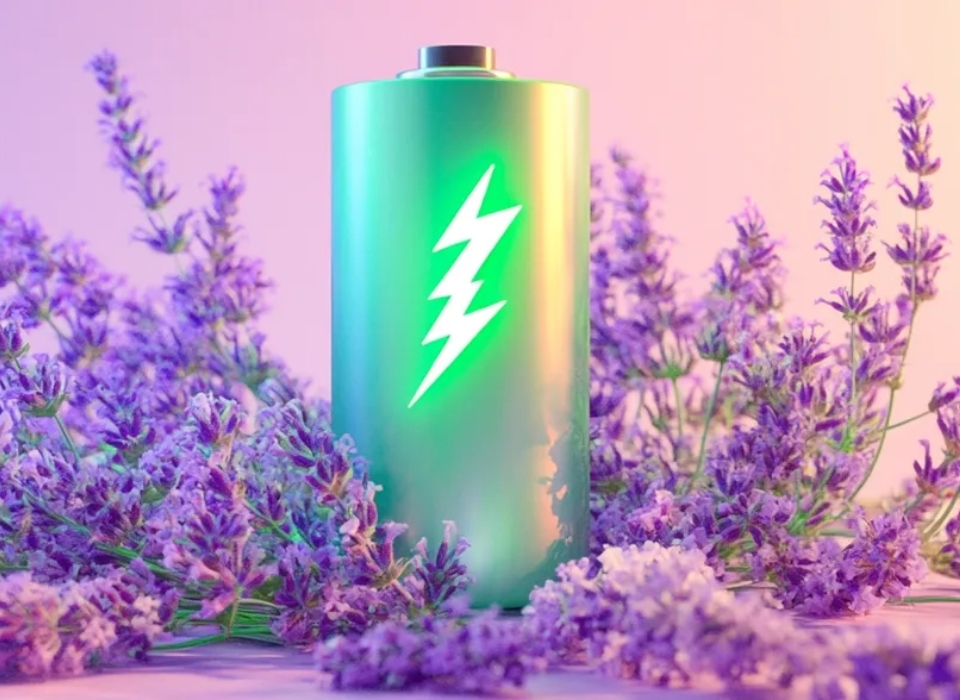
Nature's Power: Future Batteries Made with Lavender Oil
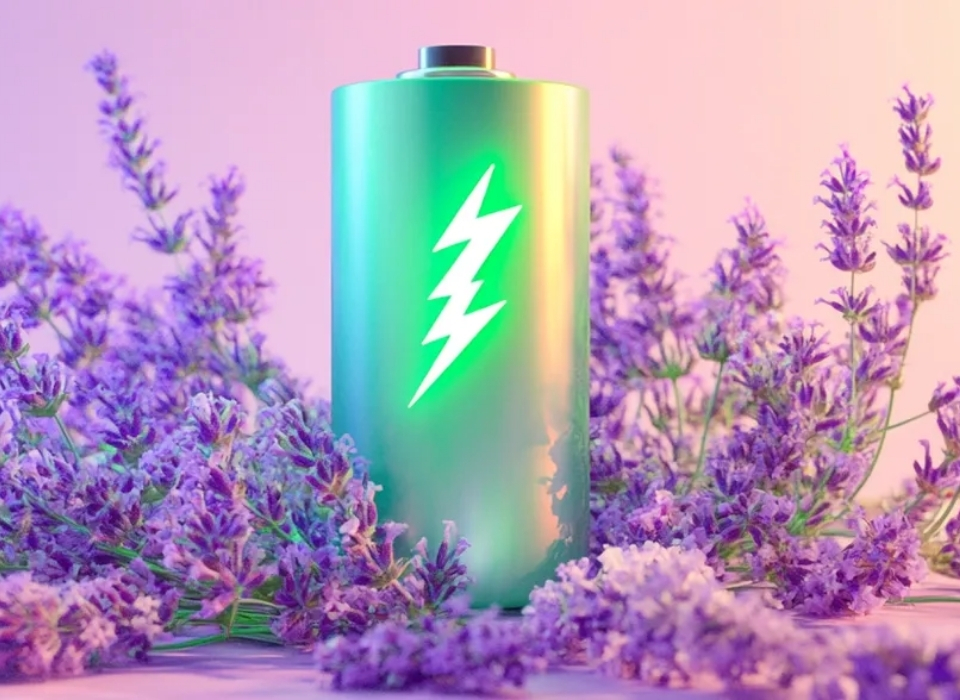
A sodium-sulfur battery with improved energy performance and longer lifespan?
The secret ingredient is growing in our gardens: lavender.
Dr. Paolo Giusto's team combined lavender oil with sulfur, developing a unique material that solves polysulfide shuttling—a persistent failure problem. This research represents an important step in developing more powerful and sustainable batteries for next-generation large-scale energy storage systems.
Alessandro Volta could not have imagined how profoundly the battery he invented would transform our lives. A long path has been traveled from his stacks of metal discs to pocket-sized energy sources in our portable devices and vast networks powering factories. Today, scientists are seeking alternatives to traditional lithium-based batteries, which cause significant pollution at every stage—from extraction of critical components to energy-intensive production and disposal of toxic waste. Dr. Paolo Giusto's team at the Max Planck Institute for Colloids and Interfaces is working on sodium-sulfur batteries, a promising option that uses less hazardous chemicals and is made from readily available elements.
However, these environmentally friendly batteries do not come without challenges. The greatest problem is polysulfide shuttling, where compounds form that interfere with the battery's operating mechanism. Polysulfides are unwanted byproducts that clog the battery and can cause complete failure when they spread. Giusto and his research team added an unexpected but revolutionary material to the synthesis process: lavender oil.
Dr. Evgeny Senokos combined linalool from lavender oil with sulfur and heated the mixture, creating a new material that acts like a cage for sulfur and polysulfides. Nanoparticles about a hundred thousand times smaller than human hair trap polysulfides while allowing smaller sodium ions to pass through, enabling continuous electron transfer. Senokos explains, "Lavender oil provided the perfect additive thanks to its thermal cross-linking and condensation properties. In simpler terms, as temperature inside the battery increases, carbon molecules bond more tightly, and as water evaporates, the resulting nanocage becomes stronger and denser. This continuous carbon layer traps sulfur and prevents it from escaping. As a result, we get a longer-lasting battery that stores more energy." Committed to contributing to green energy, Senokos will soon lead his own research group in the quest to find alternatives to lithium.
After 1,500 laboratory tests conducted over three months, the lavender-enhanced battery retained more than 80% of its initial capacity.
"If we look at nature with a creative eye, we see that it offers solutions to many challenges in energy transformation. I am confident that our results will soon leave the laboratory and reach real-world applications," says Giusto. When appropriately scaled, these innovative batteries could power industrial networks, store energy from renewable sources, and support critical infrastructure. Giusto adds, "It is enchanting to shape the batteries of the future with something that many of us grow in our gardens," as the sharp smell of sulfur in his laboratory gives way to lavender, reminding him of the lavender fields in Riviera dei Fiori, his hometown in Italy, which inspired this work.
While the future of green batteries may not yet be a bed of roses, it certainly appears to be coming up roses—or rather, lavender.
Gallery