Blood stains are among the most difficult stains to remove due to the oxidation of iron ions in hemoglobin and the binding of proteins to fabric fibers. In this study, the effects of a reducing agent (ascorbic acid), surfactants (SLES, LABSA) and different pH and temperature conditions on the removal of blood stains were examined through terg-o-tometer washing tests.
Abstract
Blood stains are among the most difficult stains to remove due to the oxidation of iron ions in hemoglobin and the binding of proteins to fabric fibers. In this study, the effects of a reducing agent (ascorbic acid), surfactants (SLES, LABSA), and various pH and temperature conditions on blood stain removal were investigated using tergotometer washing. The study also evaluated the contribution of salt addition to cleaning performance. Results show that ascorbic acid reduces the color of stains by reducing Fe³⁺ ions in blood. In studies using hemoglobin to simulate blood staining, SLES was found to improve stain removal performance by removing hemoglobin stains from fabric. LABSA, due to its acidic character, caused darkening in some cases. The findings emphasize the importance of understanding the chemical mechanisms in blood stain removal and provide a scientific foundation for the development of stain removal formulations.
Introduction
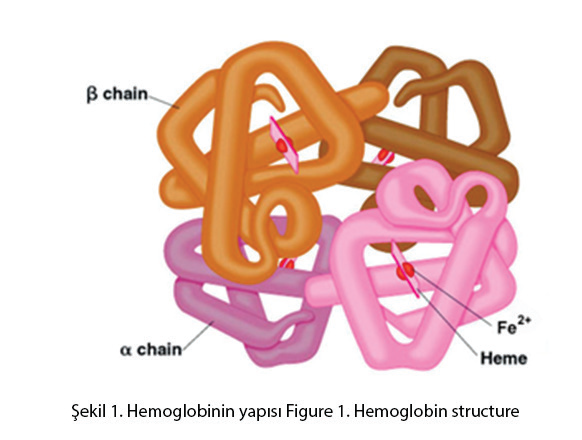
Blood stains are known to be among the most difficult biological soils to remove. This difficulty is rooted in the structural properties of hemoglobin and plasma proteins, the oxidation processes of iron ions, and the strong interactions they establish with fabric fibers. The hemoglobin molecule is a protein with a quaternary structure and contains a heme group with an iron ion (Fe²⁺) in each subunit. When blood leaves the body, hemoglobin loses oxygen and Fe²⁺ ions are oxidized to Fe³⁺ form, leading to hemin formation. Following continued oxidation processes, iron oxide and protein residues form; this causes blood stains to turn brown-black and become permanent [1]. In stain permanence, not only oxidation but also protein denaturation plays a critical role. High temperatures and acidic/basic environments break hydrogen bonds, ionic bonds, and disulfide bridges in proteins, causing irreversible hardening. In this case, proteins become insoluble and bind tightly to fabric fibers. Particularly in cellulose-based fabrics such as cotton, hydroxyl groups allow protein attachment through hydrogen bonding, while in synthetic fibers (for example, polyester), hydrophobic interactions become more dominant. Thus, blood stains are attached to fabric through different chemical binding mechanisms depending on fabric type. At this point, the selection of chemical agents in stain removal work becomes important. Reducing agents reduce iron ions in the heme group to lower oxidation states or bind through complexation. Ascorbic acid as a reducing agent provides Fe³⁺ → Fe²⁺ conversion, disrupting the colored structure of the heme group. Another important parameter is the effect of salts. The addition of salt to a solution creates an osmotic pressure difference, altering water movement in the stained area and potentially facilitating the solubility of proteins depending on their type. Ionic compounds such as sodium chloride can increase the solubility of hemoglobin or weaken electrostatic interactions between proteins, accelerating their separation from fabric fibers. Furthermore, salt can alter the micelle formation behavior of surfactants and thus increase the effectiveness of detergent formulations. When all these factors come together, the removal of blood stains is quite a complex process and the effects of chemical agents must be examined systematically. In this study, the effects of reducing agents, contributions of pH changes, and effects of salt addition on cleaning performance were evaluated using tergotometer washing. The results are expected to contribute to understanding the mechanisms of blood stain removal and provide a scientific basis for the development of stain removal formulations.
Materials and Method
In this study, the effects of a reducing agent, temperature, pH changes, and salt addition on blood stain removal were investigated. Ascorbic acid was used as the reducing agent; sodium lauryl ether sulfate (SLES) and linear alkyl benzene sulfonic acid (LABSA) were used as surfactants. NaCl was chosen as the salt. Additionally, commercial product samples were included as a reference group for comparison with existing cleaning products in the market. The fabric samples used in the experiments were cotton-based, cut to 4 × 4 cm dimensions, and Center for Testmaterials (CFT) standard blood stain fabrics were used to increase reproducibility and comparability with commercial products. In this context, two standard stains with different aging degrees were selected: C-S-01 Blood, aged (representing severe conditions) and C-S-101 Blood, slightly aged (representing moderate difficulty conditions).
Washing experiments were performed using a tergotometer device. In each experiment, 1 L of washing solution was prepared, stained fabric samples were placed in it, and washing was performed for 15 minutes at 25°C. The tergotometer ensured continuous contact of the solution with fabric fibers, allowing both chemical and mechanical interactions to occur effectively. In the solutions, pH values were adjusted to 3, 7, and 11 using H₂SO₄ and NaOH. In some experiments, 2.5% (w/v) NaCl was added to evaluate the effect of salt addition on stain removal performance through osmotic pressure difference and ionic environment. Additionally, ascorbic acid-based formulations were specifically examined to evaluate the effect of the reducing mechanism on blood proteins. The potential of ascorbic acid-containing formulations to reduce blood stain visibility and improve stain removal performance was tested. Similarly, the performance of current detergents was compared with reducing-based formulations prepared in the laboratory. After washing was completed, fabric samples were rinsed with distilled water and dried at room temperature. Stain removal effectiveness was evaluated by visual observation and spectrophotometric analysis. Measurements were performed using the CIE Lab* color space, and stain removal percentage was calculated by taking into account changes in L* (lightness) values in particular.
Results and Discussion
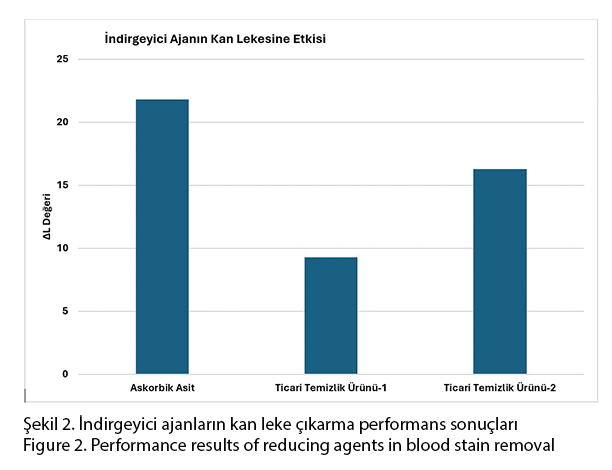
In this study, the effects of reducing agents, surfactants, pH changes, and salt addition on blood stain removal were evaluated systematically. The results indicate the importance of addressing multiple chemical parameters together in stain removal due to the structural complexity of blood stains. Among reducing agents, ascorbic acid was observed to increase stain removal performance under the examined conditions. This performance improvement may be related to the interaction of reducing agents with the color-forming components of blood stains. The findings show that formulations containing ascorbic acid can provide comparatively higher stain removal than commercial detergents under the examined conditions. In the literature, studies have shown that ascorbic acid reduces ions in the heme group [5]. Therefore, it is considered that ascorbic acid contributes to stain removal performance by reducing Fe³⁺ ions in the heme group.
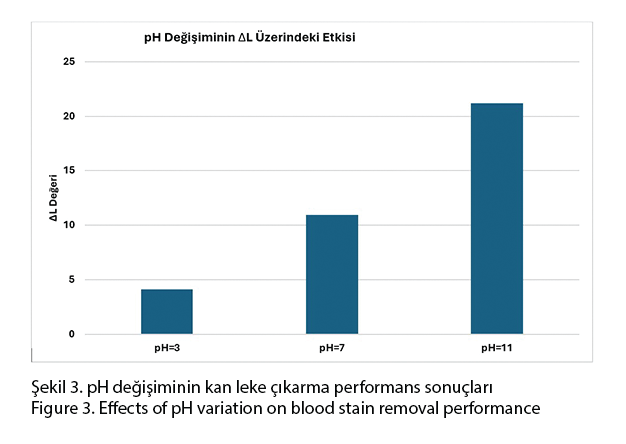
The effect of pH change was clearly reflected in the obtained performance results. While an increase in stain removal performance was observed at pH=11, a decrease in performance and darkening of stain color was observed at pH=3. This darkening observed under acidic conditions can be attributed to pH-dependent chemical/conformational changes in the color-giving components of blood stains. Additionally, it is considered that acidic conditions may show a tendency to increase the interaction of stain components with fiber surfaces and their attachment on fabric. The findings show that alkaline pH conditions generally support stain removal; this effect may be related to pH-dependent changes in the performance of reducing agents. (Figure 3)
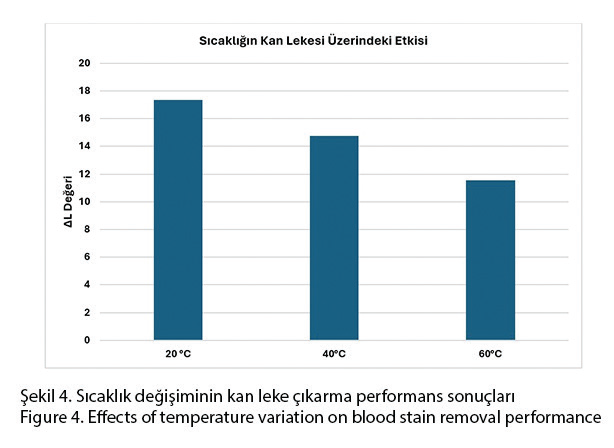
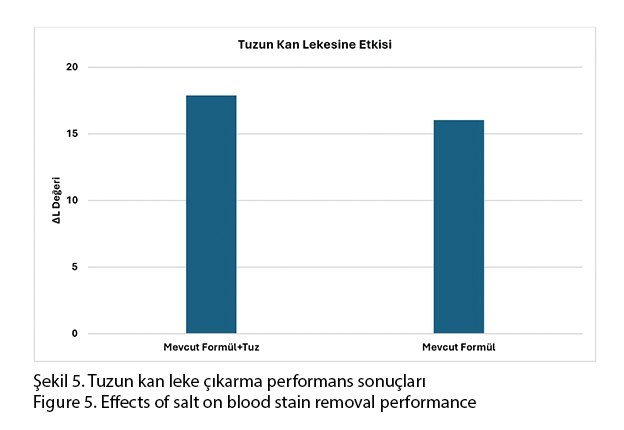
When examining the effect of temperature on blood stain removal, washing at 20°C showed higher performance compared to washing at 40°C and 60°C. This is because high temperatures such as 60°C cause thermal denaturation (cooking) of hemoglobin, a blood protein. This denaturation causes the protein to fold irreversibly and bind more tightly to fabric fibers through covalent bonds, leading to a condition known as "stain fixation" [3]. However, it should be considered that temperature may affect the effectiveness of formulation components (such as reducing agents and surfactants) and general washing dynamics. Therefore, the performance decline observed at 40–60°C conditions may be related to both temperature-dependent changes in stain components and changes in the physicochemical properties of the washing environment. At low concentrations, sodium chloride contributed to the "salting-in" effect, which changes the hydration structure of water molecules, allowing proteins and soil particles to become slightly more soluble in the surfactant solution. Ions interact around the charges on the protein surface, causing changes in the protein-protein attraction/repulsion balance; as a result, aggregation tendency may decrease and solubility may increase slightly depending on protein type [4]. In conclusion; ascorbic acid, alkaline pH conditions, washing at lower temperatures, and low-level salt addition emerged as the main parameters supporting blood stain removal under the examined experimental conditions. These findings are expected to provide an experimental basis for formulation development work aimed at blood stain removal and contribute to multi-parameter optimization approaches.
References
1- Thacker, C. R., et al. (2006). "The effect of cleaning agents on the DNA analysis of blood stains deposited on different substrates
2- Morgan, R., Oldfield, C., & Green, A. J. (2017). The efficacy of luminol in detecting bloodstains that have been washed with sodium percarbonate and exposed to environmental conditions. Forensic Science International, 273, 219–225.
3- Kurono, R., & Oya, M. (2013). Applicability of improved hemoglobin soiled fabric to bleaching test. Journal of the Japan Research Association for Textile End-Uses, 54(8), 50–57.
4- Maurer, R. W., Sandler, S. I., & Lenhoff, A. M. (2011). Salting-in characteristics of globular proteins. Biophysical Chemistry, 156(1), 72–78.
5- Giulivi, C., & Cadenas, E. (1993). The reaction of ascorbic acid with different heme iron redox states of myoglobin. Antioxidant and prooxidant aspects. FEBS Letters, 332(3), 287–290.
Gallery