





In food safety technologies, the "Retort" (sterilization) process represents the most demanding performance criteria for packaging materials. This article examines the development of ink polyurethanes used in retort-compatible printing systems (Flexo and Rotogravure). In particular, the critical advantages offered by aliphatic polyurethane resins over conventional aromatic and semi-aliphatic systems—such as thermal stability, pigment wetting and grinding capability, migration safety and lamination strength—are analyzed in light of technical data.
Abstract
In food safety technologies, the "retort" (sterilization) process represents the most demanding performance criteria for packaging materials. This article examines the development of ink polyurethanes used in retort-compatible printing systems (flexography and rotogravure). Particular emphasis is placed on analyzing the critical advantages offered by aliphatic polyurethane resins compared to conventional aromatic and semi-aliphatic systems, including thermal stability, pigment wetting and flow capability, migration safety, and lamination strength, supported by technical data.
1. Introduction: The Demanding Process of Modern Packaging—"Retort"
The flexible packaging sector is undergoing significant transformation driven by consumer demand for preservative-free products with extended shelf life in the "ready-to-eat" category. In addition to the storage advantages these packagings provide, the retort process applied to enable storage at room temperature without deterioration requires the packaging to remain at temperatures between 120°C and 135°C, under high humidity and pressure, for 30 to 90 minutes.
These harsh conditions test not only the physical structure of the packaging but also the chemical composition of the ink and binder between layers. Conventional ink systems experience "thermal shock" at this point, resulting in performance loss. This is where Aliphatic Resin Technology emerges as a key solution for packaging engineering.
2. Chemical Structure and Technical Differences
Polyurethane resins form the core of flexible packaging inks. However, not all polyurethanes possess the same molecular resistance.
2.1. Limitations of Aromatic/Semi-Aliphatic Structures
Aromatic isocyanates used in conventional packaging inks (for example, TDI or MDI-based structures) contain a benzene ring. While this ring structure provides excellent mechanical properties under normal conditions, during retort at elevated temperatures:
Thermal Oxidation: Oxidation of the benzene ring results in yellowing and color shifts in the print.
PAA Formation: The risk of Primary Aromatic Amine (PAA) formation poses a serious migration threat from a food safety perspective.
2.2. Superiority of Aliphatic Solutions
Aliphatic compounds (for example, IPDI, H12MDI, or HDI-based structures) consist of straight or cyclic carbon chains but do not contain a benzene ring. This structural difference results in:
—UV and Heat Resistance: Aliphatic bonds are far more resistant to breaking under photon and heat energy.
—Hydrolytic Stability: Water vapor and moisture (sterilization environment) are prevented from breaking polyurethane chains (hydrolysis).
3. Application Parameters in Flexography and Rotogravure Systems
In retort applications, packaging is generally designed in multiple layers (e.g., PET / Aluminum / PE). The behavior of ink between these layers varies depending on the printing technique.
In rotogravure printing, the transfer of ink from the cylinder surface to the film at high speed is critical. Aliphatic resins, owing to their high pigment loading capacity and low solvent retention properties:
—Reduce the risk of "ghosting" in highly saturated prints.
—Provide homogeneous transfer from the chromium-plated cylinder to the film.
4. Post-Retort Performance Analysis and Advantages
For a resin to be considered "retort-compatible," it must successfully pass three fundamental tests:
4.1. Lamination Bond Strength
Conventional resins may experience 50-70% loss in bond strength after retort. Inks formulated with aliphatic resins, however, owing to their stable chemical structure:
Delamination Resistance in Printed Areas: Prevents separation of film layers in inked regions.
Chemical Resistance: Blocks penetration of fats and acids in food content into the ink layer.
4.2. Heat Resistance and Color Stability
Particularly in white inks, the "pinkish" or "yellowish" color shift observed after retort is eliminated with aliphatic structures. This is a critical advantage for brands to preserve packaging aesthetics.
4.3. Migration and Food Safety
Modern regulations (Swiss Ordinance, Nestlé Guidance, etc.) strictly monitor the transfer of packaging components into food. Aliphatic resins:
—Are designed to minimize low molecular weight impurities.
—Prevent the formation of toxic by-products during sterilization.
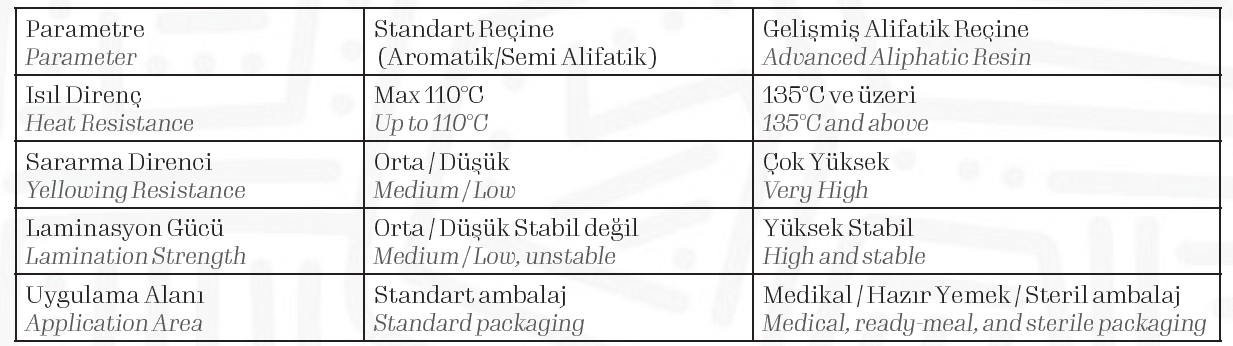
5. Economic and Operational Efficiency Table
The following table summarizes the industrial outputs of aliphatic resin utilization:
6. Future Vision: Sustainability and Bio-Based Aliphatics
The chemical industry now focuses not only on performance but also on environmental footprint. The use of "bio-based" carbon content in aliphatic resin development processes is gaining attention. Over the next decade, aliphatic systems that maintain retort performance while reducing fossil-based feedstock use by 30-40% are expected to dominate the market.
7. Conclusion
Retort applications in flexible packaging represent the most critical phase determining the ultimate safety of the packaging. Aliphatic resins provide manufacturers with operational security through the molecular stability they offer in both flexographic and rotogravure systems. This technology, which merges heat resistance, lamination performance, and food safety criteria, is an indispensable building block for high-performance packaging solutions.
To meet these technical requirements, İnterplast Kimya is conducting domestic synthesis and production of aliphatic polyurethane resins for flexible packaging ink systems. Within İnterplast Kimya's Research and Development Center, work is underway specifically on structures that maintain bond integrity under thermal stress at 135°C and above during retort cycles and eliminate PAA (Primary Aromatic Amine) migration risk. The company's aliphatic resin portfolio, optimized for both rotogravure and flexographic rheology, provides packaging manufacturers with direct operational solutions including formulation flexibility tailored to packaging structure, uninterrupted technical application support, and logistical supply continuity.
Gallery

Related News

Paints and Coatings in the Defense Sector

The Silent Origin Story of Nutrient Delivery
Next-Generation Surfactant Technology with the Power of Sunflower

Evaluation of Next-Generation Coating Systems in the Powder Coating Sector in Terms of Formulation, Thermal B…
Oyunlardan ve bulmacalardan öğren
Kimya sanayiini oynayarak tanıyın: her hafta yeni bulmaca, etkileşimli periyodik tablo, sektöre özel oyunlar ve ücretsiz hesaplayıcılar.
Deneyiminizi iyileştirmek ve site kullanımını ölçmek için çerez kullanıyoruz. Ayrıntılar Çerez Politikası ve KVKK Aydınlatma Metni'nde.