





Modern automotive engineering needs advanced polymer technologies more than ever before, driven by lightweighting, acoustic comfort (NVH), complex part geometries and increasingly stringent interior air quality (VOC/FOG) standards. In this context, polyurethane (PU) systems have become one of the most important polymer groups used in the automotive sector, thanks to their versatile physical and mechanical properties.
Introduction
Polyurethane, rubber and composite components used in the automotive sector play a critical role in meeting comfort, safety, acoustic performance and weight reduction objectives.
Modern automotive engineering requires advanced polymer technologies more than ever to meet weight reduction objectives, acoustic comfort (NVH), complex part geometries and increasingly stringent interior air quality (VOC/FOG) standards. In this context, polyurethane (PU) systems have become one of the most important polymer groups used in the automotive sector thanks to their multidirectional physical and mechanical properties. This article examines polyurethane quantities used in modern passenger vehicles and corresponding isocyanate consumption; polyurethane-based component manufacturing processes and mold release technologies used widely throughout the vehicle are evaluated. We will also examine the selection criteria of mold release systems used in different automotive parts, their effects on process performance and the manufacturing dynamics and preferred mold release technologies of the parts indicated in the visual representation from a technical perspective.
Mold release selection is not limited to merely ensuring easy separation of the part from the mold. Parameters such as surface quality, paintability, cycle time, VOC emissions, mold cleaning and total production cost are directly dependent on the technology employed.
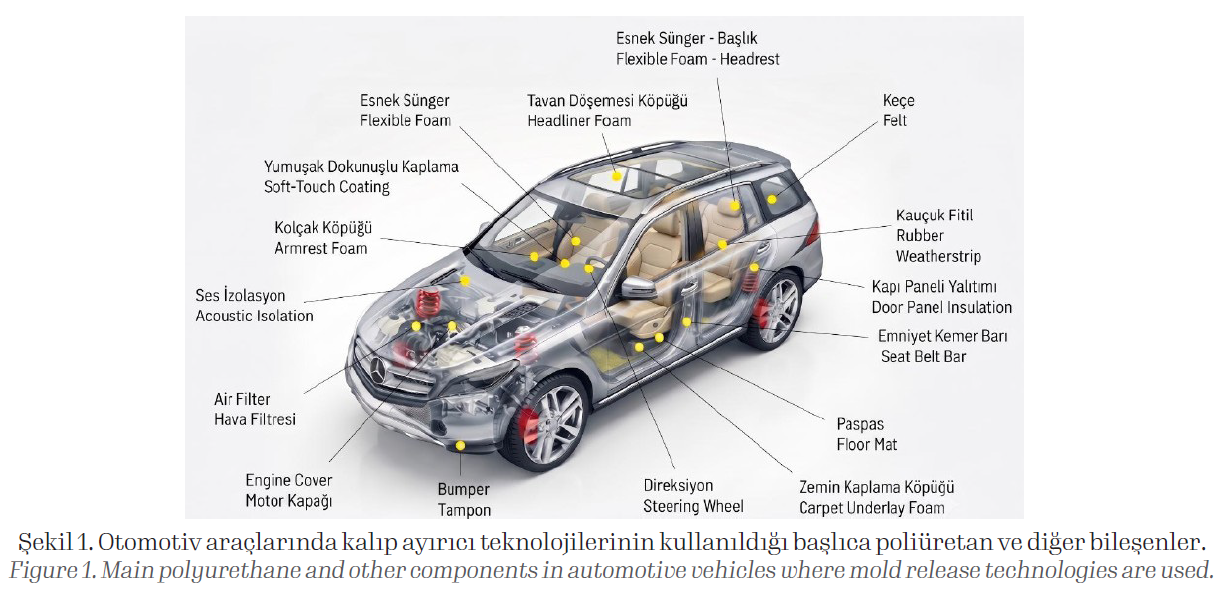
Figure 1 shows the main polyurethane and rubber components where mold release is used in the automotive sector. As can be seen, in a modern passenger vehicle, numerous components are produced via molding processes, from engine compartment elements to interior comfort components, from acoustic insulation to exterior body parts.
1. The Importance of Polyurethane Use in the Automotive Sector
In the automotive industry, sustainability objectives, energy efficiency and optimization of production costs are directly related to the performance properties of materials used. Data published by the European Polyurethane Block Foam Manufacturers Association and the European Automotive Sector Molded Polyurethane Parts Manufacturers Association show that more than 20 percent of the total plastic volume used in a modern passenger vehicle consists of polyurethane-based systems.
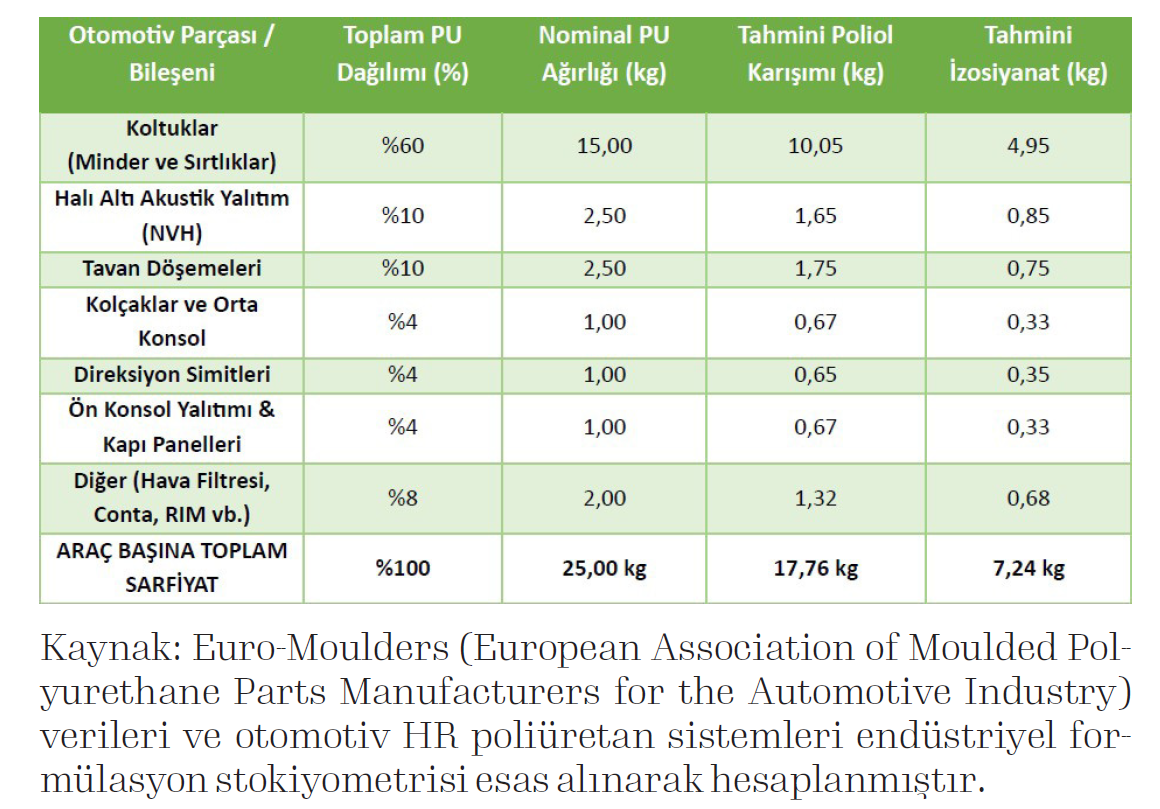
According to sectoral statistics, an average of 22–28 kg, nominally approximately 25 kg of polyurethane is used per passenger vehicle. Approximately 75 percent of this amount is produced using molded foam technologies, while the remaining portion consists of block foam laminations, microcellular elastomers and specialized polyurethane applications.
Based on Euro Moulders data and industrial formulation practices, the part-based polyol/isocyanate mass balance calculated over nominal 25 kg PU consumption per vehicle is given in Table 1.
2. The Critical Role of Mold Release Technologies in Automotive Production
In the production of polymer-based automotive parts, mold release chemicals are not merely auxiliary products that ensure easy separation of the part from the mold. They are simultaneously process components that directly affect surface quality, paintability, mold cleaning, cycle time and production efficiency.
Mold release technologies in automotive applications can generally be evaluated under three main groups:
2.1. Comfort and Interior Components
Seat Foams and Headrests
Seat systems, which account for approximately 60 percent of total polyurethane consumption in the vehicle, are produced using foam technologies in the 45–55 kg/m³ density range with high flexibility characteristics.
Mold releases used in these applications must:
- Have low VOC values,
- Not damage the open cell structure,
- Not cause corrosion on metal inserts,
- Not affect the final product's comfort performance.
For this reason, water-based or low solvent content reactive wax emulsions are currently preferred.
Steering Wheels
Steering wheels produced from integral polyurethane foams are specialized products with a dense outer skin and elastic core structure.
Mold releases used in these parts must:
- Ensure flawless skin pattern transfer,
- Be compatible with in-mold coating (IMC) processes,
- Prevent surface defects.
For this reason, fast-drying silicone-free solvent-based or hybrid resin systems are commonly used.
Safety Belt Components
In parts containing metal or composite inserts, high cycle rates are targeted. In these applications, semi-permanent mold release systems that chemically bond to the surface are preferred, which reduces both the risk of residue and increases process efficiency.
2.2. Acoustic and Insulation Applications
Sound Isolation Elements and Felts
Components designed to enhance NVH performance are produced via polyurethane foam injection or molding of felt-based composite structures.
The primary objectives in these applications are:
- Not causing staining,
- Protecting porous surfaces,
To achieve high cycle times, economical water-based wax emulsions are preferred.
Mats and Rubber Seals
EPDM-based rubber products are vulcanized at 160–200°C temperatures.
For this reason, mold releases used must:
- Have high temperature resistance,
- Demonstrate wear resistance,
- Facilitate demolding in complex geometries. For this purpose, semi-permanent silicone resin-based systems are commonly used.
2.3. Engine Compartment and Exterior Body Parts
Engine Hoods and Bumper Systems
Bumpers and engine hoods produced using RIM, S-RIM and R-RIM technologies go directly to paint lines after production.
For this reason, mold releases used must:
- Not contain silicone,
- Not cause paint defects,
- Preserve surface quality, which is of critical importance.
Air Filter Systems
In air filters produced with microcellular polyurethane gaskets, the most critical point in the process is preventing mold buildup.
Thanks to mold releases with low solids content and rapid drying properties:
Mold cleaning frequency is reduced,
Production continuity is maintained,
Sealing tolerances are guaranteed.
The following criteria are decisive in the selection of mold releases used in the automotive sector:
- Low VOC and low fogging performance
- High cycle rate
- Minimizing mold buildup
- Paintability compatibility
- Surface quality and aesthetic performance
- Process cost
- Environmental sustainability
These criteria may have different priority rankings depending on the part's function and the polymer system employed.
A modern automobile is not merely an engineering product composed of mechanical systems; it is also a complex material platform with advanced polymer technologies integrated throughout. Polyurethane systems play a critical role in achieving comfort, safety, acoustic performance and weight reduction objectives. However, sustainable maintenance of production efficiency depends on the selection of the correct mold release technologies. Mold releases are no longer merely process auxiliaries today; they are evaluated as strategic engineering components that directly affect production quality and cost structure.
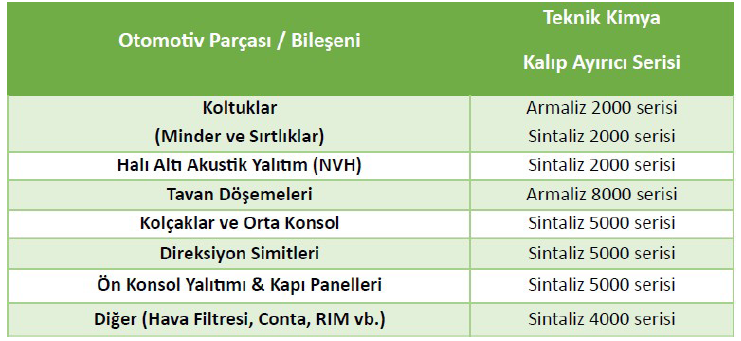
Solutions developed by Teknik Kimya for automotive systems spread well on the mold surface, creating a uniform film, whereby the produced polyurethane parts possess the desired properties. Depending on usage and application area, there are different carrier systems formulated as the Armaliz 2000 series, Sintaliz 2000 series, Sintaliz 4000 series, Sintaliz 5000 and Armaliz 8000 series.
Armaliz 2500 and Armaliz 2600 Series Mold Releases are formulated as water-based and provide good results in a wide range of mold temperatures and mold types. They can be safely used without flammability risk during storage, transport and use stages. Concentrated versions can be diluted with ionized water for use.
Sintaliz 2000 and Sintaliz 5000 Series Mold Releases are formulated in different solvents according to requirements. Our products, formulated with different levels of matting and oiliness, have minimum mold contamination properties. Mold releases formulated with Class I A1 type solvents are preferred for their fast-drying properties, while mold releases containing Class II A2 and Class III A3 type solvents are preferred due to their high flash points.
Gallery

Related News

Paints and Coatings in the Defense Sector

The Silent Origin Story of Nutrient Delivery

Next-Generation Surfactant Technology with the Power of Sunflower

Evaluation of Next-Generation Coating Systems in the Powder Coating Sector in Terms of Formulation, Thermal B…
Oyunlardan ve bulmacalardan öğren
Kimya sanayiini oynayarak tanıyın: her hafta yeni bulmaca, etkileşimli periyodik tablo, sektöre özel oyunlar ve ücretsiz hesaplayıcılar.
Deneyiminizi iyileştirmek ve site kullanımını ölçmek için çerez kullanıyoruz. Ayrıntılar Çerez Politikası ve KVKK Aydınlatma Metni'nde.