The paints and coatings industry, which has reached approximately $230 billion globally, is currently facing various challenges in terms of R&D. If we summarize these issues under three main headings, they are: regulations concerning environment and sustainability, high performance expectations, and increases in raw material costs.

Mehmet Bulut
General Manager
EM Mineraller
1. Introduction
The paint and coatings industry, which has reached around USD 230 billion globally, faces a number of R&D challenges today. These can be summarised under three main headings: environmental and sustainability regulation, high performance expectations, and rising raw material costs.
The aim of this article is to look briefly at AI/ML applications in the formulation process in the paint industry, at how these applications address the problems described above, and at their possible effects on industrial raw materials, which are our area of expertise.
2. The challenges of the traditional approach to paint formulation
Traditional paint formulation processes involve almost limitless combinations of dozens of resins, pigments, fillers and additives. They consist of “empirical” or “semi-empirical” processes, rely heavily on trial and error, and are carried out using the “One Variable At a Time” (OVAT) approach, which depends on time-consuming manual testing.
In this method only a single variable is changed while the others are held constant. Instead of decisions based on data, the process is sometimes driven by “intuitive” decisions in order to save time. It can take a long time for such processes to yield a new product, formulation or raw material proposal.
When new market demands (high-performance functional paints, for example) and critical environmental compliance parameters (KKDIK regulation, VOC emissions, CBAM and so on) are added, the number of parameters in the paint formulation process increases and simple deterministic models are no longer sufficient. (1)
3. The innovative AI/ML approach to formulation
The integration of AI/ML into R&D processes in the paint industry marks a shift from empirical trial-and-error formulation to predictive, data-based modelling.
In this approach, past laboratory data, raw material specifications (TDS) and test results are fed into artificial intelligence algorithms (Artificial Neural Networks or Random Forest models, for example). The model learns the hidden correlations between the chemical and physical properties of raw materials and the final performance of the paint (viscosity, gloss, corrosion resistance and so on). In this way the “optimum” formulation – one that meets the targeted performance, cost and regulatory requirements – can be predicted from among billions of combinations in seconds on a computer (in silico), without a single sample being produced in the laboratory. (2)
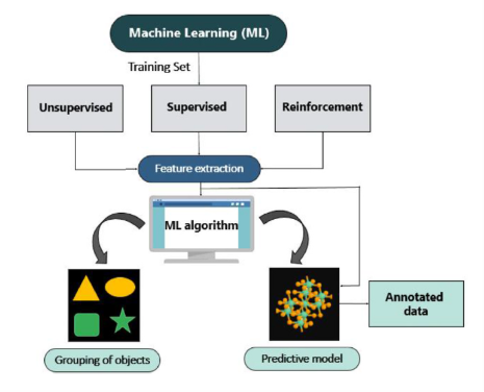
Figure 1. ML algorithms
4. An assessment from the perspective of industrial raw materials
The success of artificial intelligence models depends directly on the quality and depth of the raw material data fed into the system. This is reshuffling the pack in the world of industrial raw materials:
• Alternative raw material substitution and supply chain flexibility: In global crises or sudden price fluctuations, finding an equivalent for a raw material (a specific titanium dioxide or acrylic emulsion, for example) requires weeks of testing by traditional methods. AI/ML models, by contrast, analyse the technical parameters of alternative raw materials (particle size distribution, oil absorption, functional groups and so on) and instantly calculate the most suitable substitute and dosage that will not upset the balance of the formulation.
• Sustainability and the integration of green raw materials: The Carbon Border Adjustment Mechanism (CBAM) and VOC limits are steering R&D teams towards bio-based resins and functional natural fillers (calcite, talc, barite and so on). By predicting in advance how these new-generation sustainable raw materials will interact within the system, AI radically accelerates “green transition” processes.
• Cost and performance optimisation: By processing the Quantitative Structure-Activity Relationships (QSAR) and physical properties (PSD – Particle Size Distribution) of fillers, AI establishes the balance between minimum cost and maximum Pigment Volume Concentration (PVC).
5. Global industrial applications and efficiency outcomes
Looking at the global impact of artificial intelligence in the world of industrial minerals, the added value this technology creates in raw material development and application engineering is clear. In summary:
• More than 80 per cent faster R&D: Paint formulation optimisation and new raw material development cycles, which take an average of six months by traditional methods, can be reduced to as little as one month thanks to AI predictive models.
• Logistical and geographical flexibility: AI/ML models can adapt formulations to local raw materials and minerals in different geographies within seconds while preserving product quality and performance consistency. This gives manufacturers global flexibility during supply chain crises.
• Institutional memory and knowledge transfer: The expertise and historical laboratory experience of people approaching retirement is turned into permanent data on AI platforms, providing a complete and lossless transfer of knowledge to the next generation of engineers. (3)
6. Conclusions and outlook
The AI/ML approach to paint formulation is not merely a tool that speeds up paint manufacturers’ R&D laboratories; it is a disruptive innovation forcing the industrial raw materials ecosystem to become more transparent, more measurable and more performance-focused. Traditional “relationship-driven” sales and raw material supply strategies are gradually giving way to “data-driven” processes.
In the industry’s future, the success of raw material suppliers will depend on how cleanly, accurately and efficiently they can prepare the technical data on their raw materials (input parameters) and laboratory test outputs in a form artificial intelligence can understand (data readiness). At a time when we have reached the end of the traditional trial-and-error methodology, AI/ML adoption will carry the paint and coatings industry towards a more sustainable, flexible and efficient future.
References
(1) Kim, M. O. (2026). AI-Driven Polymeric Coatings: Strategies for Material Selection and Performance Evaluation in Structural Applications. Polymers, 18(1),
(2) Verma, J.; Khanna, A.S. Digital Advancements in Smart Materials Design and Multifunctional Coating Manufacturing. Phys.Open (2023), 14, 100133.
(3) https://citrine.io/leveraging-ai-and-machine-learning-in-coatings-adhesives-and-sealants/
Gallery

Advertisement
Ad Space728 × 90