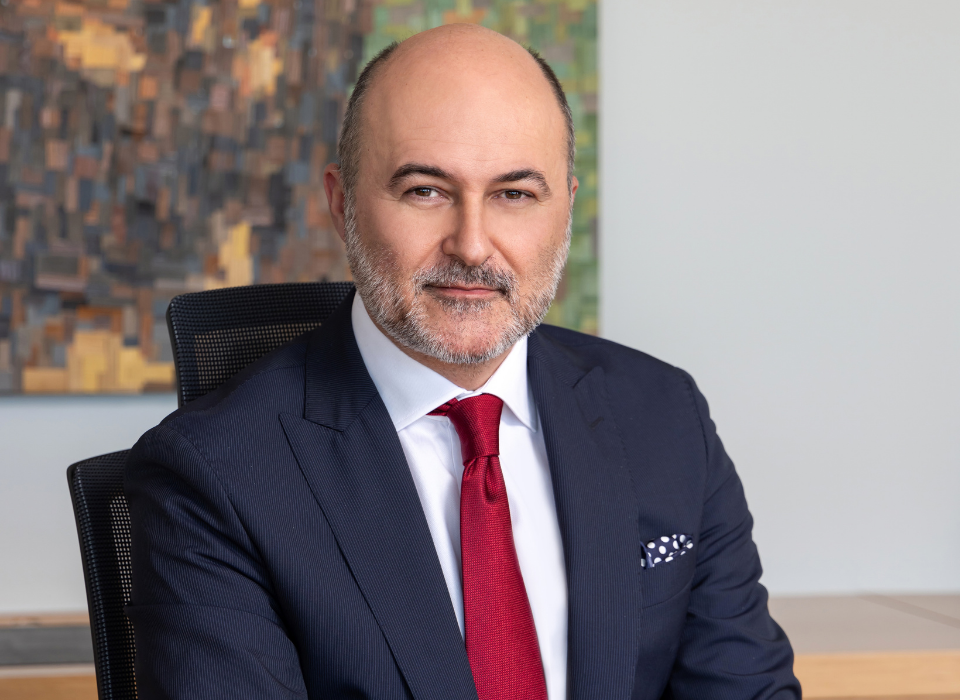
Interview with Emrah Şenol, General Manager of Netzsch Türkiye
We had an enjoyable interview with Emrah Şenol, General Manager of Netzsch Türkiye. Emrah Şenol shared valuable information with our readers about Netzsch's organization and services in Turkey. Enjoy your reading…
Could you tell our readers about yourself and your professional background?
I began my professional career after graduating from the Department of Mechanical Engineering at DEU in 2009, and I further complemented this with an MBA from Ege University. I held positions in technical sales departments at companies operating in diverse sectors such as energy, sheet metal production, and air conditioning. Subsequently, I transferred to our company during the establishment process of Netzsch Türkiye.Could you share with our readers the founding story of Netzsch and the development process of your organization in Turkey?
Netzsch is a company founded approximately 150 years ago in the town of Selb in Germany, a region renowned for porcelain production. While initially focusing intensively on the ceramics sector due to its location, through growth over the years the company has concentrated on three main business units: "Analysis and Testing," "Pumps and Systems," and "Grinding and Dispersion," continuing global operations with approximately 5,000 employees. Netzsch Türkiye was established in 2013 in Izmir within the "Grinding and Dispersion" business unit, serving Turkey and surrounding markets.Could you tell us about the sectors you serve and your product groups?
We serve many different sectors including energy, chemicals, minerals, cement, food, pharmaceuticals, and cosmetics. From mobile phones to disinfectants, from the coffee we drink to the t-shirts we wear—virtually all everyday items we use contain an application we address. Within our Grinding and Dispersion business unit, we produce machines and facilities for processes such as dry and wet grinding, classification, mixing, homogenization, and more. As Netzsch Türkiye, from our Izmir headquarters we provide technical sales, engineering, service and spare parts from stock, as well as grinding media sales for the processes I mentioned. Additionally, we serve as a procurement center for our global projects.What work do you undertake to develop your services in order to better serve your customers? Could you describe your R&D activities?
Because we operate across diverse sectors, we are a company that continuously learns based on market needs and provides solutions tailored to requirements. For example, a technological advance we achieve in wet grinding technologies can be applied to dry grinding technologies. Or, because we understand specific needs in the cosmetics sector's end products, we can update processes for grinding and classifying industrial minerals. Therefore, I can say that in every project we work on, there is an R&D component.Following your work, are there new products you plan to introduce to the sector?
I can mention our Pamir mill, which we recently introduced and which creates a significant difference in dry grinding technologies. Particularly in the paints and coatings sector, for micronized dry grinding of industrial raw materials such as calcite, talc, and barite, we can achieve high energy efficiency and create significant cost advantages in production. With our Neos mills used in grinding pigment pastes, we offer higher color intensity, lower waste, high energy efficiency, and sustainable production.How do you evaluate the development of the paints and coatings sector in Turkey? What is the importance of the Turkey market worldwide?
As you know, we are Europe's 5th largest paints and coatings producing country. Due to our position, our paints and coatings sector must grow in continuous competition with European producers, particularly on a quality basis. We observe that alongside increasing technological infrastructure investments required by this competition, there is also a growing trend toward higher value-added products driven by ongoing R&D activities. Due to our belief in this potential and sector development, we at Netzsch have invested in a grinding laboratory at our Izmir headquarters, where we provide our customers with process support scalable to production in R&D studies.The climate crisis occurring worldwide and the depletion of resources have made sustainability increasingly important. What are your sustainability-related initiatives at Netzsch?
Netzsch is a company that believes in continuous improvement, and high energy efficiency and sustainability are our main objectives in all technologies we develop and provide. For example, with our recently developed Pamir mill, we achieve energy consumption reductions of up to 30 percent per ton in existing dry grinding processes, creating advantages for our customers' primary cost items, and ultimately environmental benefits as well. Similarly, with our Neos high-performance wet grinding mills used in paints and coatings production processes, we deliver performance improvements of up to 10-fold, providing advantages such as energy savings, time reduction, and lower pollution.We have passed through a long pandemic period and its effects continue. How did this period affect your company and what measures did you take?
Initially, like all companies, we had no idea how the pandemic would progress, how severe it would be, and how it would affect our business operations. However, because we have a dynamic and flexible workforce that could use any location with telephone and internet access as an office, we managed to emerge from the process having grown. Like many of our customers, Netzsch Türkiye also managed to turn the crisis in global supply chains during the pandemic into an opportunity and succeeded in increasing our exports.Advertisement
Ad Space728 × 90