
The paints and coatings industry has changed significantly in response to environmental, occupational health and safety, and sustainability regulations. The shift from solvent-based to water-based systems has accelerated due to efforts to reduce VOC emissions. While traditional solvent-based coatings perform well, their environmental impact, flammability risks and health issues arising during application have increased demand for alternatives. In line with this trend, water-based resin technologies are becoming more important, with the industry prioritizing environmentally friendly solutions without compromising performance. Water-based polyaspartic resins stand out in modern coating methods due to their fast curing, high mechanical strength, low VOC emissions and excellent surface performance.
The paints and coatings industry has undergone significant transformation in response to environmental, occupational health and safety, and sustainability regulations. The transition from solvent-based systems to water-based systems has accelerated with the desire to reduce VOC emissions. Although traditional solvent-based coatings perform well, their environmental impact, flammability risks, and health problems arising during application have increased demand for alternatives. In this trend, water-based resin technologies are becoming increasingly important, and the sector is prioritizing environmentally friendly solutions without compromising performance. Water-based polyaspartic resins are unique in modern coating methods due to their rapid curing, high mechanical strength, low VOC emissions, and excellent surface performance.
Comparison of Solvent-Based and Water-Based Resins
Solvent-based resins have long been preferred in coatings. Exceptional film formation, adhesion, chemical resistance, and ease of use are the main factors. However, these systems have significant limitations.
Problems with Solvent-Based Systems
High VOC emissions harm the environment. Toxic solvent vapors are released during application.
Flammability and explosion risk. Limited area applications require strict occupational safety protocols.
Environmental compliance costs are increasing.
Water-based resin systems are more environmentally benign because water is used as the carrier phase.
Advantages of Water-Based Systems
Low VOC emissions make them environmentally friendly.
Low odor.
Slightly flammable.
Provide greater safety in terms of worker health.
Equipment sanitation with water is usually possible.
Traditional water-based systems have been criticized for performance issues. Insufficient chemical resistance, long curing time, moisture sensitivity, and mechanical durability limit their use in heavy-duty coatings. Innovative hybrid technologies and next-generation resin systems are gaining importance. Water-based polyaspartic resins are state-of-the-art products that meet high performance standards while maintaining the environmental benefits of water-based systems.
Development of Polyaspartic Coating Technology
Aliphatic polyisocyanates react with aspartic esters to form polyaspartic systems, polyurethane derivatives. Polyaspartic chemistry has made polyurethane systems more applicable by controlling the reaction rate. Since their development for high-performance protective coatings, polyaspartic systems have extended to floor coatings, industrial paints, automotive coatings, and outdoor applications. Modern water-based variants of this technology are ecologically safe and high-performing.
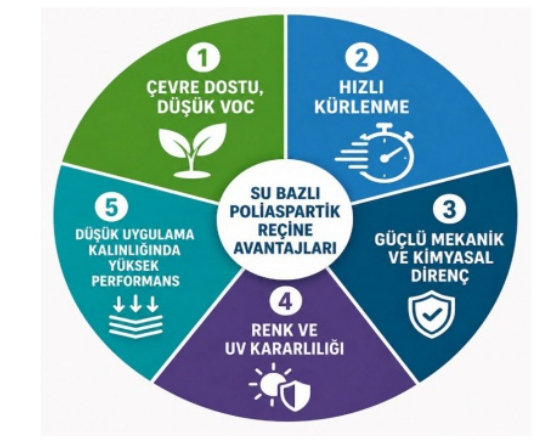
Characteristics of Water-Based Polyaspartic Resins
Polyaspartic resins offer numerous advantages.
1. Environmentally Friendly, Low VOC: Water-based polyaspartic systems meet environmental criteria due to low solvent concentrations. This characteristic gains importance as EU and global environmental regulations tighten.
2. Rapid Curing: Polyaspartic technology cures faster than water-based approaches. Application efficiency and production time increase.
3. Strong Mechanical and Chemical Resistance: High chemical resistance, abrasion resistance, impact resistance, UV resistance. For these reasons, they are preferred for heavy-duty use.
4. Color and UV Stability: Aliphatic compounds are resistant to yellowing. This benefits exterior and decorative coatings.
5. High Performance at Low Application Thickness: Superior performance at thin film thicknesses provides material savings.
Significance in the Paints and Coatings Sector
Water-based polyaspartic polymers can help paints and coatings companies combine sustainability and performance. Their value is increasingly growing particularly in these areas: Industrial protective coatings, Concrete floor coatings, Automotive coatings, Wood protection, Metal coatings, and Exterior facade paint protection. Rapid curing and low VOC values reduce production line time and help achieve environmental targets. As sustainable production standards become more common, high-performance water-based technologies can gain market share.
Looking Ahead
Future coating technologies must be energy-efficient, environmentally friendly, and high-performing. These three requirements can be met with water-based polyaspartic resins. In the coming years, these systems should show improvements in: VOC reduction, improved emulsion technology, longer service life, better mechanical performance, and bio-based raw material integration.
Final Assessment
The coatings industry must transition from solvent-based solutions to water-based solutions for environmental and industrial reasons. However, performance must be maintained during this transition. Water-based polyaspartic resins are attractive coating methods due to their low VOC emissions, chemical resistance, rapid curing times, and superior mechanical properties. We anticipate that water-based polyaspartic systems will form the foundation of sustainable high-performance coatings in the paints and coatings industry.
At the Reaction Chemistry R&D Center, we aim to develop environmentally conscious water-based polyaspartic resins and bring new products to market for use in the coatings sector.
Gallery