Innovative Material Developed with Advanced Flexibility Properties
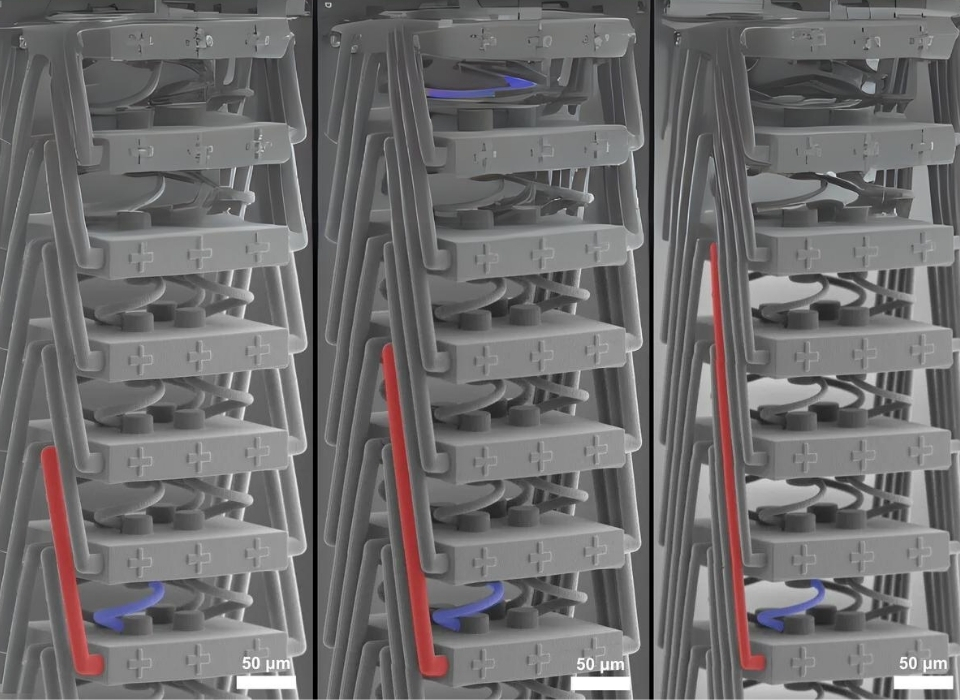
KIT researchers have developed a metamaterial that stretches and compresses differently than conventional materials.
Metamaterials are synthetic materials not found in nature and developed specifically for special properties. The building blocks of these materials behave like atoms in conventional materials; however, they possess special characteristics in optical, electrical or magnetic terms. The interaction between these building blocks is highly important for the functionality of metamaterials. Until now, this interaction has generally only been able to occur between neighbouring building blocks. However, researchers from the Karlsruhe Institute of Technology (KIT) have developed a new mechanical metamaterial that enables interactions to spread over greater distances within the material. This innovation has potential applications in areas such as force measurement or static monitoring.
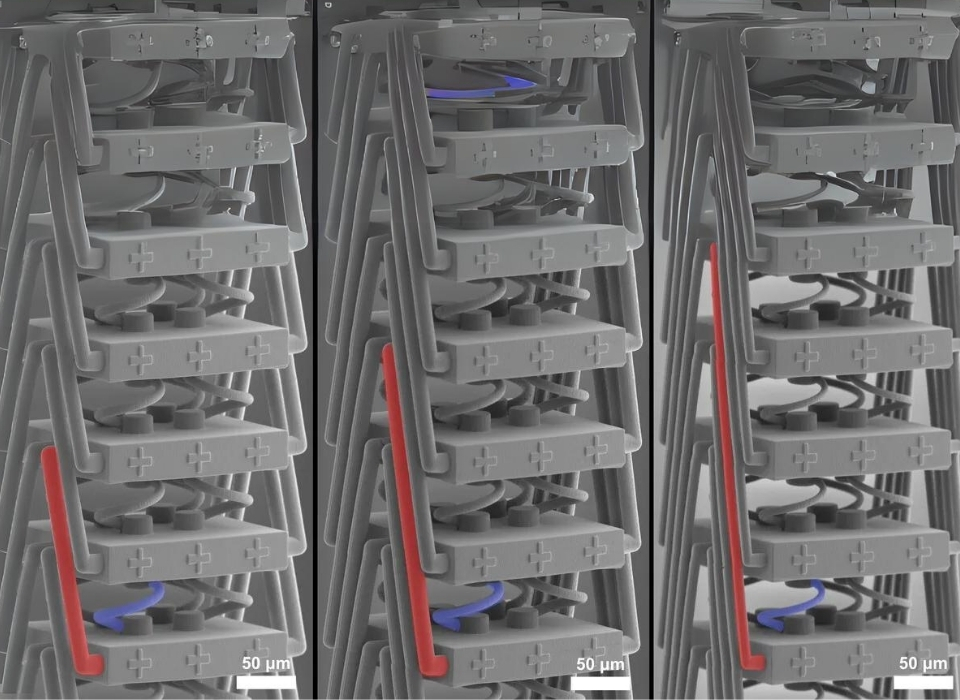
The research group led by Professor Martin Wegener from KIT's Institute of Applied Physics (APH) has succeeded in overcoming this limitation in metamaterials. Dr. Yi Chen, lead author of the study, explains this by comparing it to human communication and the "Telephone Game": when you communicate through an intermediary, you may encounter different outcomes compared to a direct conversation. Chen notes that a similar principle applies to this new metamaterial design. "The material we developed contains special structures (structures shown in red in the diagram). These structures allow individual building blocks to 'communicate' not only with their neighbours, but also directly with all other building blocks in the material," he adds.
Experiments conducted on microscopic samples produced with a 3D printer
Ke Wang, co-author from APH, states: "These structures impart interesting properties to the material, such as unusual stretching characteristics." By working with micron-sized samples produced using a 3D laser printer, the team observed these properties under a microscope and recorded them with a camera. In these examinations, when the material was pulled from one end, a one-dimensional string (1D) did not expand uniformly. For example, when an ordinary rubber band is stretched, every part expands at the same rate, but this metamaterial could exhibit compressions in certain areas. Shorter sections of the material could stretch more than longer sections despite the same force being applied everywhere. Jonathan Schneider, co-author from APH, states: "This extraordinary behaviour, where individual extensions and compressions occur only locally, is not possible in conventional materials." The team plans to investigate this behaviour in two-dimensional (plate-like) and three-dimensional metamaterials as well.
Another potentially valuable property is the metamaterial's ability to respond to stress with high sensitivity. The fact that it causes different expansion responses even in regions far from the point where force is applied makes it even more interesting. In conventional materials, the effect of force can only be observed in the region where it is applied, whereas this metamaterial enables even distant points to be affected. The research team notes that a material with this sensitivity could be used in engineering applications requiring large-scale force measurement, such as monitoring building deformations or in biological research for determining cell forces.
Gallery