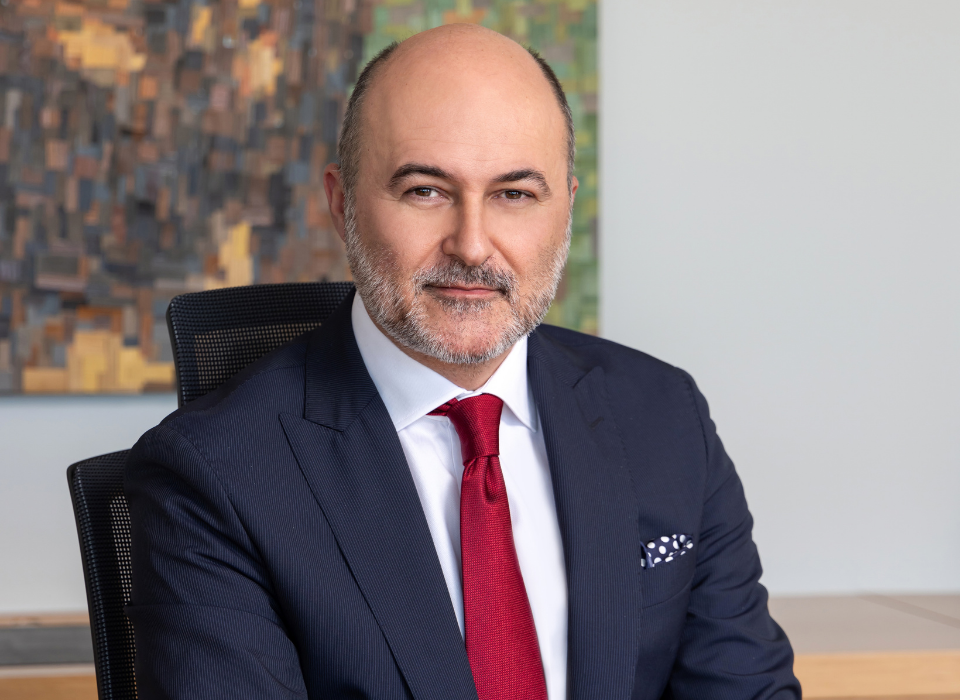
Interview with Emre Kuzucu, R&D Director of Mercedes-Benz
Could you briefly introduce yourself to our readers, and tell us about your education and professional background in the sector?
I was born in Izmir in 1977 and completed my education in Istanbul. In 2000, I graduated from Boğaziçi University with a degree in Mechanical Engineering, and completed my master's degree at Boğaziçi University in Industrial Engineering, focusing on Engineering and Technology Management. My 19-year career began in the Production Planning department at Mercedes-Benz Türk A.Ş., Hoşdere Bus Factory, where I held managerial positions in Production Planning, Factory and Investment Planning, and the Lean Production Office. After serving as project manager for the next-generation Travego and Tourismo vehicles between 2012-2017, I have been serving as Development Director responsible for Bus Interior Equipment at the Hoşdere R&D Centre since the beginning of 2018.Mercedes-Benz has been in Turkey for 52 years. What do you think Mercedes-Benz has contributed to Turkey's automotive sector?
As Mercedes-Benz Türk, with investments exceeding EUR 1.2 billion, we are among Turkey's largest foreign-invested companies. Through our headquarters in Istanbul Hadımköy, our bus factory in Hoşdere, and our truck factory in Aksaray, we employ nearly 7,000 personnel, supporting Turkey's economic development. As a brand operating in the Turkish market for approximately 52 years, we continue to lead the automotive world, create differentiation in multiple segments with Mercedes-Benz models available in the market, and develop ourselves. Beyond product sales, we sustain our investments in Turkey without interruption through after-sales services, used vehicles, financing, corporate social responsibility projects we have implemented, and work in sports and the arts. Mercedes-Benz Türk, which produces inter-city and municipal buses at the Hoşdere Bus Factory in Istanbul and medium-heavy and heavy-class trucks and tractors at the Aksaray Truck Factory, makes these facilities important parts of Daimler AG's development and production network. The company also plays a significant role in domestic sales and exports of products including models manufactured in Turkey. Furthermore, Mercedes-Benz Türk is among the leading companies in the automotive sector, carrying out imports and sales of Mercedes-Benz brand light commercial vehicles and all automobile brands under the Daimler AG umbrella.Could you briefly tell us about your factories and production technologies?
Our Hoşdere Bus Factory, which entered service in 1995, produces buses for the Turkish domestic market as well as exports to the entire world. Our factory is also the largest integrated bus manufacturing facility among Daimler AG's bus production plants. Thanks to the factory, where more than 85,000 buses have been produced to date, one out of every two buses manufactured in Turkey today bears the Mercedes-Benz Türk signature. At the Hoşdere Bus Factory, we produce inter-city bus models such as Travego, Intouro, Tourismo and Setra UL Business, as well as city buses such as Conecto Solo and Conecto Articulated (with diesel and gas options). The cataphoretic coating system (KTL) used at Hoşdere Bus Factory, which is of great importance for vehicle quality and provides superior protection against corrosion, is a first in bus manufacturing in Turkey. Within the factory, there is also a Cogeneration Centre that meets the facility's electrical energy needs. The factory continues to serve as a model facility for environmental protection through the technology it uses, special precautions taken, treatment facilities and alternative energy solutions. At Hoşdere Bus Factory, a multi-level central battery charging area was put into operation with an investment of EUR 1 million. Through this area, our company achieved efficiency rates reaching 100 percent in terms of charging capacity and replacement times. Mercedes-Benz Türk, implementing a first in Turkey, can now manage battery replacement operations for forklifts very quickly and effectively through the special roller shelf system and battery replacement lift in the area. Thanks to this newly developed project, the factory's carbon footprint resulting from battery charging processes was reduced by up to 25 percent.In which countries are your production centres and factories located?
As Mercedes-Benz Türk, we have two factories in Turkey, one in Hoşdere and one in Aksaray, and our headquarters in Hadımköy. Daimler AG conducts production and sales operations in many countries, with Germany being the primary location. Since 1886, as "the brand that invented the automobile," we continue to preserve our pioneering identity by using the most advanced technologies and production capabilities in all branches of this field.What are your efforts related to Industry 4.0 at Mercedes-Benz?
Our work on Industry 4.0 is actually an ongoing process. As a company, we have taken pioneering steps for this integration in our multi-year investments. Industry 4.0 is particularly relevant to the automotive sector. As Mercedes-Benz Türk, to adapt to this process, we build strong infrastructure in our production units and at the Hoşdere R&D Centre, implementing our Industry 4.0 projects. This is not a process that will end in a specific period, and it would not be correct to say we have completed it. Because as we meet Industry 4.0 requirements, we are also preparing for the next phase. At this point, "data" or "information" is the fuel of our time. We use BIG DATA in every work we do. In 2018 alone and only in bus road tests, we collected approximately 10 TB of data. In this digital process, our engineers take the usable data from the iceberg and make necessary improvements. Meanwhile, our changes continue on the physical level as well. Now an engineer in Turkey can come together simultaneously with R&D engineers at different locations around the world in virtual or semi-virtual environments. This increases our production speed and efficiency while reducing costs. One of our organization's greatest objectives is to integrate our customers, our vehicles, and our entire supply chain with digital technologies we have implemented in our company in a different way than today.Could you provide information about the work conducted at Mercedes-Benz Türk's R&D Centres in Aksaray and Hoşdere, as well as your Global IT Solutions Centre?
As Mercedes-Benz Türk, in addition to the production operations we carry out in Turkey, we are increasing our importance in the global R&D network through our research and development efforts. Our company, which has emphasized research and development activities since its establishment, officially acquired R&D Centre status in 2009. Mercedes-Benz Türk R&D engineers actively participate in bus and truck research and development activities under the Daimler umbrella.The latest technological systems used in factories are also used at the R&D Centre, and all work is conducted in an integrated and simultaneous manner with the world.
This provides the opportunity to work collaboratively with other engineers at Daimler facilities at international standards, and we benefit from the power of the resulting synergy. Components and vehicles are approved after passing a series of tests and begin to be used worldwide. Mercedes-Benz Türk Hoşdere R&D Centre produces R&D services in Turkey and exports them to the world. Mercedes-Benz Türk also has a second R&D Centre, which was commissioned in 2018 within the Aksaray Truck Factory and assumes global responsibility specifically in the truck product group.Thanks to this R&D Centre, where final road test approval is given for all Mercedes-Benz trucks worldwide, we are in a very strong global position.
Our factory also has a special status in the Daimler global network through the services provided by Daimler's Global IT Services Centre within it and the work conducted through its R&D Centre. With Daimler AG, Mercedes-Benz Türk's parent company, positioning Turkey as one of its information technology hubs through investments exceeding EUR 4 million, the Global IT Solutions Centre opened within Hoşdere Bus Factory celebrated its fifth anniversary in December 2018. The Global IT Solutions Centre provides information technology services and expertise to more than 40 countries, from Germany to Japan. At the end of 2018, Mercedes-Benz Türk was selected as one of the largest three companies in the architecture, engineering and technical category in the Turkish Exporters Council (TİM) "Turkey's 500 Largest Service Exporters" ranking announced. Through service works conducted at two R&D Centres located at Aksaray Truck Factory and Hoşdere Bus Factory and Daimler's Global IT Solutions Centre also located in Hoşdere, Mercedes-Benz Türk, which generated approximately USD 80 million in service exports, became one of TİM's three largest companies on the list.Could you tell us about your sustainability initiatives?
Our company continues to fully comply with environmental protection efficiency regulations within Daimler; in line with our sense of responsibility, we continuously reduce and improve the environmental impacts of our facilities, leading the automotive sector. Mercedes-Benz Türk, which has qualified for Environmental Management System certification in recent years, implements necessary investments after determining areas requiring improvement and energy-saving potential through regular reports prepared by the Energy Management Team, composed of specialists with the required certificates mandated by relevant regulations.In Waste Management at Hoşdere Bus Factory and Aksaray Truck Factory, "hazardous" and "non-hazardous" waste is collected at the points where they are generated and sent for disposal.
This method facilitates the transport of waste within the factory while gaining more space at the central waste yard in the factory area. Mercedes-Benz Türk invested more than EUR 1,000,000 at Hoşdere Bus Factory and more than EUR 700,000 at Aksaray Truck Factory in waste management.At Aksaray Truck Factory, with the new waste collection concept, proper waste sorting is ensured, achieving a waste recycling rate exceeding 95 percent.
The "Trigeneration Facility" established at Hoşdere Bus Factory aims for more efficient energy use and prevents potential negative environmental effects resulting from power outages. Through this facility, using natural gas, electricity, heating and cooling water are obtained. With this system, 100 percent of electricity needs, 40 percent of heating needs in winter months, and part of cooling needs for air conditioning in summer months are met. As a result of all these efforts, within the scope of energy efficiency efforts sustained at Mercedes-Benz Türk Hoşdere Bus Factory since 2007, energy savings of more than 30 percent per vehicle have been achieved, while a reduction of approximately 10,000 tons annually in carbon dioxide emissions has been provided.How many people work at your bus R&D centre?
At our Hoşdere R&D Centre, under "Bus Development," 211 people work in a total of 21 units. While 16 percent of the Bus Development Department consists of female engineers, 34 percent of employees have a master's degree.What are Mercedes-Benz Türk's global responsibilities in the bus R&D field?
We conduct comprehensive R&D work on buses. These include bodywork, exterior equipment, aerodynamic calculations, interior equipment, interior lighting concepts, documentation centre, electrical comfort systems, wiring harnesses and diagnostics, endurance and long-distance testing. We also export engineering expertise from Hoşdere worldwide. We develop all the scopes mentioned earlier at our centre and subsequently assume responsibility for all vehicles produced at Daimler's Mannheim, Ulm and Ligny factories.Where do you conduct bus road tests?
All test vehicles are tested 7 days, 24 hours for more than a year at 4 different locations: in winter, on the 2,000-meter-high plateaus of Erzurum at -30 degrees; in summer, in the Taurus and Izmir regions at +40 degrees; and in spring, in the Istanbul vicinity and Thrace region, under all kinds of weather and road conditions. Vehicles are used on various road types such as highways, urban roads and back roads in each region, on the steepest slopes and in heavy traffic, and all vehicle limits are stressed with different test scenarios.Do you also conduct electric bus tests?
Yes; road tests for eCitaro are also conducted in Turkey. R&D activities in this area are located at the centre within Hoşdere Bus Factory. After completing winter tests in Erzurum, we also conducted summer tests for eCitaro.How do you conduct road tests in a digital environment?
We conduct some road tests through a system called Hydropuls. The Hydropuls test, considered the most advanced in terms of bus production R&D in Turkey, provides us with all the scopes that need to be tested for a vehicle. In this test, where parameters of different types of road routes are entered, we test the bus equivalent to 1 million km. That is, through simulation, we measure what kinds of malfunctions and failures might arise in the bus when it travels 1 million km. This test lasts approximately 2 weeks. In 2018 alone, we conducted more than 3,200 hours of Hydropuls testing on our newly developed products. This is equivalent to 11,000,000 km of road testing.Tell us about some of the firsts from your R&D centre?
Globally, within Daimler's buses, we were the first to develop a ceiling concept and textile air duct for new city vehicles. This allowed us to achieve lightness, practicality, and brought the centre of gravity closer to the ground. Through these more modular textile air ducts, we also achieved logistics efficiency. Taking our R&D efforts for CNG buses a step further, we produced models with textile-covered ceilings. After this R&D work, which provided 40 percent lightness, the vehicle's operating costs were also reduced. Another first of ours is the Remote Bus App, through which we enabled remote control and operation of bus functions for the first time. Within Remote Bus App 1.0, the driver is provided with information on many topics such as mileage, temperature, fuel and adblue levels, tyre pressure, and open/closed status of doors and cargo lids, and this data is continuously updated in real time. Similarly, tyre pressure, tyre temperature, and tyre sensor battery status are displayed in detail for every tyre on the bus. Additionally, to alert the driver of a possible situation, the status and locking conditions of doors, lids, and cargo compartments can be monitored in the application.Advertisement
Ad Space728 × 90