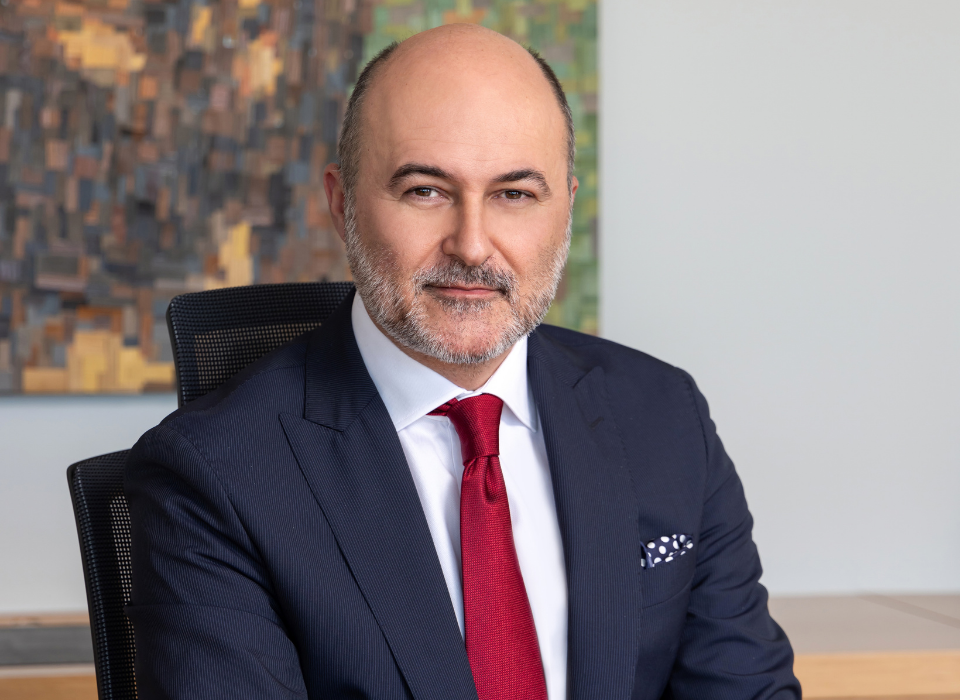
Interview with Adil Pelister, Chairman of the Board of İKMİB
İstanbul Kimyevi Maddeler ve Mamulleri İhracatçıları Birliği (İKMİB) Board Chairman Adil Pelister spoke with us in an enjoyable interview. Pelister shared his work on the current situation and his views on the new world order.
Coronavirus response: what new decisions have you taken? Could you share details on the work you have undertaken in this regard?
During this challenging period for our country, İKMİB, the association for the chemical sector—which touches all areas of life and holds vital importance—has acted with a "health first" approach in combating the Covid-19 pandemic, which threatens all humanity and produces destructive consequences in many respects. We prioritised our country's needs. During this period, we believe in the importance of unity and solidarity, and national cohesion. In line with this, we quickly made decisions with our Board of Management and took action to support our country's healthcare workers. From the outset, following decisions and measures taken by our President, the Ministry of Health, our ministries and our Science Board, we, as an exporters association, launched a production mobilisation under TİM coordination to rapidly meet the needs of our healthcare sector. For all our physicians and healthcare personnel working with historic dedication and commitment day and night, we sought to secure supplies of disinfectants and cleaning materials, as well as all necessary chemicals. Within this scope, we delivered 100,000 litres of disinfectant to our Ministry of Health and hospitals on behalf of TİM.Furthermore, in cooperation with the Plastics Manufacturers Association (PAGDER), we delivered 100,000 medical face shields to our Ministry of Health and 10,000 medical face shields to the Turkish Red Crescent to meet the need for face protection equipment that would reduce exposure risk for our healthcare workers facing high risk.
As the coronavirus began to appear in our country, there was intense demand for cologne and disinfectant products. There was a shortage of ethyl alcohol in disinfectant and cologne production. As a result of our initiatives at İKMİB, we made an important contribution to redirecting ethyl alcohol supplies in our sector from the 3 percent use of bioethanol produced from molasses in sugar factories in fuel, toward disinfectant and cologne production. With the announcement published in the Official Gazette on 2 May, restrictions on the export of medical, cosmetic and chemical products were lifted. İKMİB, together with our sector NGOs, made a significant contribution to this. Products including "Ethyl Alcohol", "Cologne", "Disinfectant", "Alcoholic Wet Wipes" and "Hydrogen Peroxide", which were included in the scope of "Export-Regulated Goods" by the announcement published in the Official Gazette on 18 March 2020, were removed from the aforementioned list by the announcement published in the Official Gazette on 2 May, thereby ending the regulation requiring these product exports to be recorded. Furthermore, products including "Ventilators, ECMO, Oxygen Concentrators, Ventilation Supplies and Accessories, Patient Circuits (Anesthesia/Ventilator Circuit), IV Cannulas, Intubation Tubes, Intensive Care Monitors", which were included in the scope of "Export-License-Required Goods" by the announcement published in the Official Gazette on 26 March 2020, were also removed from the aforementioned list by the announcement published in the Official Gazette on 2 May, thereby ending the regulation linking the export of these products to the prior approval of the Turkish Pharmaceutical and Medical Devices Institution. With the lifting of export restrictions on these chemical products, we anticipate that exports in our medical and cosmetic sectors will continue to accelerate."If we manage this process well as a country and business community, we foresee that in coming periods our country could serve as an alternative to China for raw material supply, investments from different countries could come to our country, and there could be opportunities for cooperation with companies in China."
How did this process affect the Turkish chemical and paint raw material sector? Were there new opportunities created by the crisis, and to what extent were they capitalised upon? Our chemical sector is 70 percent dependent on imports, while our plastic raw material subsectors are 82 percent import-dependent. From this perspective, the supply of raw materials and semi-finished products is crucial for our sector. Accordingly, we can say that disruptions in supply processes will affect all sectors. Particularly for the procurement of critical products, both customs processes need to operate very rapidly and necessary regulations must be implemented to make transport costs more affordable. In the long term, it is of great importance to identify critical raw materials, semi-finished products or finished goods not produced domestically or produced insufficiently to ensure long-term supply security, and to provide necessary incentives and support for their production.In this direction, as İKMİB, we are sharing our expectations and proposals with relevant institutions, particularly TİM, on risk distribution regarding raw material and semi-finished product procurement.
We are exerting great care and effort to resolve the difficulties experienced by our exporting companies during this process and to minimise the impact of coronavirus, and we are in regular consultations with our relevant ministries and NGOs. We expect the chemical sector and particularly all critical sectors supporting the supply chain to be considered within the scope of force majeure and to benefit from the opportunities provided by our state. During the four-month period this year, most of our subsectors, particularly the paint sector, experienced a decline of nearly 40 percent in the domestic market. Our hope is that from June onwards, this demand postponement will end and business will resume. Consumption is as important as supply. Consumption and supply must operate in parallel. The normalisation process of our largest export market, the European Union countries, is important for our exports. Turkey's geostrategic location provides logistical advantages to European, Middle Eastern, African countries and Russia. If we manage this process well as a country and business community, we foresee that in coming periods our country could serve as an alternative to China for raw material supply, investments from different countries could come to our country, and there could be opportunities for cooperation with companies in China. Supporting domestic production and investments is very important from this perspective.How do you assess the new world order that will emerge after coronavirus? How will this new order affect the chemical sector?
At İKMİB, we are conducting our meetings via video conference during this period and holding consultations with our board of management and members. We frequently inform our members about announced incentives and measures and relay taken decisions and developments concerning our sector. Particularly during this period, it has become clear how important the chemical sector—encompassing health and food sectors above all, as well as pharmaceutical, medical, cleaning and hygiene sectors—along with digital transformation, software, access to reliable and accurate information, communication management, reliability, cooperation and solidarity concepts have become. The new world order is forming more rapidly with Covid-19. Technology and digital transformation occupy the centre of this order. To ensure sustainability, all sectors will need to integrate their business practices according to this new order. In trade, contactless commerce and e-commerce will come to the forefront in future periods. In our chemical sector, we believe that critical sectors, particularly the medical and pharmaceutical sector, the cleaning and hygiene sector, and the plastic and packaging sectors producing for these sectors, should be identified, and investments and support should prioritise these sectors. As a result of the pandemic's scale creating negative impacts on international trade, until the current process is concluded, there may be fluctuations in raw material prices due to supply and demand imbalances. Furthermore, exchange rate volatility is a situation that troubles our exporting companies."Technology and digital transformation occupy the centre of this new world order."
You announced four-month export figures for the chemical sector as İKMİB. Could you share details on this with us?
April exports from our chemical sector, Turkey's second-largest export sector, decreased by 27.39 percent to USD 1 billion 288 million due to the negative effects of the coronavirus pandemic on the world economy. In April, we were the sector with the highest exports among all sectors. This provides an opportunity to observe that chemistry is a fundamental part of our lives and that, from automobiles to furniture, textiles to food, our raw materials touch many areas and provide significant added value for our country. In the first four months, we exported USD 6 billion 57 million. During the four-month period, there was an 11 percent decline in our chemical exports. In April, Germany was our largest export destination. Other countries in the top ten following Germany in April were Iraq, Italy, Netherlands, Spain, United Kingdom, United States, Romania, Israel, and Azerbaijan-Nakhchivan. For the four-month period of January-April 2020, the top ten countries for chemical exports from Turkey were respectively Netherlands, Italy, Germany, Iraq, United States, Spain, United Kingdom, Belgium, Egypt and Israel. In April, plastics and plastic products exports, at USD 411 million 888 thousand 406, ranked first in chemical exports. Mineral fuels, mineral oils and products ranked second with USD 187 million 68 thousand 218 in exports, while inorganic chemicals exports ranked third with USD 137 million 178 thousand 812. Other sectors in the top ten following inorganic chemicals were: 'miscellaneous chemical substances', 'pharmaceutical products', 'essential oils, cosmetics and soap', 'washing preparations', 'rubber and rubber articles', 'paints, varnishes, inks and preparations' and 'organic chemicals'.Could you provide information on the webinar on the Colombian market that you will hold on 11-22 May 2020?
As İKMİB, we are setting a first in digital export in Turkey. The first of the virtual trade missions, which is one of the new methods our Trade Minister announced for continuing trade, is the "Colombia Virtual Trade Mission", which we are holding on 11-22 May. As the first step of this mission, we held a webinar on 30 April 2020 providing information on the Colombian market. At the webinar, where an assessment of the current market situation in Colombia was conducted, presentations were made on the construction materials, construction chemicals and paint sectors. Information on import rules in these sectors, products and prices on the market was shared and questions from our companies were answered. This organisation covers our paint, construction chemicals and infrastructure plastics sectors. We expect 32 companies from Colombia, Peru, Ecuador, Mexico, Chile, Costa Rica, Paraguay, Argentina, El Salvador, Panama and Uruguay to participate in our organisation, to which 12 companies from our country in these sectors will participate. These companies will hold bilateral business meetings via Skype between 11-22 May. We had actually planned to conduct this organisation as a Sectoral Trade Mission to Colombia at the end of March, but we had to postpone it due to the coronavirus pandemic. We began work with our Trade Ministry and Turkey's Exporters Assembly to realise this project.I would like to thank our Trade Ministry and our TİM Chairman for their support. As the chemical sector, we also place particular importance on the South American market.
The Latin American construction materials sector market has great potential, particularly in terms of product groups from our chemical subsectors such as paints, adhesives and construction chemicals, and plastic pipes. Last year we conducted a very successful mission to the Latin America region, particularly regarding cosmetics. This year we also plan to conduct the second as a virtual trade mission. We also plan to conduct virtual trade missions for our other sectors. I see this virtual trade mission as an opportunity to introduce our products to this region on our radar, to demonstrate our quality, and at the same time to increase our bilateral business meetings. We need to pay attention to Latin American countries with less production capacity. Perhaps in the next stage, we could reach a position where we could carry out joint production there. We prepared a special website for our companies to be able to promote their products. https://www.turkishbuildingchemicals.com/, which we have used over the past month, will continue to conduct product promotions. We wish to complete this first organisation conducted virtually with success. This experience will be an example for our other exporter associations. I believe it will make serious contributions to our exports. I wish success to the participating chemical exporting companies in their bilateral business meetings, and I hope our virtual trade mission proceeds productively.Advertisement
Ad Space728 × 90