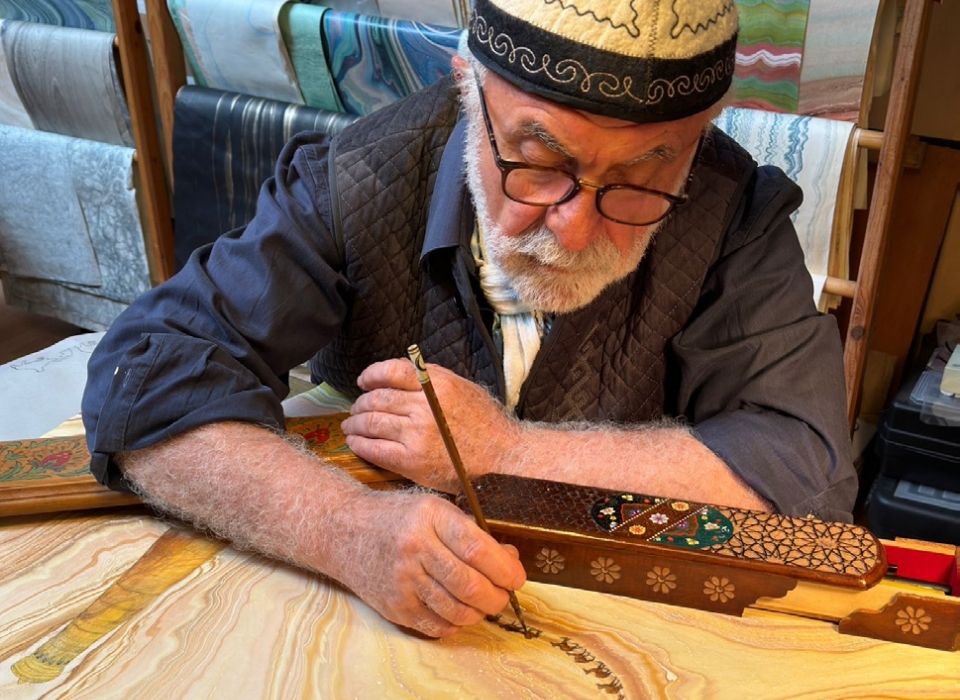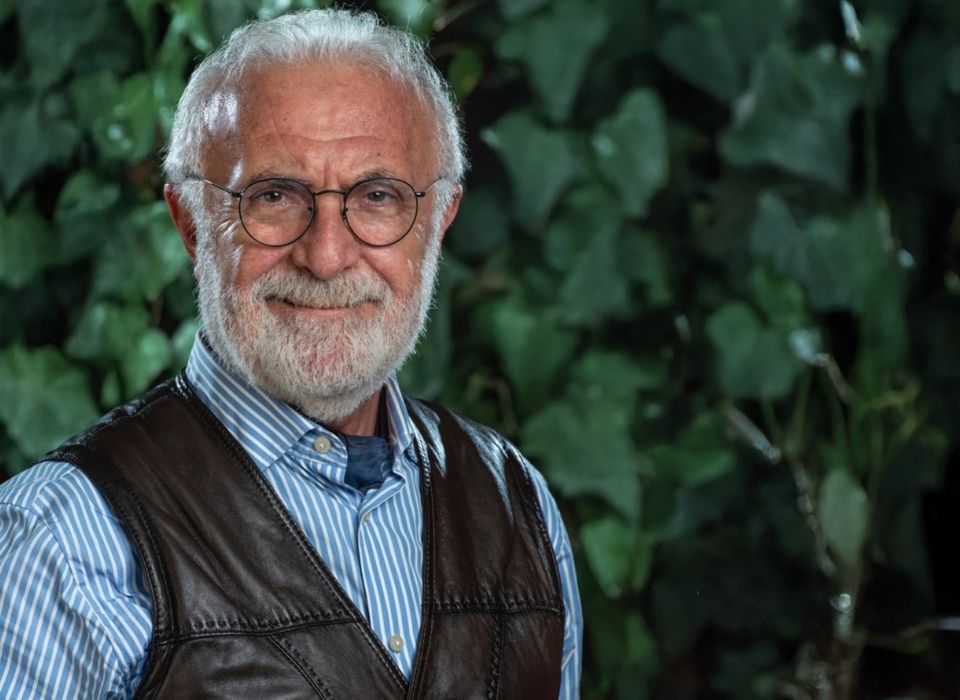
The founder and internationally recognized figure of contemporary ebru (paper marbling) art, HİKMET BARUTÇUGİL, who was deemed worthy of the "Living Human Treasure" award by the Ministry of Culture and Tourism…
Report by: Gamze Ünal
We conducted a special interview with Hikmet Barutçugil for Turkcoat—the artist who has reshaped marbling art with a contemporary interpretation, gained recognition in art literature through the "Barut Marbling" technique, and is the first name that comes to mind when marbling is mentioned both in Turkey and worldwide. Barutçugil, deemed worthy of the "Living Human Treasure" award by the Ministry of Culture and Tourism, is also the first and only Turkish artist to have won the "The Best of the Best" award from the London School of Economic Science twice.
In this report, you will explore many different topics ranging from the historical origins of marbling art to the innovative techniques developed by Barutçugil, from the use of marbling in living spaces to his vision for the future of the art.
Hikmet Barutçugil, who discovered the marbling type that entered literature as "Barut Marbling," holds the distinction of being the first name that comes to mind both in Turkey and worldwide when marbling art is mentioned. Barutçugil, the first and only Turkish artist deemed worthy of the "The best of the best" award twice by the London School of Economic Science, spoke with us about marbling art, his own techniques, and the daily-life applications of marbling.
How does the idea that the artist is a tool in marbling art affect you, and how does it reflect in your works?
When examining marbling and some other Turkish and Islamic arts, I would first like to explain that they are based on aesthetic principles different from Western art. To summarize very briefly: Western art addresses the eye, Islamic art addresses the heart. Since the word "heart" has no equivalent in any Western language, it is quite difficult to explain in a Western sense. At the core of Islamic arts lies the pursuit of divine beauty. It revolves around the idea of approaching the creator by imitating created beauties.
How did your "Barut Marbling" technique emerge within a creative process?
I first came to marbling through an interest in calligraphy. As a student at the Fine Arts Academy, I developed a strong interest in calligraphy through the encouragement of my calligraphy instructor, Emin Barın. Through him, I realized that calligraphy is a very advanced art form. When I asked my instructor what I could do to learn and develop further, he sent me to the Süleymaniye Library. While examining old calligraphic examples there, I noticed painted papers on the margins of some of them. I could not figure out what they were, and when I asked, he said that was marbling, done on water. At that moment, I fell in love with it and began to research what marbling was. The year was 1973.
In those years, marbling art was unfortunately on the verge of disappearing. Whatever water I could get, whatever paint came to hand, I tried to float images on the water's surface. But the images that came out did not resemble any marbling done before, and there were no written sources or masters about it in those days. However, this fire for marbling within me never went out, and I continued.
Later, I realized that the images I was obtaining in marbling already existed in nature in microscopic and telescopic forms. This was given the name BARUT MARBLING at an exhibition I opened in 1987 at the Royal College of Art in London. But my curiosity about how traditional marbling was done did not fade; my research continued, and after 17 years of work on a book, my first book titled THE INFINITY OF COLORS was published in Turkish and English. I saw the reward for pursuing dreams and working persistently.
What was the greatest difficulty you encountered when combining traditional arts with "contemporary" interpretations?
Marbling is one of our traditional crafts, and we know it has a history of approximately 500 years. During this time, it has not shown much development; similar things were made, and we cannot call these art—as long as similar or identical things are made, this work is called craft. For it to be art, something that has never been tried or done before must be created. We should not understand marbling merely as a painted paper or a tulip; marbling is the name of a major art discipline.
Like painting, sculpture, or music, it is the name of a major art discipline. It comes from the Persian root "ab-ru," which means water surface. The Barut marbling works, which had never been done before, were naturally met with criticism, like any innovation. This system has never changed since the beginning of history. I did not pay attention to any of the criticism and insults. I abandoned concern with people and events many years ago and tried to focus only on new ideas and concepts. I was alone in the beginning on the path I believed was right, but because I believed that perfection was the secret of creation, I never gave up. In the end, I realized that success in art is not thanks, appreciation, awards, or commendation—success in art is imitation. If others begin to imitate you, it means that the work has taken root. Meanwhile, the basic art education I received at the Fine Arts Academy—knowledge of painting, color, composition—merged with marbling art and began to appear in international museums.
During your studies and academic education in London, what changes did you experience in your views regarding marbling art?
The most important change and realization I learned abroad was that "being international requires first being national." It was understanding how foreign I was to education based on Roman and Greek aesthetic principles and that we could never compete with them or go beyond imitation. I realized how important it was for me to work with marbling, known in the West as Turkish paper.
You took innovative steps such as bringing marbling to everyday-use products. Do you have a memorable experience related to these projects?
I believe that to keep an art alive, one must live it. If we can incorporate it into everyday-use areas, we introduce it and keep it alive. Unfortunately, there are few people interested in art works in museums and private collections. If we cannot say that painting is done only on canvas or sculpture is made only from marble, we cannot say that marbling is done only on paper. When the right dyes and suitable materials are used, there is no surface that cannot be marbled.
Wood, ceramics, even wax can be marbled. One of the largest projects I undertook was combining my original profession, textiles, with marbling technique on fabrics. We marbled all the curtains in a hotel in Alanya, approximately 8,000 meters of fabric.
Would you share the founding story of Ebristan Istanbul Marbling House? How do you evaluate the impact of this place on future-generation artists?
In 1992, an international marbling congress was held in San Francisco, America. They invited me to participate and give the opening speech under the title International Marblers Gathering. I was the only Turk among 302 participants. I thought for about six months about doing something extraordinary. Finally, I prepared an article titled "Aesthetic Principles of Islamic Arts."
In my presentation, I explained the invisible aspects of marbling, the pursuit of divine beauty. It was received with great interest; many people came up to me and said, "There was something in marbling, but we didn't know what it was. You explained it to us very beautifully." and there was a focus on TURKEY. Because they know that marbling went to the West under the name Turkish paper. Therefore, I thought that the venue for such a gathering from that point on would be Istanbul. I realized it in 1997. In those years, I had also purchased a historic wooden house in Üsküdar. The idea emerged that a marbling house in Istanbul should exist, with the art thriving properly in its homeland. Following this, we established "Ebristan Istanbul Marbling House." Since 1996, it has continued as an education center, atelier, and gallery. These days, we have begun working to make it a marbling museum.
Gallery