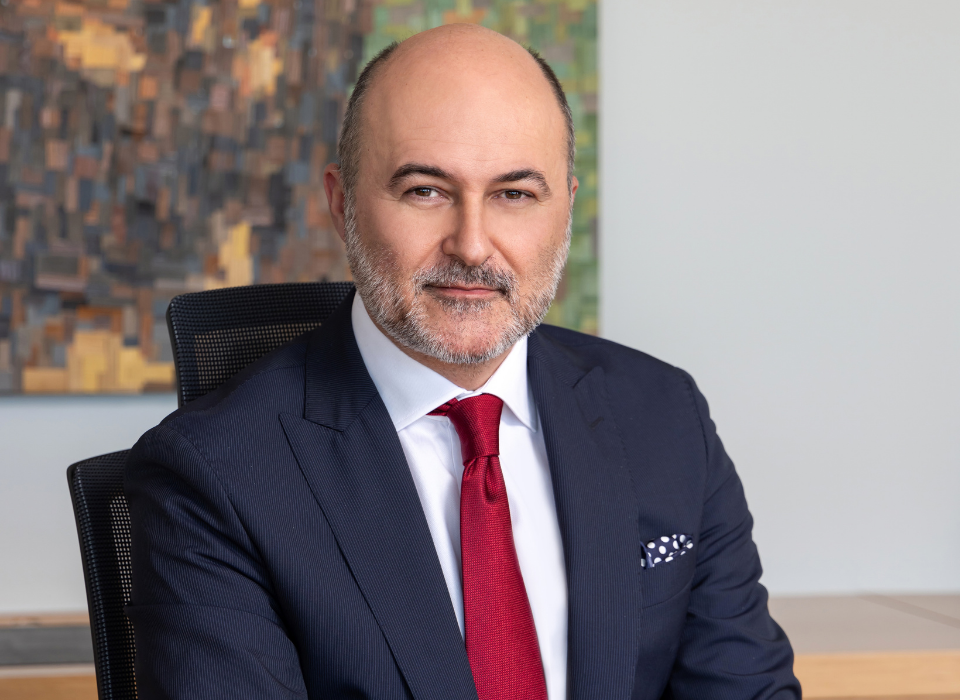
Interview with Yaşar Şenal, Chairman of the Board of ÇATIDER
We spoke with ÇATIDER (Roof Manufacturers and Businessmen's Association) Board Chairman Yaşar Şenal about the roofing sector. Şenal explained how roof systems can play an effective role in combating global warming.
Could you briefly tell our readers about yourself, your education and professional background?
I was born in Ankara in 1976. I completed my bachelor's degree in 1998 at Istanbul Technical University Faculty of Architecture. Between 1998 and 2005, I worked as Site Manager, Marketing Manager and Sales Director at leading companies in the roofing and façade sectors. In 2005, I started work as Technical Consultant at RHEINZINK, one of the leading companies in the German metal industry. Since 2009, I have been serving as General Manager of RHEINZINK Turkey and subsequently as Regional Manager overseeing 18 countries in Central Asia, the Near and Middle East. At the Roof Manufacturers and Businessmen's Association, I served as Audit Board Member, Treasurer Member and Vice Chairman of the Board of Management between 2010 and 2018. In 2019, I was elected Chairman of the ÇATIDER Board of Management. I also continue to serve as Treasurer Member of the Façade Manufacturers and Businessmen's Association—Cepheder Board of Management. I speak English and German.The Roof Manufacturers and Businessmen's Association (ÇATIDER) is an extremely active association. Could you provide information about the events and training programs organized by ÇATIDER?
As the largest organization in the roofing sector, we conduct very important work toward the development of the sector and increasing our educated workforce. I would like to briefly summarize these efforts. To date, 9 National Roof & Façade Symposiums have been organized, beginning in 2004, with a total of 230 papers presented. Through cooperation with TMMOB-Chamber of Architects SMGM, "Roof Systems" training has been provided to 1,150 architects within 29 architects' chambers throughout Turkey to date.Three separate occupational standards for Roof Master Crafts—Tile Type Roof Layer, Panel Roof Layer and Cover Type Roof Layer—were prepared in cooperation with INTES (Turkish Construction Industry Employers' Union) and published in the Official Gazette to take effect.
In 2004, a "Theoretical and Practical Training and Seminars on Roof Systems" event was launched at Istanbul Technical University. To date, 168 training sessions organized at 51 schools have reached 7,166 students as well as approximately 150 academics and teachers. With support from the European Union "New Opportunities Grant Plan" fund and sponsorship from sector companies, roofing training was provided to 452 people, 30 of whom were persons with disabilities, between 16 May 2005 and 18 February 2006.The "Building School" distance education system project went into service in 2017. Over 1,000 masters registered for the e-learning project, which offers free training and is designed for masters preparing to enter the roofing profession and those wanting to develop their skills.
Under the scope of the "Establishment and Development of Roof and Roofing Training System IQVET Project," participation certificates were awarded to 115 teachers from various vocational high schools in Ankara and Istanbul within the "In-Service Training Course Activity Program" framework. Under the scope of the Establishment and Development of Roof and Roofing Training System IQVET Project, training was provided to 510 vocational high school students.Protecting the environment and our natural resources is extremely important. In this context, what role can roof systems play? Could you evaluate this within the framework of green roofs and passive house concepts?
The European Union, through its 20-20-20 plan, aims to reduce energy consumption by 20% by 2020, increase renewable energy use by 20%, and reduce harmful greenhouse gas emissions by at least 20%. In the EU, which is taking serious steps on climate change and reducing greenhouse gas emissions, from 2020 onward, all buildings are required to be constructed according to the "nearly zero-energy" principle. In these buildings, both energy consumption must be minimized and the energy needed must be supplied from renewable energy sources. Turkey also needs to reduce energy consumption in buildings in the short term to below 80 kilowatt-hours per square meter per year. These targets can only be achieved by placing importance on roofs and roof systems. Nature-compatible, environmentally friendly designs are gaining increasing importance on the agenda of the construction and roofing sectors day by day. "Green roof" applications, whose numbers are beginning to increase worldwide and in Turkey, are an excellent example of nature-city harmony. As a result of rapid urbanization, the soil and green plant cover that absorb rainwater in cities have decreased. When all rainwater falling on a city is discharged simultaneously, flood disasters can occur. Green roofs can delay the discharge of rainwater falling on the roof surface to the drainage system by about one hour, thereby reducing flood risk. Additionally, global warming creates urban heat islands in cities. Microclimates created by urban heat islands lead to large temperature differences between areas, degraded soil, changing weather conditions, and water resource losses. With planted roofs, a large portion of the energy collected during the day is retained in the soil and plants, preventing its reflection outward during sunset hours. The temperature difference that occurs within heat islands compared to rural areas can be reduced. In conclusion, green (planted) roofs contribute to solving many problems, from oxygen production to reducing heat islands and improving energy efficiency.Passive houses, which offer heating and cooling savings of up to 90% with minimal energy use without requiring active heating systems, are seeing increasing demand worldwide. Today there are over 50,000 passive houses in the world, with the best examples found in Austria and Germany.
In our country's residences, 10 times more energy is consumed for heating compared to Germany, which has a much colder climate. Uninsulated buildings consume 20 times more energy than passive houses just for heating. The passive house approach, on the other hand, is not limited to heat savings alone; it demonstrates a holistic approach by taking into account ecology, indoor air quality, acoustics and visual comfort, and fire safety. The cost increase envisioned in Turkey for creating a passive house ranges between 20% and 40%. For cost-effective "Passive House" construction, it is extremely important to work with an expert team during the design process. Today, building energy identity regulations expect the energy class of an existing building to be at least C. In your building's energy identity certificate, you can see how much energy your building consumes on a monthly and annual basis (kw/h-m2/year). Your building's energy identity also specifies the amount of greenhouse gas your building produces in a year (CO2/kg-m2). In other words, you can see how much your building pollutes the air. Under the Energy Efficiency Law, buildings must obtain an energy identity certificate—by January 2020 for existing buildings and with the permit application for new buildings. Now is the time to reduce energy consumption as much as possible. Particularly in old buildings that have been renovated and insulated to passive house standards, it is possible to achieve energy savings of over 90% by carrying out thermal insulation on the external façade, foundation walls and roofs.We know that ÇATIDER places great importance on occupational health and safety. Could you provide information about your work in this area? What should be done to prevent workplace accidents, and what are your comments?
The Occupational Health and Safety Law, which took effect in 2012, introduced comprehensive regulations regarding workplace accidents. Additionally, through OHS specialists on construction sites, training efforts to prevent accidents have also been put in place. However, the absence of significant reduction in workplace accidents and the continuation of accidents resulting in death and serious injury indicate that the laws and regulations being applied and the measures taken on construction sites are insufficient. In this direction, we believe it is necessary to move beyond the legal measures being applied to implement awareness-raising programs with more comprehensive theoretical and practical training that covers all parties in the sector. People who will work on roofs must have training and certification in working at heights and occupational safety. In this way, roof masters can adapt to new technologies and develop their professional knowledge and experience. Occupational health and safety training should be disseminated throughout the profession, and awareness on this issue should be increased not only among employers and workers, but also to encompass all parties serving the sector and workers' families. "Falls from height" cases rank first among accidents that occur in the construction sector. Material dropping and material splashing are other frequently occurring accidents. Because a building's roof is, by its location, the area with the highest risk of falling from height, the most intensive attention needs to be paid to roof applications. For this reason, employers bear a great responsibility regarding occupational health and safety. The No. 6331 New Occupational Health and Safety (OHS) Law concerns all employers, even those with only one employee, imposes many obligations on employers, and provides for severe penalties. With the legal regulations enacted, in 40 occupations, including construction and insulation sectors, those without competency certificates cannot work, and those working in hazardous and highly hazardous jobs must be certificate holders.Advertisement
Ad Space728 × 90