A group of researchers from the Wood Materials Science group at ETH Zurich and Empa has developed a process that converts wood shavings into a recyclable, environmentally friendly composite using struvite, a crystalline, colorless ammonium magnesium phosphate mineral. The method allows wood shavings to remain in the material cycle for longer.
Researchers from the Wood Materials Science Chair at ETH Zurich and Empa have developed a process that can transform wood sawdust into a recyclable and environmentally friendly composite using struvite mineral, a crystalline and colorless ammonium magnesium phosphate. This method enables sawdust to remain in the material cycle for longer.
Struvite has long been known for its superior fire protection properties. However, previously, combining the mineral with sawdust particles seemed difficult due to its crystallization behavior. Now, ETH researchers are using an enzyme extracted from watermelon seeds to control struvite crystallization from an aqueous suspension of newberyite, a mineral precursor. This process creates large crystals that fill the voids between sawdust particles and bind them together tightly. The material is pressed for two days, then removed from the mold and dried at room temperature.
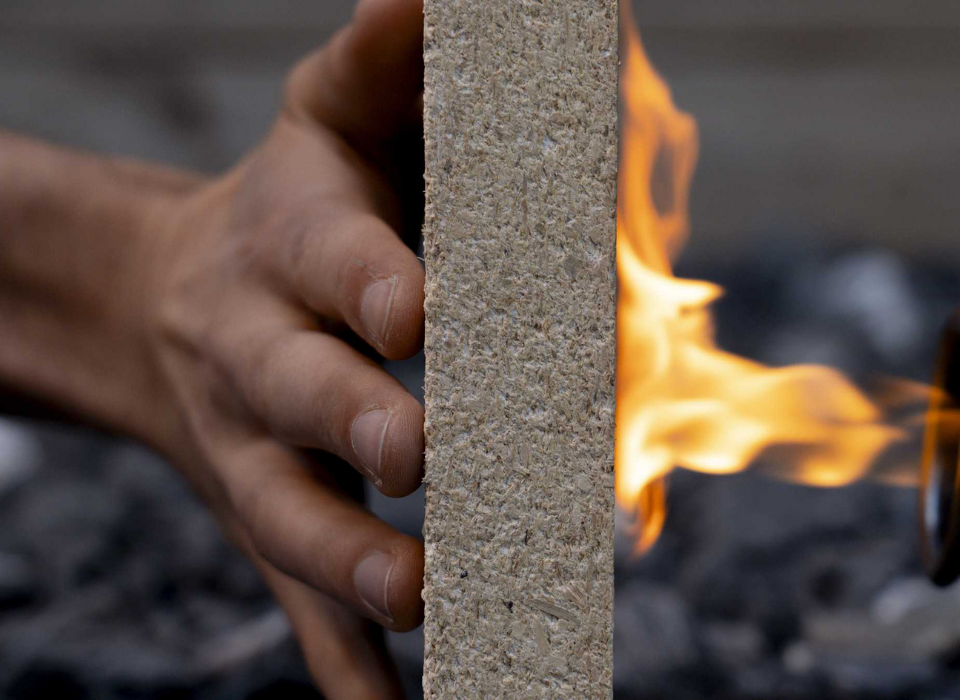
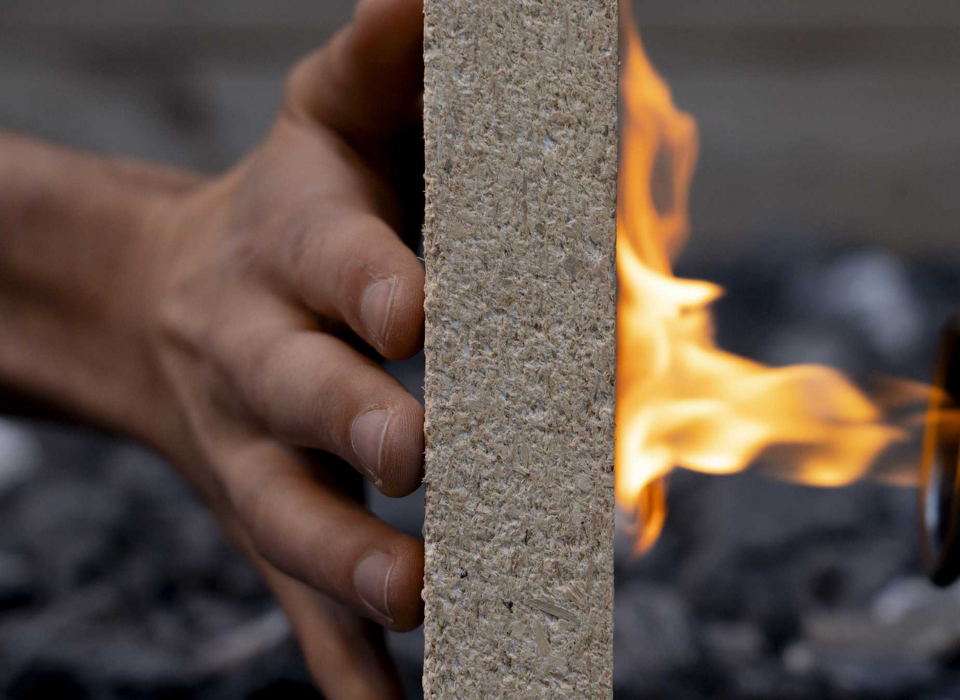
The ETH team partnered with researchers at Politecnico di Torino, who subjected the material to a standard test called cone calorimetry, which simulates how a material behaves when exposed to an external heat source. While untreated spruce ignites after approximately 15 seconds, it takes more than three times as long for the struvite-sawdust composite to ignite. When it does ignite, a protective layer consisting of inorganic matter and carbon forms rapidly, shielding the material from further fire spread. Kürsteiner states, "Struvite-sawdust panels essentially protect themselves."
Initial estimates suggest the material could achieve the same fire protection class as conventional cement-based particle boards, but larger-scale flame retardancy tests are still needed to confirm this. Cement-based particle boards are currently widely used in interior fixtures for fire-protection applications. With cement content of 60 to 70 percent by weight, they are heavy and have a poor carbon footprint due to the high energy levels involved in cement production. The struvite-sawdust board, on the other hand, contains only 40 percent binder, making it significantly lighter.
Another advantage of this innovative composite compared to other composite building materials is that, unlike cement-based particle boards for example, it does not become waste after demolition. After dismantling, the struvite-sawdust board can be separated into its components by mechanically breaking it up in a grinder and heating it to slightly above 100°C. This process releases ammonia and allows the sawdust to be separated by sieving. After the recovered material is dissolved, the precursor newberyite precipitates again as a solid.
The newberyite can then be remixed with sawdust to create struvite composites. This new material could therefore make a significant contribution to the circular economy in the future. It can also be used as a natural fertilizer, which yields interesting results for agriculture since it slowly and in a controlled manner releases bound phosphorus that plants need for growth.
Researchers plan to continue optimizing and scaling the production process. Kürsteiner states that whether the material will gain traction in the construction sector depends primarily on the cost of the binder. Struvite is relatively expensive compared to polymer binders or cement. However, this could change if they can take advantage of another cycle: Struvite accumulates in large quantities in wastewater treatment plants where it clogs sewage pipes. Kürsteiner says, "We can use these deposits as raw material for our building material."
The researchers' new mineralized sawdust-based material is a superior flame retardant. (Image: Dan Vivas Glaser / Kürsteiner R et al. Chem Circularity 2026, CC BY 4.0)
Source https://www.tohoku.ac.jp/en/press/selfpowered_composite_material_detects_its_own_cracks.html
Academic Reference / Journal Reference: Yuki Sueda, Zhenjin Wang, Yaonan Yu, Yusuke Watanabe, Hoshiki Sato, Ryozo Ohiwa, Yu Shi, Hiroki Kurita, Fumio Narita, From Vibration to Information: Self-Powered Crack Detection and Wireless Communication in Carbon Fiber Reinforced Piezoelectric Nanocomposites, International Journal of Smart and Nano Materials, DOI: 10.1080/19475411.2025.2610182
Gallery