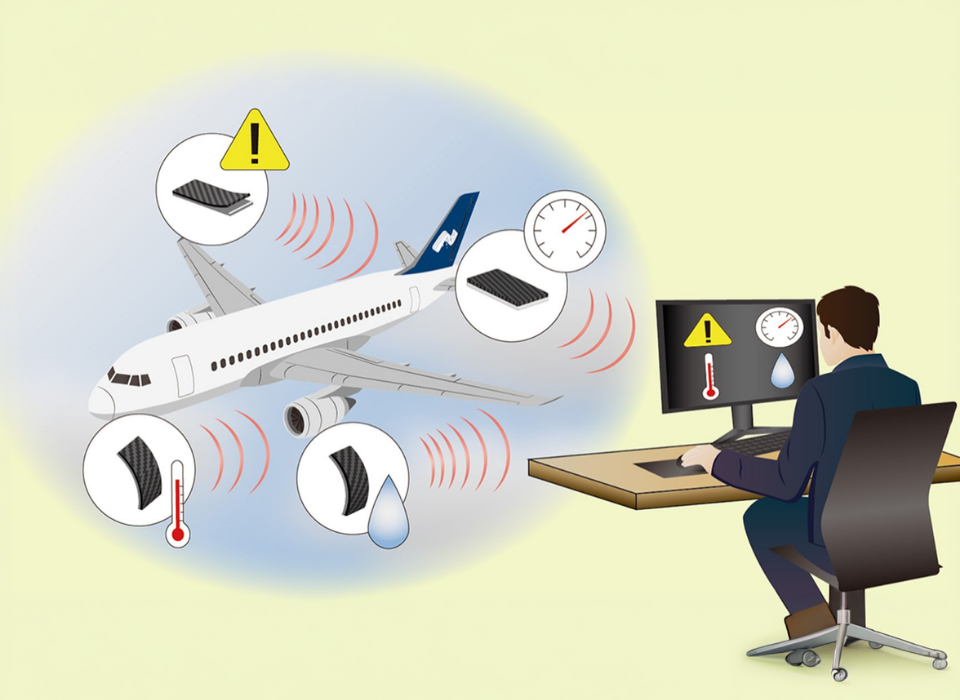
A new multifunctional composite made of carbon fiber reinforced polymers (CFRP) and piezoelectric materials can self-detect micro-scale cracks by using vibrations. This material can be used for structural health monitoring in the aerospace, automotive and construction sectors without requiring an external power source. Details of this technology were shared in an article published in the International Journal of Smart and Nano Materials.
A new multifunctional composite made of carbon fiber reinforced polymers (CFRP) and piezoelectric materials can self-detect micro-scale cracks by using vibrations. This material can be used in the aerospace, automotive and construction sectors for structural health monitoring without requiring an external power source. Details on this technology were shared in an article published in the International Journal of Smart and Nano Materials.
Zhenjin Wang stated, "CFRP is extremely durable and lightweight. It is used in aircraft, wind turbines and other large structures. However, when cracks form in the internal structure and grow, they can lead to sudden damage. Early detection of these cracks is difficult, and many structures cannot easily use battery or wired sensors. There is a strong need for a self-powered sensing solution."
To make CFRP smarter, researchers integrated a piezoelectric nanocomposite that converts mechanical energy into electrical energy into the structure. This piezoelectric nanocomposite consists of piezoelectric nanoparticles and epoxy, providing a balance between electrical performance and mechanical strength. For practical use in aircraft and energy systems, the team used potassium sodium niobate (KNN), a lead-free piezoelectric material, instead of traditional lead-based ceramics. This approach supports safer and more environmentally friendly sensing technologies. Wang said, "Our material converts vibration into information. Crack progression can be observed in the timing of wireless signals; this provides fully autonomous structural monitoring for safer aircraft and energy systems."
Researchers tested both the mechanical strength and electrical generation capacity of the composite. Under vibration, the material generated up to 13.6 V in open-circuit voltage. More importantly, when artificial cracks were placed between the CFRP and piezoelectric nanocomposite layers, it was observed that as crack length increased, output voltage and resonance frequency decreased. This demonstrates that the material not only harvests energy but also "senses" internal damage through changes in its electrical response.
Based on this behavior, the team proposes a new approach that combines energy harvesting, sensing and structural health monitoring in a single material system. Thanks to the piezoelectric "brain," CFRP generates electricity from vibrations and can use this to monitor critical parameters such as acceleration and pressure; it can also transmit data wirelessly to a computer without an external power source. Additionally, internal damage such as delamination can be detected by analyzing changes in the timing of received wireless signals.
"Currently, inspections require sensors, cables and power sources. This new material operates on its own. While reducing cost, weight and maintenance needs, it increases safety in environments where energy access is limited," Wang said. "Our research will not only support safer aircraft and energy systems, but will also contribute to future smart materials research and accelerate the development of battery-free sensor technologies."
Researchers are evaluating how this multifunctional composite could be used in next-generation self-powered structural health monitoring systems in the future. However, the durability and long-term stability of the composite must be verified through additional testing before practical applications can be determined.
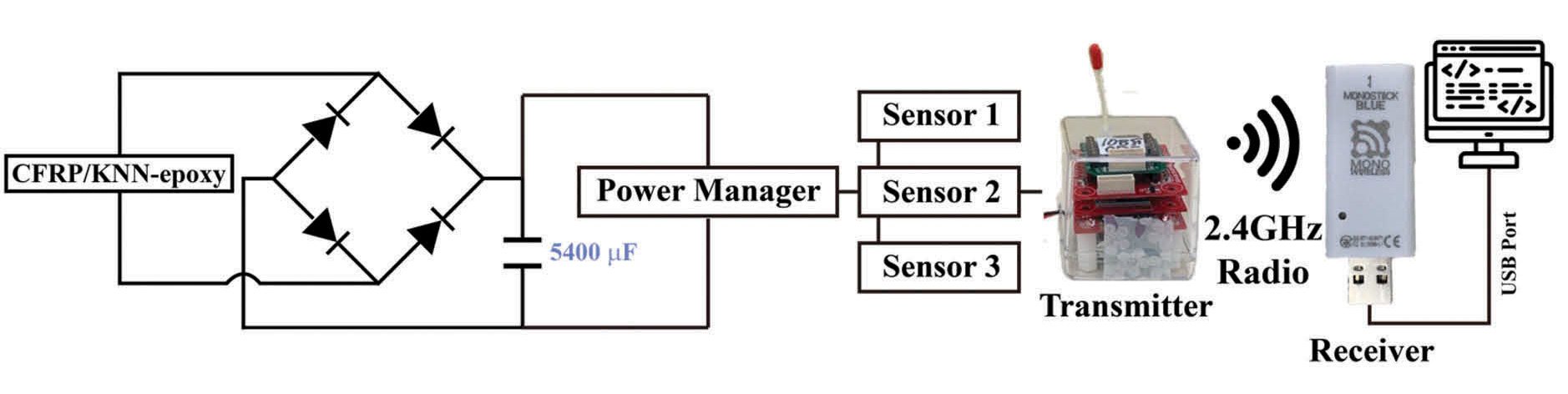
Schematic diagram of the circuit that drives the wireless integrated device. ©Zhenjin Wang et al. / A schematic diagram of the circuit that drives the wireless integrated device. ©Zhenjin Wang et al. ©Zhenjin Wang et al.
Source
https://www.tohoku.ac.jp/en/press/selfpowered_composite_material_detects_its_own_cracks.html
Academic Reference / Journal Reference: Yuki Sueda, Zhenjin Wang, Yaonan Yu, Yusuke Watanabe, Hoshiki Sato, Ryozo Ohiwa, Yu Shi, Hiroki Kurita, Fumio Narita, From Vibration to Information: Self-Powered Crack Detection and Wireless Communication in Carbon Fiber Reinforced Piezoelectric Nanocomposites, International Journal of Smart and Nano Materials, DOI: 10.1080/19475411.2025.2610182
Gallery