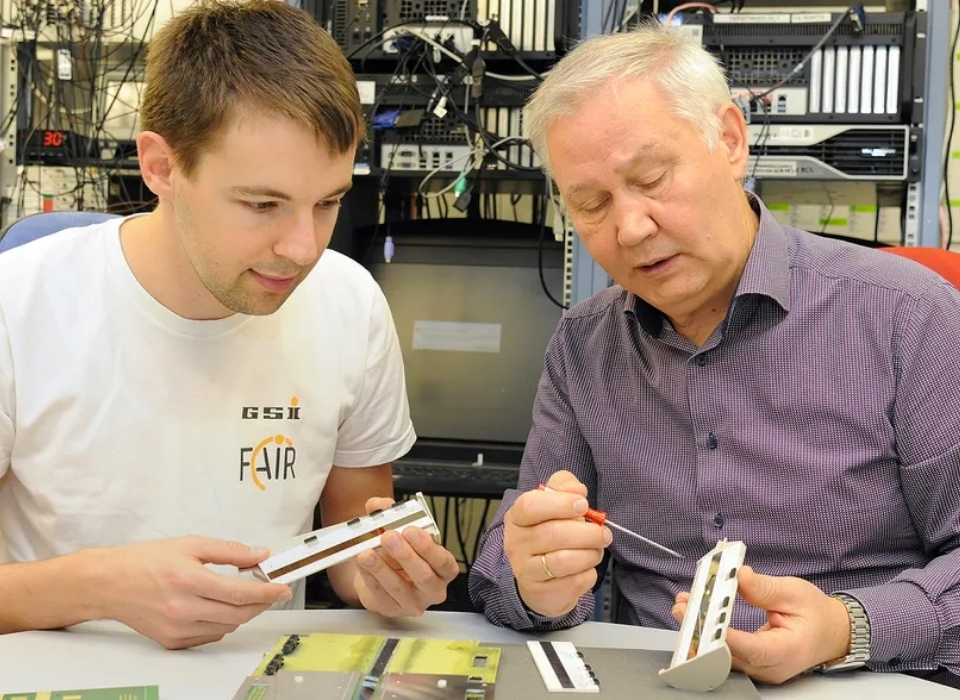
An international team led by scientists from GSI/FAIR, Johannes Gutenberg University Mainz and Mainz Helmholtz Institute has succeeded in determining the chemical properties of artificially produced superheavy elements Moscovium and Nihonium (elements 115 and 113). This makes Moscovium the heaviest element ever chemically studied to date.
With these results, experiments conducted at GSI/FAIR provide data on three superheavy elements: 113, 114 and 115, enabling reliable classification of their properties and evaluation of the structure of these three regions of the periodic table. As elements become heavier, the large number of protons in the nucleus accelerates electrons orbiting the nucleus to increasingly higher speeds, so that effects that can only be explained by Einstein's famous theory of relativity come into play. This speed makes electrons heavier. For example, in lead (element 82), such relativistic effects already exist and contribute to chemical processes in lead batteries. Neighbouring elements thallium and bismuth behave differently. This effect, though small, is localized in lead. But what if a superheavy element could be a lead alternative? What about Flerovium (element 114), a heavier neighbour in the same group of the periodic table, discovered only in the last 20 years and chemically studied? This element was found not to be like lead, to easily vaporize, and to be less reactive.
To find answers, nihonium (element 113) and moscovium (element 115) also had to be tested. While first clues about nihonium chemistry had been reported, a study of moscovium chemistry had not yet been carried out – because its most suitable isotope could only exist for approximately 0.20 seconds. This success has now been achieved by international collaboration at GSI Helmholtzzentrum für Schwerionenforschung in Darmstadt, Germany. The team reported that nihonium and moscovium exhibit higher chemical reactivity than the intermediate element flerovium. The local effect seen in lead is also seen in flerovium, but much more strongly – which is not surprising given the higher nuclear charge.
Observation of a few atoms was sufficient to obtain this result. Nevertheless, achieving this result required continuous two-month work at the heavy ion accelerator facility at GSI/FAIR. To produce superheavy elements, the team bombarded thin foils containing americium-243 (element 95) with beams of calcium-48 (element 20) ions. This fusion created moscovium-288 (element 115) nuclei, which transformed into nihonium-284 (element 113) in a very short fraction of a second.
As an inert gas carried both elements through a detector array coated with a thin quartz layer, the detectors recorded the decay of individual superheavy atoms and determined whether the atoms formed a chemical bond strong enough to hold them at the point where they first struck the surface. A weaker bond led to more transport by the gas. In this way, the pattern recorded in the detector array provided information about the strength of chemical bonds – and thus the chemical reactivity of the elements. Elements with low reactivity can even leave the array, but only to encounter gold-coated detectors. Bonds with gold are usually stronger than with quartz, thus ensuring that every examined atom is retained and recorded.
Dr. Alexander Yakushev, spokesperson for the international collaboration at GSI/FAIR, explains: "Thanks to the newly developed chemical separation and detection system in combination with the TASCA electromagnetic separator, we were able to extend our gas chromatography studies to more reactive chemical elements such as nihonium and moscovium. We succeeded in increasing and decreasing the time it takes to perform chemical separation to such an extent that we could observe the very short-lived moscovium-288 and its daughter nihonium-284 at a detection rate of approximately two atoms per week."
In total, four moscovium atoms were recorded and all were observed in the quartz-coated array. Most of the 14 detected nihonium atoms accumulated on quartz, indicating chemical bond formation. One atom reached the gold-coated array, indicating that the quartz bond was not very strong. This contrasts with the behaviour of lighter homologues, which are known to form strong bonds with quartz – thallium (for nihonium) and bismuth (for moscovium). Similarly, lead, the homologue of flerovium, forms strong bonds with quartz, while flerovium does not.
The complete data set for these elements shows that superheavy elements are much less reactive than their lighter homologues, which is associated with inertness resulting from relativistic effects. The most pronounced effect, however, is seen in flerovium, which, despite being a metal, is a rather poor reactor – this behaviour indicates the presence of closed electron (sub)shells, almost as in inert noble gases. The results demonstrate the effect of Einstein's theory of relativity on the periodic table and also set a new record for the heaviest element ever chemically studied.
With technological advances, new requirements for new materials emerge. Can new elements contribute? As cars transition from fossil fuels to electricity, other things in our daily lives are also being replaced by technology based on new materials. The first flerovium-based device is not yet on the horizon. Currently, only a few atoms can be produced per week, and they exist for less than a second. This may change as technology advances, and eventually larger quantities could be obtained. Whether in the future they could be used in battery manufacturing, as an agent in medicine, or enrich our lives in unforeseen ways, we do not know. However, thanks to the groundbreaking experiments conducted in Darmstadt, future researchers will be one step ahead and will already know the chemical character of these new materials. These results also open new perspectives for the international FAIR (Antiproton and Ion Research Facility) facility currently under construction in Darmstadt.
https://www.chemeurope.com/en/news/1184836/the-heaviest-element-ever-chemically-studied.html
Gallery