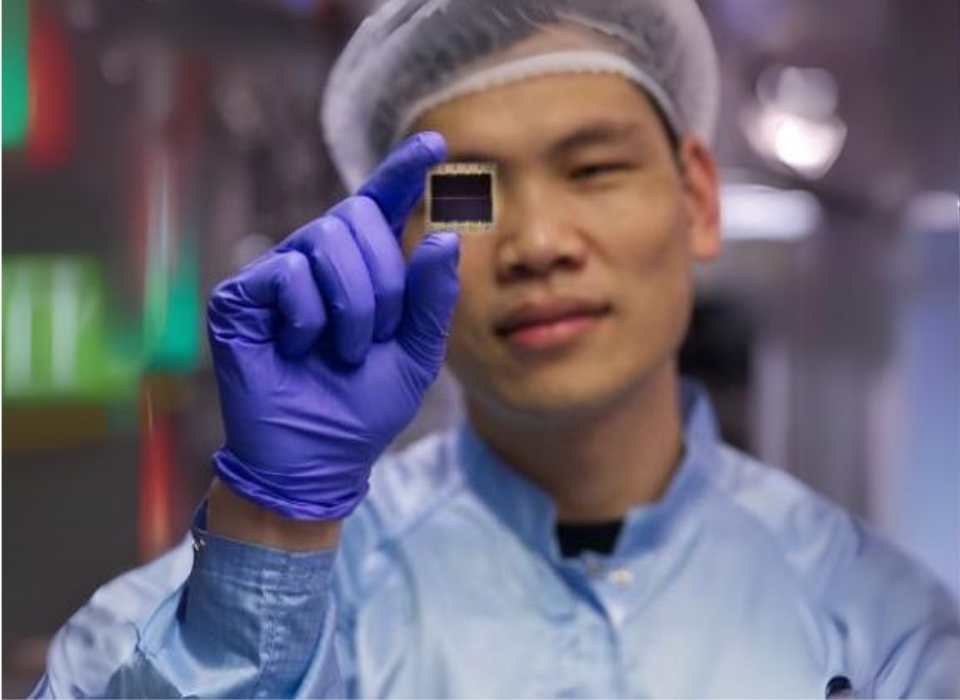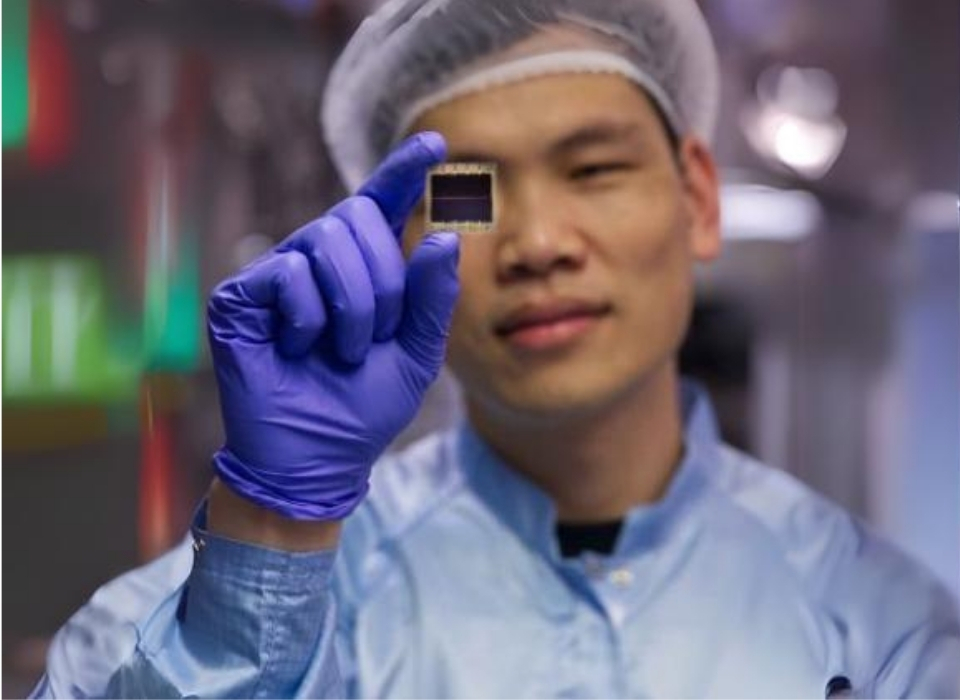
Scientists from Oxford University's Department of Physics have developed a revolutionary approach that can generate increasing amounts of solar energy without relying on silicon-based solar panels. Instead, their innovation works on the principle of coating a new energy-generating material onto the surfaces of everyday objects; these objects include backpacks, cars and mobile phones.
The new light-absorbing material is thin and flexible enough to be applied to almost any building surface or common object for the first time. Using a pioneering technique developed at Oxford University, multiple light-absorbing layers have been stacked onto a solar cell, allowing a broader range of the light spectrum to be used to generate more power from the same amount of sunlight.
This ultra-thin material was certified to achieve energy efficiency of over 27 percent using a multi-layered approach; this means it has reached the same performance as conventional single-layer energy-generating materials, silicon photovoltaics. The National Institute of Advanced Industrial Science and Technology (AIST) in Japan issued the certification before the researchers' scientific work was published. Dr. Shuaifeng Hu, a lecturer in the Department of Physics at Oxford University, said: "After testing our stacking or multi-layered approach for five years, we increased the power conversion efficiency from approximately 6 percent to over 27 percent; this is quite close to the limits of today's single-layer photovoltaics. Over time, we believe this approach could enable photovoltaic devices to achieve much higher efficiencies, exceeding 45 percent."
The energy efficiency obtained from today's solar panels is approximately 22 percent (that is, converting approximately 22 percent of the energy in sunlight), but the versatility of the new ultra-thin and flexible material also plays a key role. With a thickness just over one micron, it is approximately 150 times thinner than a silicon sheet. Where conventional photovoltaics are typically applied to silicon panels, this material can be applied to almost any surface.
Dr. Junke Wang from Oxford University's Department of Physics said: "Using new materials that can be applied as coatings, we have shown that silicon can be replicated and surpassed, while also gaining flexibility. This offers the promise of providing more solar energy, because we can obtain more energy without needing many silicon-based panels or specially built solar energy plants."
The researchers believe this approach will reduce the cost of solar energy and make it the most sustainable renewable energy source. Since 2010, the global average cost of solar electricity has declined by approximately 90 percent, making it nearly three times cheaper than energy produced from fossil fuels. Innovations promise additional cost savings by reducing the need for silicon panels and specially built solar energy plants through new materials such as thin-film perovskite.
Dr. Wang said: "We foresee that perovskite coatings could be applied to broader surface types, such as vehicle roofs and building rooftops, and could even be applied to the back surfaces of mobile phones. If more solar energy is produced this way, we foresee that in the long term the need for silicon panels or more solar energy plants will decrease."
The researchers are part of a team of 40 scientists working on photovoltaics at Oxford University's Department of Physics under the leadership of Henry Snaith, Professor of Renewable Energy. Previous work on photovoltaics and particularly the use of thin-film perovskite began approximately ten years ago and benefits from a specialized robot laboratory.
The research has strong commercial potential and has already transitioned to applications in the public utilities, construction and automotive manufacturing industries. Oxford PV, a UK company that spun off from Oxford University's Department of Physics in 2010, was founded to commercialize perovskite photovoltaics. The company has begun large-scale production of perovskite photovoltaics in Brandenburg-an-der-Havel, near Berlin. This creates the world's first series production line for 'perovskite-silicon' tandem solar cells.
Professor Snaith said: "To begin production, we initially examined UK sites but the government did not match the financial and commercial incentives offered in other European and US regions." "So far, the UK has thought of solar energy only in terms of building new solar power plants, but real growth will come from the commercialization of innovations – we hope to draw the attention of the newly established UK Energy to this area."
Professor Snaith said: "The latest solar materials and techniques demonstrated in our laboratories could be a platform for a new industry that produces solar energy in a more sustainable and cost-effective way by using existing buildings, vehicles and objects. The provision of these materials will be a rapidly growing new industry in the global green economy, and we have shown that the UK has scientific leadership. However, without new incentives and a better roadmap to turn this innovation into production, the UK will miss the opportunity to lead in this new global industry."
Gallery