Hyundai Motor Group Stays Committed to Hydrogen Technology

Hyundai Motor Group is one of the brands turning sustainable mobility into a concrete solution for today, not just a future goal. Having started out with its first investments in hydrogen fuel cell vehicles nearly thirty years ago, Hyundai has now reached the point of being a global leader setting the standards for hydrogen-powered mobility in both passenger and commercial vehicles.
Hyundai Motor Group is among the brands that have made sustainable mobility not merely a future goal, but a concrete solution of today. Beginning nearly three decades ago with its initial investments in hydrogen fuel cell vehicles, Hyundai has reached a position today as a global leader setting standards for hydrogen mobility in both passenger and commercial vehicles.
The company's pioneering role in this field became widely recognized in 2013 with the launch of the ix35 Fuel Cell, the world's first mass-production fuel cell passenger vehicle. With a range of 594 km, this model became a landmark as the first tangible result of Hyundai's long-term R&D investments in hydrogen technologies. This success was followed by the NEXO, introduced in 2018. With a longer range (666 km), advanced driver support systems and intelligent parking technologies, NEXO continues to hold the title of the world's best-selling hydrogen fuel cell passenger vehicle today.
The completely redesigned NEXO, introduced in 2025, takes Hyundai's ambitions in hydrogen mobility to the next level. With its redesigned interior space, fuel refilling completed in five minutes, a target range exceeding 700 km, improved aerodynamic structure and towing capacity offered for the first time, it represents a turning point in both functionality and zero-emission performance.
Hyundai's hydrogen journey is not limited to passenger automobiles. The N Vision 74, introduced in 2022 and designed as a high-performance hydrogen concept automobile, demonstrates how the company pushes engineering boundaries. With its retro-futuristic design paying tribute to the 1974 Hyundai Pony Coupe, this model combines hydrogen fuel cells with high-performance battery systems, proving that future sports automobiles can also be sustainable.
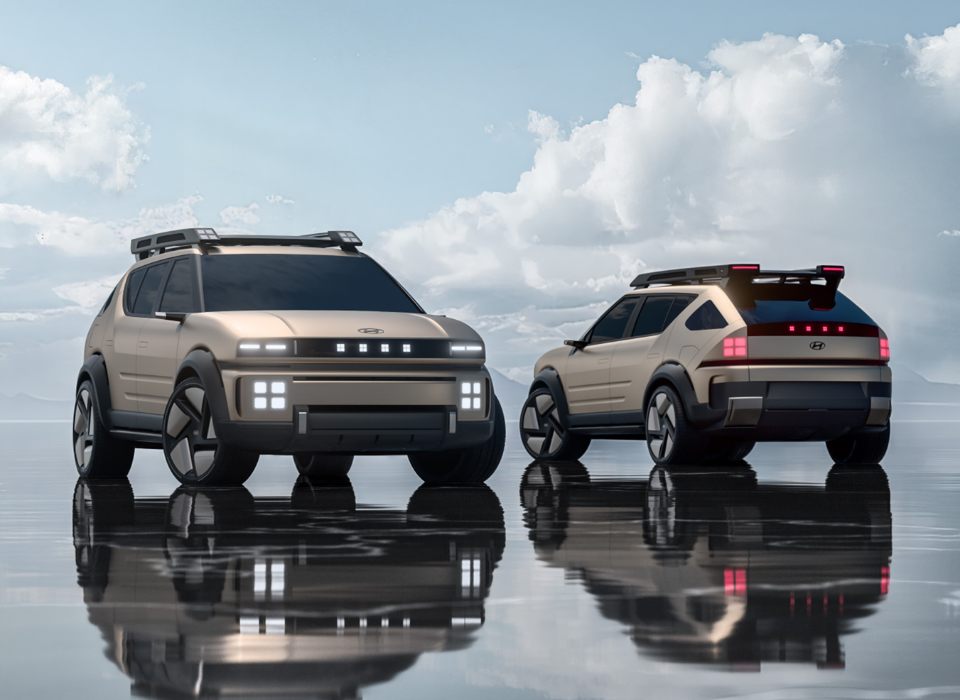
Parallel to this, the INITIUM concept vehicle introduced in 2024 targets a broader audience. Taking its name from a Latin word meaning "beginning," the INITIUM demonstrates the potential of hydrogen vehicles for family use, with features such as long range, spacious interior and powerful engine performance. The production version of INITIUM, shaped by HTWO's new design language "Art of Steel," is planned to be introduced in the first half of 2025.
Hyundai's hydrogen vision is not limited to passenger vehicles; heavy commercial vehicles and public transportation solutions are an integral part of this vision. The XCIENT Fuel Cell, launched in 2020, was a significant milestone as the world's first mass-production hydrogen heavy commercial truck. Today, with operational experience exceeding 16 million kilometers in Europe, XCIENT has proven Hyundai's technological reliability. The ELEC CITY fuel cell bus, entering service in Vienna, the capital of Austria, in 2025, is the first model with 350 and 700 bar refueling systems, supporting sustainability in urban public transportation.
Hyundai's hydrogen strategy, pursued under the HTWO brand, extends far beyond mobility to establish a complete hydrogen ecosystem. This approach, spanning the entire value chain from hydrogen production to storage, distribution and application, is oriented not only toward the automotive sector but also toward energy transformation. Investments in low-carbon production methods such as Waste-to-Hydrogen (W2H) demonstrate how committed Hyundai is to environmental sustainability. Aligned with its "Progress for Humanity" vision, Hyundai Motor aims to shape not just today's world but tomorrow's as well. The achievements gained over nearly three decades of the hydrogen journey prove that this vision is built on a strong foundation.
Gallery