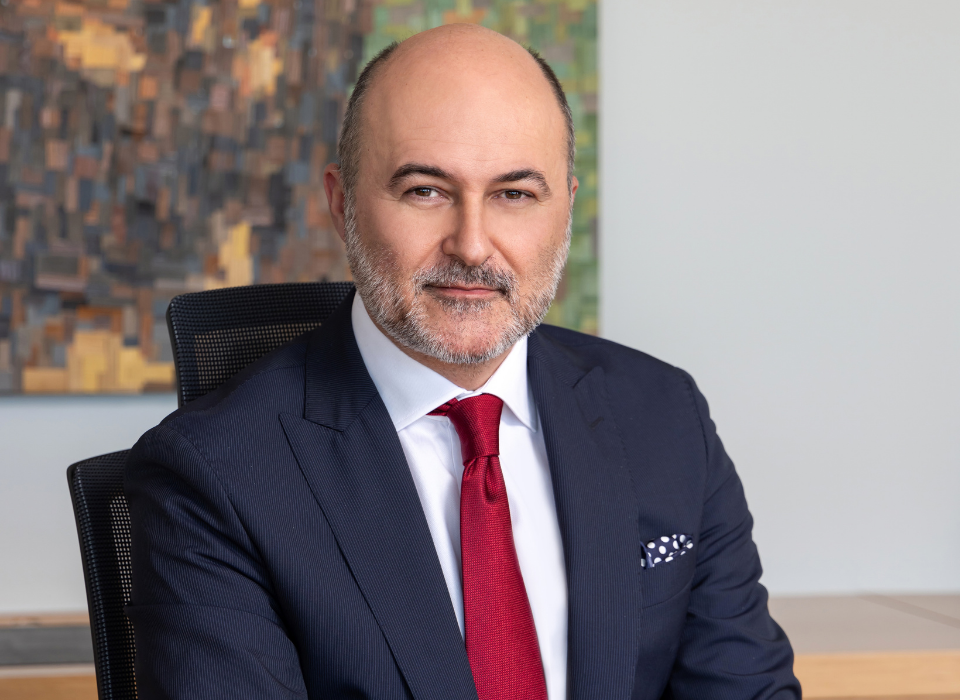
Interview with Vedat Ozan, One of Türkiye's Leading Perfumers
In this engaging conversation with Vedat Ozan, one of Turkey's prominent perfumers, we discussed the journey of scent from history to the present day and the role of fragrance in our lives, among many other scent-related topics.
Mr. Vedat Ozan, could you tell us about your education and professional background?
I am a graduate of Bogaziçi University with a degree in Management. After graduation, I worked on textiles at various companies, and later I conducted accessory imports at my own company—at a time when importing was just beginning to take off in Turkey. The market and sales structures of the products I was importing began to change, and I needed to expend more energy to keep up. As I discovered that I had other interests, I made a choice and decided to redirect my energy not towards importing but towards the fragrance field, which fascinated me. I have a four-volume book project. I have completed the first three volumes, and I believe I will complete the fourth volume by mid-next year. The first volume covers scent perception, the second volume addresses fragrances, and the third volume discusses cultures. The fourth volume will cover flavors. Beyond these, I design scents for special projects. I provide corporate training on scent because when we talk about scent, we mean a very broad world. If we consider that scent exists in every field, from cough syrup to shoe polish, I believe many sectors need to be informed on this subject.You are one of Turkey's most important and noted perfumers. How did you discover your sensitivity and interest in scent?
When I mention sensitivity to scent, I want to address a point—it is not the case that my nose detects scent better than everyone else's nose. However, because I am familiar with the components that make up scents, I can distinguish them more easily from among them. My interest in scent began at a very young age. I could say that most of my childhood memories are scented memories. There is one memory I tell frequently: as a child, they would chase me from the porch to make me drink milk, and even today, whenever I smell milk, I feel uneasy, because the scent of being forced to do something I did not want to do comes to my nose. Then one day I thought, could I also make perfume? When I did not get the results I wanted in my first attempts, I began to read various articles and magazines, and thus I entered a process of development. During my work, when you produce a perfume or scented product, you are actually the giving side, and there is also the receiving side, which is the perception side, and this became the aspect that interested me most. When I wanted to advance in this field, work in this area was still very new.What do you believe is the place and importance of scent in human life?
Like all living beings, we maintain our communication with the world through our senses. And scent is only one of these five senses. Scent is actually an instrument through which we communicate with the outside world, like our other senses. However, it differs from our other senses in this way: while the stimuli that reach our other senses first pass through a cognitive filter in our brain and are then directed to our memory and emotional processing center, the sense of smell does not pass through such a filter and goes directly to our memory and emotional processing center. We call this the limbic system. Therefore, our reactions to scents are responses that are far removed from logic and rich in emotion. Another characteristic of scent is that we smell approximately 23,000-24,000 times per day, and this is equivalent in quality to our breathing. Thus we can understand that it is a sense that is aligned with our most vital function.Scents undoubtedly have important connections with cultures. How do you define these connections?
Not only scents but all things need to be approached from a cultural perspective. There are very significant differences between cultures among the stimuli that reach all the senses. When we compare our culture to cultures that have a greater need for the sense of smell in order to continue living their lives, we see many differences beginning with the language of scent. In our lives, scent vocabulary is very limited. More accurately, scent has no language in our lives. We use words borrowed from other senses to describe scents. For example, we say a heavy scent, but heavy is actually something related to muscle movements. We say a sweet scent, but sweetness is actually related to our sense of taste. When these are not sufficient, we try to describe scents by making comparisons. For example, we say it smells like freshly cut grass in trying to explain what a scent is like. But when we go to certain cultures that we might describe as distant and, in quotation marks, wild, we see that they have a very extensive scent vocabulary. There are cultures where a single scent-smelling verb is expressed by eight different words. For example, the place of scent in life can differ from one culture to another. This also brings us to this: there is universally no such thing as good or bad scent; a scent that we find bad can be seen as something held in high regard in another culture. Knowing these things enriches our lives, so we become aware of our sensory diversity and are able to see the details of life that is passing by better because of this.How do we distinguish between good scent and bad scent?
This is entirely a perception we create afterward—we create these labels with our personal history. Through our personal history and certain variables such as the cultural codes we are immersed in, we separate scents into good or bad.Mr. Vedat Ozan, what should we pay attention to when choosing a perfume? To what extent is the correct perfume selection realized, in your view?
Just as we give a visual message with our clothes, we also give an invisible message through the perfume we use in the social setting we are in. Therefore, we should pay at least as much care when purchasing the perfumes we use as we do with our clothes. There are several requirements for this. The first is that when we go to buy perfume, we should not have any scent on us, and this applies not only to perfume but to every scented product such as lotion and cream. Second, we should set aside a long amount of time when selecting a perfume. This is because perfume is not a static thing; it has a structure that changes over time. A perfume you purchase within 15 minutes will smell quite different two hours later. For this reason, after applying the perfume to your skin, you should wait six to eight hours before purchasing it. Third is to close ourselves off to external guidance and choose a perfume in which we feel comfortable within ourselves, not based on the recommendations of others.What process do you follow to create a perfume, a scent?
What matters here is the starting point of the perfume—that is, if you are going to design something without being bound by any limitations, the process is different. If I am going to create a perfume based on a brief, that also requires a different process. One of the important points in custom briefs is the price ceiling. This determines the raw materials you will choose and the direction you will take. But if I am making a perfume just for myself, I do not feel such a limitation.You once produced a radio program on scent; how do you evaluate this program, which created a difference for listeners? What kind of experience was it for you?
If I created a difference for listeners and that difference was positive, of course I am pleased. I produced the program every week for 25 minutes, but the preparation of this 25-minute program took 20-22 hours. First, you need to make academic knowledge and language understandable for everyday life. I believe in principle that information does not have to be boring; we can learn things by being entertained and laughing. Therefore, I spent part of the 20-22-hour preparation time searching for stories in which I would use that information in daily life. After the first 10-15 weeks, I felt that the information I had provided was being used as a reference, and this brought with it an additional responsibility. Thus I felt compelled to subject myself to a cross-check when conveying that information. You will find a topic, you will research the accuracy of the information presented on that topic, and you will convey it in understandable language. When you gather all these things, a time period of 20-22 hours emerges. After 154 weeks, I ended the program because I could no longer set aside that much time.You have published three books on scent; could you tell us about your book-writing journey? What were the reactions you received from your readers?
I can say that I have not encountered any negative reaction so far. The language I used in the books was also no different from the language I used on the radio. I received a few criticisms regarding that language. Of course, after explaining things to people for 150 weeks, their notes become a very strong and valuable asset in your hands, and those notes form the skeleton of the books. The books were not, of course, a decryption of the radio programs. However, they were versions in which the information provided there had been converted into reading language, with some sections removed and some new information added.What does a note mean in perfume? Please explain. Is there a mathematical equation for beautiful scent?
We cannot say there is a mathematical equation, but to make a scent that no one will reject, you do not need to rack your brains too much. The real issue is whether to make a beautiful scent that no one will reject, or to make a scent that everyone admires and that can become a classic that can be remembered 60-70 years later. If you look in the short term, you can certainly think that no one reject it right away and let the money come to me. There are a few materials that, when you use them, there is no likelihood of rejection. But the issue is not about not being rejected; as in every work, as the risk you take increases, the gain you can obtain from that work is directly proportional. The note enters the perfume world in a very interesting way. In the 1800s, there was a perfumer named Septimus Piesse. Piesse not only designs scented products but also touches on the philosophy of perfume and borrows certain terms from the music world. And among the terms he borrowed is the note. For example, you bring together rose and jasmine and create a chord, and you create a chord in music. Then you bring chords together and turn them into a composition, and in perfume you bring chords together and turn them into a perfume. A perfume designer has a device on which to store their materials, and this is called an organ. This is also a term that comes from music. Septimus Piesse reveals these, and even goes a bit further, bringing the scent note corresponding to each musical note. The second use of the note is in perfumes, when we separate and group molecules that are close to each other according to their times of mixing into the air, we obtain different layers. Those that mix into the air the quickest are called top notes, and they are scents we perceive for a maximum of 10-15 minutes. Then come the middle notes, which are felt from 15-20 minutes up to 2 hours. Finally comes the layer we call base notes or basenotes, and depending on the weight of the molecule, these can last from 6 hours to 2 days. In short, for us, the order in which the notes come on stage is not important; the order in which they leave the stage is important.What is a scent workshop? What kind of training do you provide to participants in your scent workshop?
I have a one-day practical scent training course that I conduct whenever I have the opportunity at my own workshop, but I cannot say I find many opportunities. In the scent workshop, I initially explain how scent perception works, then I talk about the changes that scented materials have caused in world history, which many of us are not aware of. Then I explain examples of certain scent raw materials, because while everyone talks about amber, very few people actually know what real amber smells like. In the final section, we create a perfume together. The reason I say "practical" is because of the stages the perfume goes through in being created.What are the projects and initiatives you wish to carry out in the future?
First, I want to complete all four books and finish this series. Because the number of books in the world containing easily accessible and understandable information about scent is very small. Therefore, I can say I have made this a mission for myself. If I complete this four-volume series, I can say that I would feel happier. What comes after that, of course, I cannot know. Due to my intensity, I cannot move in a very planned and programmed manner. I hope to be involved in certain initiatives to increase awareness regarding the sense of smell and to increase the number of people interested in this. Vedat OzanAdvertisement
Ad Space728 × 90