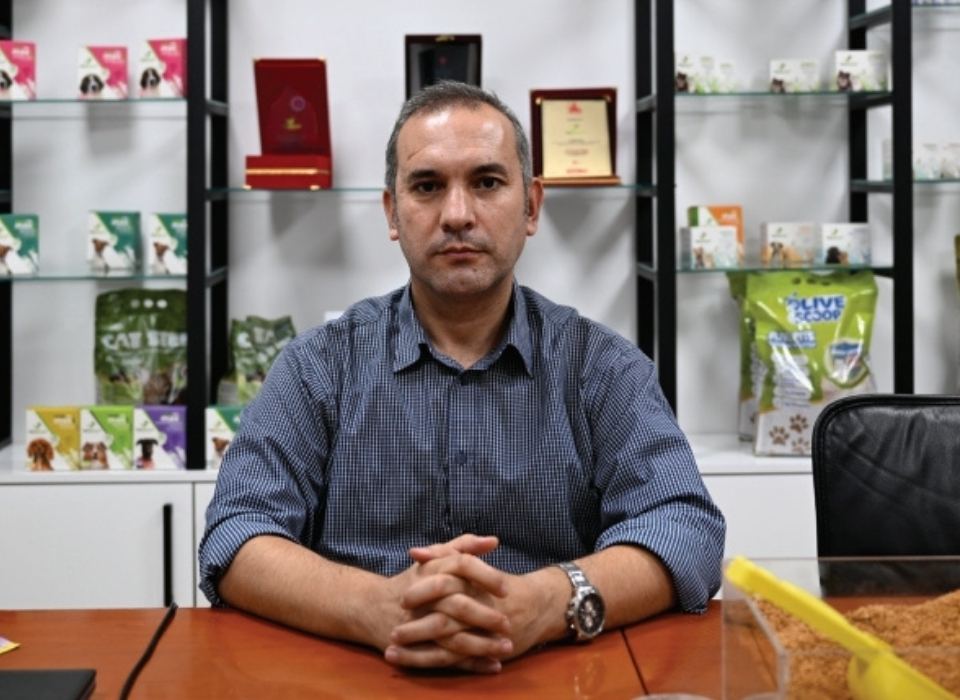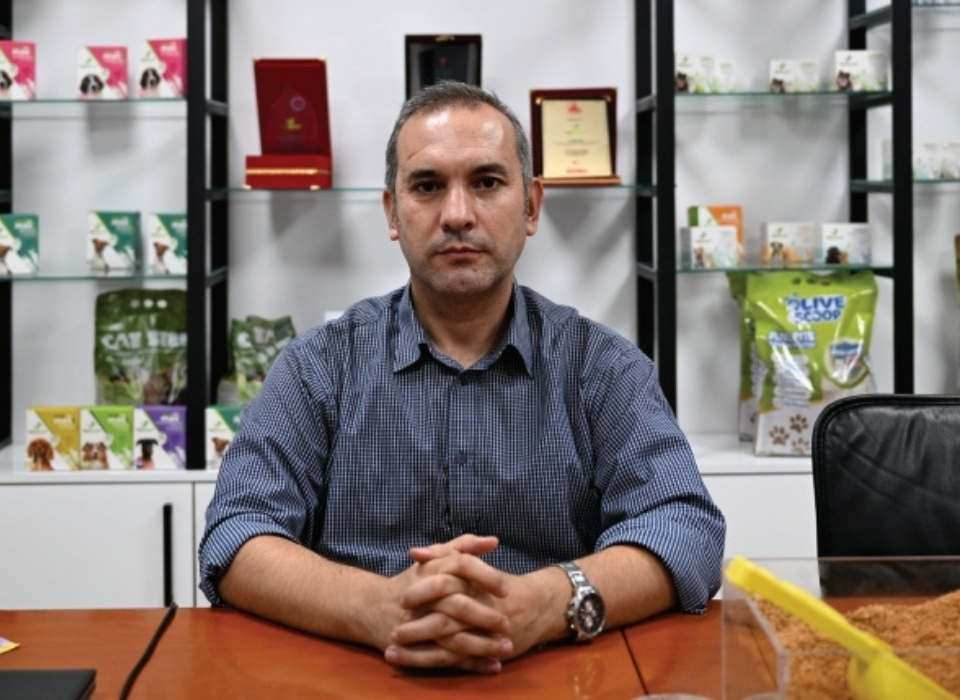
Under the leadership of Project Manager Dr. Emrah Giziroğlu, PG Kimya has successfully addressed significant environmental and economic concerns by transforming olive pits, a common agricultural byproduct, into cat litter. Initially a corporate social responsibility initiative, this innovative project has scaled to high-volume production and comprehensive exports to six countries, including the United States, United Kingdom, and Canada. We spoke with Dr. Emrah Giziroğlu about the project details and PG Kimya's future plans.
Could you briefly introduce yourself to our readers by discussing your education and professional career?
My education began in the Chemistry Department at Muğla University. I subsequently completed my master's degree, doctorate, and postdoctoral studies at Adnan Menderes University and University of California Riverside. Until 2017, I continued my academic career at university, during which I took part in various research projects and conducted numerous scientific studies. In 2017, I made the transition to the private sector and chose a different career path. Since 2019, I have been working within Polat Group Holding. Here, I focus on sustainability and circular economy, particularly developing value-added products from agricultural waste. Environmental sustainability and innovation have been two core elements on which I have concentrated throughout my career.
Circular economy and sustainability are increasingly prominent across all industrial sectors. Often, a byproduct or waste with limited economic value can become a value-added product when viewed from a different perspective. In this context, could you discuss your work on converting olive pits into cat litter? What advantages does this product offer?
Circular economy and sustainability have become indispensable elements of today's industry. Byproducts and waste with limited economic value can deliver substantial environmental and economic benefits when transformed through creative solutions. We developed our olive pit to cat litter conversion project with this understanding. What initially began as a corporate social responsibility initiative saw strong demand both domestically and internationally, prompting us to launch high-volume production. We are currently exporting extensively to six countries, primarily the United States, United Kingdom, and Canada. Olive pits are normally considered a byproduct used as fuel. However, through appropriate processing, these pits can be transformed into value-added products such as cat litter. The product we obtain from this conversion addresses serious problems in the cat litter sector. As a natural material, olive pits are biodegradable and environmentally friendly, causing no environmental harm. Unlike synthetic cat litters, they leave no toxic residue when they break down in nature. The most important characteristic of the cat litter we produce from olive pits is that it is completely dust-free. We have verified this in accredited laboratories both domestically and internationally, and as far as we know, it is the first cat litter approved by international laboratories to contain 0% dust content. This characteristic is very important for cats and owners with health issues and is highly appreciated both domestically and internationally. Cat litter produced from olive pits stands out for its high clumping properties. This characteristic provides more effective hygiene as cats use the litter box and aids in odour control. Due to its natural structure, it minimizes odour formation and provides a fresher atmosphere in the home. The utilization of agricultural byproducts such as olive pits adds value to both the agricultural sector and the circular economy sector. This contributes to waste management and environmental sustainability goals. Our olive pit to cat litter production project can be considered an important step towards environmental sustainability and waste management. Through such innovative projects, we will continue to develop solutions that are compatible with nature's cycles, environmentally friendly, and economically sustainable.
Could you provide information about the global market size for this product? Are you planning to offer key turnkey systems for industrial facilities that wish to produce this product?
The cat litter market is growing rapidly as pet ownership rates increase and interest in pet care rises. As of 2023, the global cat litter market is estimated to have reached approximately USD 10 billion, with an estimated annual growth rate of around 5%. Although the cat litter market is dominated by cat litters produced from bentonite mining, demand for natural and environmentally friendly products is also increasing steadily. Cat litter produced from olive pits stands out as a product capable of meeting this demand.
I would like to briefly summarize the basic solution systems we plan to offer for industrial facilities wishing to produce these and similar products. Raw material supply and processing systems consist of several basic steps. The first step is olive pit procurement, which focuses on establishing sustainable supply chains from regional and international olive producers. This is followed by cleaning and drying, where olive pits are cleaned and brought to appropriate moisture levels.
In terms of production technologies, the process includes grinding and granulation, which converts olive pits into granules of appropriate size for cat litter. This is followed by heat treatment and stabilization, where granules are made stable and long-lasting through heat treatment.
Quality control systems are necessary to ensure the product meets high standards. Laboratory tests are conducted to ensure the produced cat litter meets criteria such as absorbency, dust content, odour control, and biodegradability. Certification and standardization ensure the product complies with international quality standards. Packaging and logistics solutions focus on environmentally friendly packaging and building an effective logistics network. Environmentally friendly packaging involves the use of recyclable and biodegradable materials, while an effective logistics network ensures the product reaches the global market quickly and safely. Finally, market and sales strategies are crucial to product success. Market research and analysis identify target markets and analyse their needs. Branding and promotion involve developing marketing strategies that emphasize the product's environmentally friendly and innovative features. Within this scope, by offering integrated and comprehensive solutions to industrial facilities, we aim to expand organic cat litter production and bring these and similar innovative products to the global market.
Could you discuss PG Kimya's future strategies? Will you have similar circular economy projects?
We will continue to develop innovative and ecological products while prioritizing environmental sustainability. Alongside our current products, we will develop new products to strengthen our position in the global market. Through international collaborations and partnerships, we aim to reach a broad customer base worldwide. Additionally, as PG Kimya, we currently produce industrial-scale supercritical extraction systems within Polat Group Holding and wish to obtain value-added products from byproducts generated, particularly in the food industry. In this context, bioactive compound extraction from the aforementioned waste and plant protein purification are among our main areas of interest.
We are conducting intensive R&D work in many areas. For example, Bioplastic Production from Agricultural Waste involves producing biodegradable plastics by utilizing agricultural waste. This project focuses on developing environmentally friendly packaging materials. Fertilizer Production from Food Waste involves converting waste generated in the food industry into organic fertilizer through composting. This way, we plan to provide the agricultural sector with a valuable recycled product. Electronic Waste Recycling aims to recycle electronic waste to prevent environmental harm and enable the reuse of valuable metals and components they contain. Construction Material Production from Plastic Waste involves evaluating plastic waste to produce durable and environmentally friendly construction materials for the construction sector.
As PG Kimya, we believe that through our environmental sustainability and innovation-focused strategies, we will play a pioneering role in the sector. Through our innovative projects and integrated solutions, we will continue to contribute to both the environment and the economy.
What developments do you expect to see in the circular economy field in the near and long term? Could you evaluate this particularly from the chemical industry perspective?
In the near term, we expect to see the widespread adoption of advanced separation and recovery technologies in the circular economy field. Chemical recycling methods in particular will help achieve more effective recovery of plastic waste. Biotechnological applications will enable the biodegradation of plastic and organic waste using specific enzymes and microorganisms. Different solution approaches will be developed particularly in industries that play a major role in the consumption of the world's clean water resources. For example, sectors requiring intensive water such as textile dyeing will transition to supercritical carbon dioxide dyeing systems. In wastewater treatment facilities, the recovery and reuse of chemical substances through biological methods will increase.
In the long term, advanced recycling technologies will enable the complete recovery of plastic and composite materials. The chemical industry will increase the use of bio-based and compostable materials in place of petrochemical-based plastics. Industrial symbiosis models will enable waste to be used as raw material between different industries. Stricter regulations on global recycling and waste management will be implemented. I believe the chemical industry will continue to develop environmentally friendly and economically efficient recycling solutions by adapting to these developments.
Gallery