Evaluation of Next-Generation Coating Systems in the Powder Coating Sector in Terms of Formulation, Thermal Behavior and Performance Properties

1. Introduction
Powder coating technology has been developed as an alternative to solvent-based coating systems; it is a surface technology used in fields such as automotive, white goods, architectural aluminum, metal furniture, machinery and electrical-electronics. It greatly reduces VOC emissions. However, environmental performance cannot be measured solely by the absence of solvents; curing temperature, baking time, overspray recovery, material efficiency, coating lifetime and production energy also determine the overall impact. Therefore, powder coating systems should be evaluated holistically on the axis of thermal behavior, physical properties, curing kinetics, surface performance and energy efficiency.
ASTM D3451-24 provides guidance for testing powder coatings and coating powders [1]. The ISO 8130 series covers powder properties such as particle size, density, gel time, flow behavior and storage stability [2-5]. These standards are a prerequisite for producing reproducible and comparable data at the industrial scale.
In this study, the effect of different ratios of binder, hardener, pigment, mineral filler and functional additives on coating performance in a polyester-based powder coating system was examined through three formulations: reference (F1), high filler (F2) and optimized (F3). The aim is to demonstrate that high performance can be achieved not merely by increasing resin content, but by optimizing the balance between resin, hardener, filler and additives [6,7].
2. Materials and Method
Within the scope of the study, three polyester-based powder coating formulations were designed. The formulations were created by varying the binder ratio, mineral filler amount and functional additive levels.
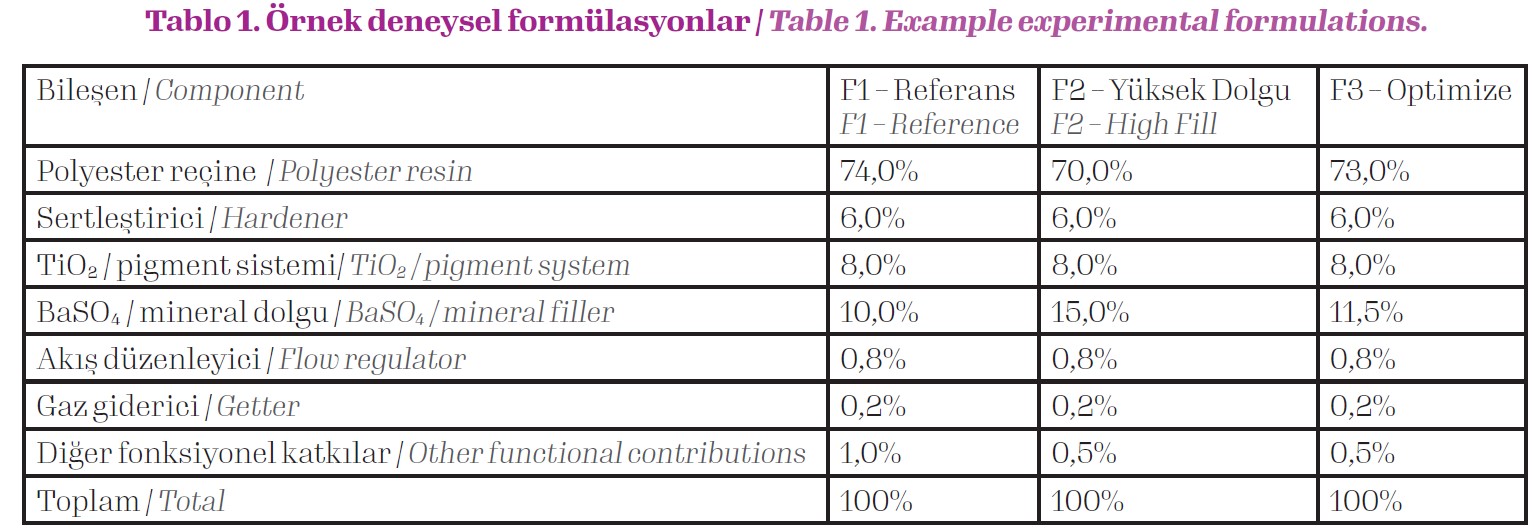
The ratios represent a sample research design. Prior to actual production, they must be verified against the acid value of the resin, the functionality of the hardener and stoichiometric equivalence. The hardener ratio should be determined not merely by weight percentage, but by reactive group equivalence; otherwise under- or over-curing will occur [6].
The components were weighed, homogenized by extrusion after pre-mixing, cooled, crushed and ground. A dry film thickness of 60–80 µm was targeted on metal panels after electrostatic application. The reference curing was 180 °C × 15 min; for low-temperature potential, 160 °C × 15 min and 170 °C × 10 min were compared. Temperature should be verified based on the actual metal temperature of the sample rather than the oven air temperature [7].
Functional groups and changes before/after curing should be assessed with FTIR; Tg, onset of curing, exothermic peak and ΔH cure with DSC; thermal stability and decomposition with TGA; particle size, density, gel time; and film thickness, adhesion, hardness, impact resistance, gloss, chemical resistance and corrosion tests should be performed [1-5].
3. Findings and Discussion
FTIR is used to identify the functional groups in the formulation and to monitor chemical changes before and after curing. In polyester systems, C=O, C–O, C–H and aromatic C=C bands, as well as bands associated with the hardener, are evaluated. A decrease in reactive groups after curing provides supporting information regarding cross-linking [8].
Tg, onset of curing, exothermic peak and ΔH cure are determined with DSC; thermal stability, mass loss temperatures, maximum decomposition temperature and residue amount are determined with TGA [6].
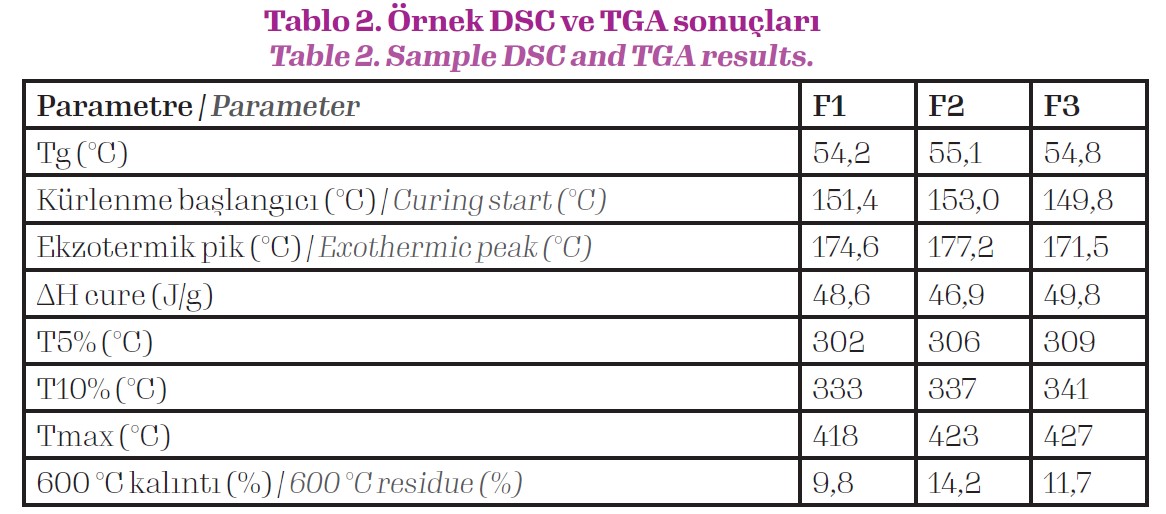
Note: The values are not actual measurements; they illustrate a sample data structure. In F3, the shift of the exothermic peak to a lower temperature indicates a potential for low-temperature curing with suitable kinetics [6]. The higher T5%, T10% and Tmax values of F3 indicate the thermal stability of the organic phase [7]. The high residue in F2 is due to the increased mineral filler; on its own, it does not mean good thermal performance [8].
Particle size distribution affects electrostatic charging, transfer efficiency, surface appearance and film thickness. In the sample distribution, D10 is in the range of 9.5–10.4 µm, D50 33.8–36.1 µm, and D90 74.8–79.5 µm. ISO 8130-1:2019 defines the sieving method [2]. A D50 range of 33–36 µm is suitable for industrial electrostatic spraying; keeping D90 below 80 µm reduces surface roughness [9]. Gel time is an indicator of curing reactivity; ISO 8130-6:2021 defines this measurement [5]. Storage stability is the ability of the powder to be stored without caking under humidity, temperature and pressure [3,4].
Increasing the filler amount from 10% to 15% can reduce raw material cost. With resin at €2.50/kg and filler at €0.30/kg, replacing 4% of the resin with filler:
Cost advantage = 0.04 × (2.50 – 0.30) = €0.088/kg
provides a theoretical advantage. However, increasing filler content can dilute the resin phase, disrupt surface flow, reduce gloss, weaken mechanical properties and adversely affect film formation. The target should not be maximum filler, but optimum filler [6,8].
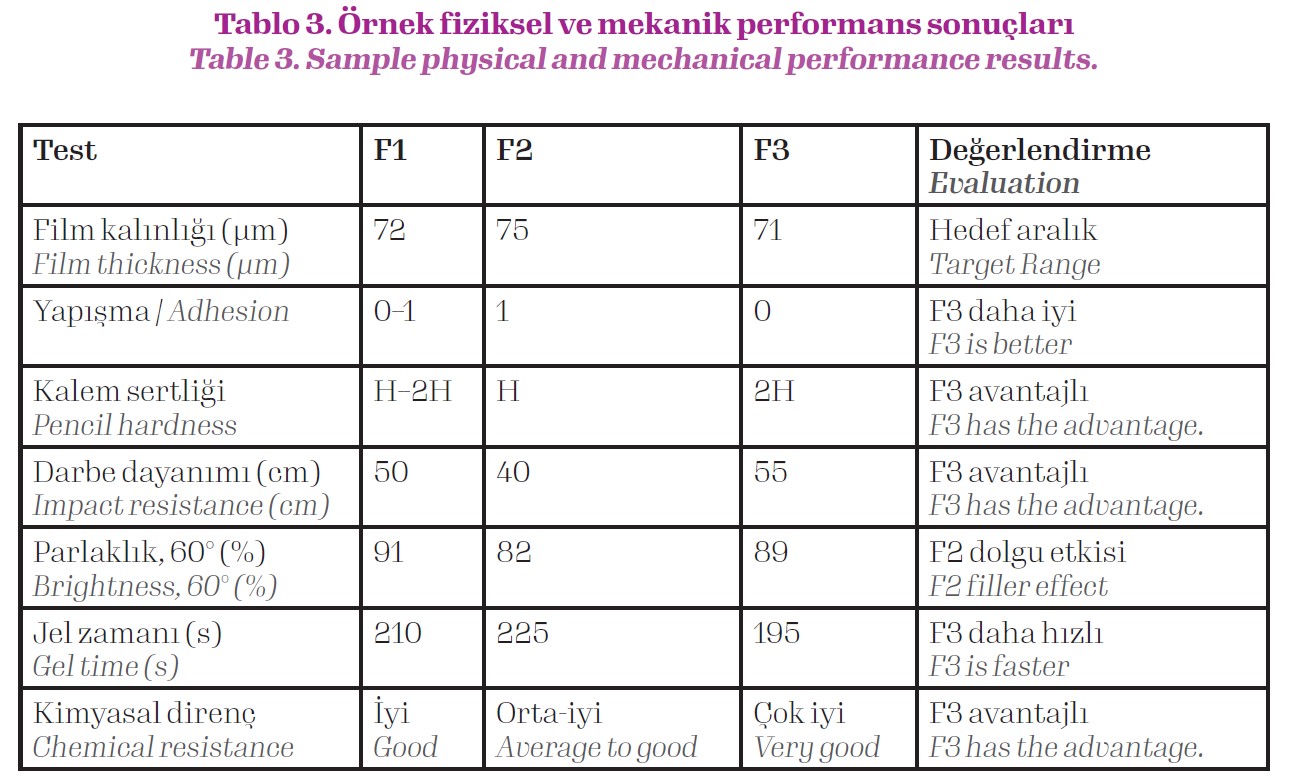
Note: This table is not actual measurement data; it should be replaced with real experimental results. ASTM D3451-24 emphasizes that test selection requires evaluation dependent on application and chemistry [1]. While F3 offers a balanced profile, the increased filler in F2 reduced gloss and impact resistance [6].
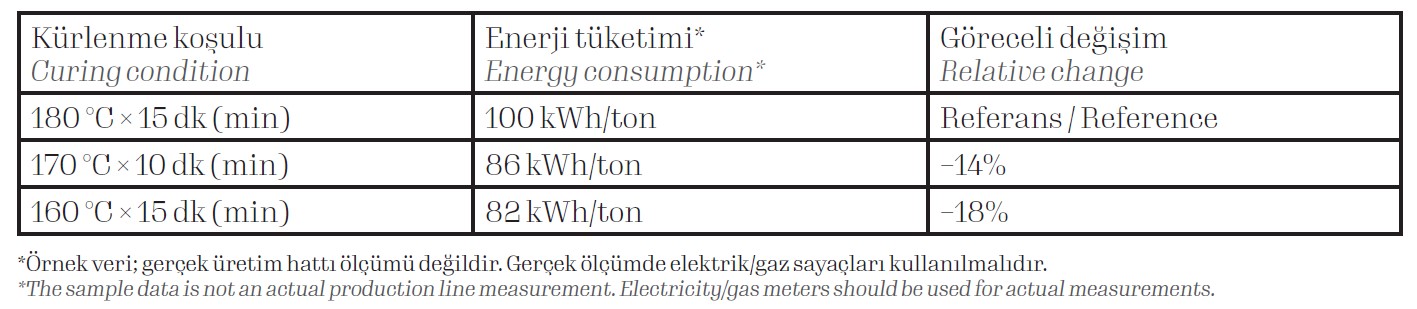
Oven energy consumption depends on curing temperature, oven volume, line speed, product load and insulation. Lowering the temperature from 180 °C to 160–170 °C creates energy saving potential. Actual savings should be measured as kWh/ton of coated product or kWh/m² of coated surface [7].
Corrosion resistance determines industrial use value. Neutral salt spray, cyclic corrosion, humidity resistance and corrosion progression after adhesion should be evaluated together. “How many hours did it withstand?” alone is not sufficient; corrosion spread + blistering + adhesion loss + film integrity should be reported together [1].
Performance cannot be reduced to a single parameter. The optimization sequence should be established as:
Resin ratio → Hardener equivalence → Filler ratio → Particle distribution → Curing → Film formation → Mechanical/chemical performance
In this way, it can be objectively determined whether performance is maintained while cost is reduced [6,7]. Laboratory success may not yield the same result on the production line. Extrusion capacity, grinding efficiency, spraying equipment, oven heat transfer and line speed must be taken into account during scale-up. Economic evaluation should not be limited to raw materials alone; labor, energy, waste, recovery, maintenance and quality control should also be included in total cost. In terms of sustainability, low-temperature curing, overspray recovery and long-lasting coatings stand out. Although mineral filler appears advantageous, mining, processing and transportation effects should also be evaluated [8,9].
4. Conclusion and Recommendations
Optimum performance cannot be achieved solely with high resin or high filler content; the balance of binder–hardener–pigment–filler–additive must be designed. Increasing filler content can provide a cost advantage; however, the optimum level must be determined in terms of surface flow, gloss, mechanical properties and film integrity [6,7].
DSC and TGA are critical tools for determining curing and thermal stability in next-generation powder coatings. FTIR monitors chemical change. Control of particle size, density, gel time and storage stability is necessary for industrial continuity; the ISO 8130 series covers these characterizations [2-5].
In the future, the goal should not be “lower cost” but “higher performance per unit cost.” Low-temperature curing, short duration, high corrosion resistance, long lifetime, low energy use and low environmental impact should be optimized together. In Türkiye, through university-industry collaborations, new resin systems, functional fillers, low-temperature curing formulations and digital process control systems can increase the competitiveness of the coatings sector [8,9]. Powder coating should be regarded as a high-value-added technology field at the intersection of energy efficiency, advanced materials science, surface engineering and sustainable production.
References
[1] ASTM International. ASTM D3451-24, Standard Guide for Testing Coating Powders and Powder Coatings. ASTM International, 2024.
[2] ISO. ISO 8130-1:2019, Coating powders — Part 1: Determination of particle size distribution by sieving.
[3] ISO. ISO 8130-2:2021, Coating powders — Part 2: Determination of density by gas comparison pycnometer.
[4] ISO. ISO 8130-3:2021, Coating powders — Part 3: Determination of density by liquid displacement pycnometer.
[5] ISO. ISO 8130-6:2021, Coating powders — Part 6: Determination of gel time of thermosetting coating powders at a given temperature.
[6] Misev, T. A. (1991). Powder coatings: chemistry and technology. (No Title).
[7] Jones, F. N., Nichols, M. E., & Pappas, S. P. (2017). Organic coatings: science and technology. John Wiley & Sons.
[8] Tracton, A. A. (Ed.). (2005). Coatings technology handbook. CRC press.
[9] Li, L., Xu, L., Yang, M. S., Huang, J., Zhang, H., & Zhu, J. (2022). A novel method to formulate pigmented powder coatings by ultrafine powders. Powders, 1(4), 221-230.
Gallery
Advertisement
Ad Space728 × 90