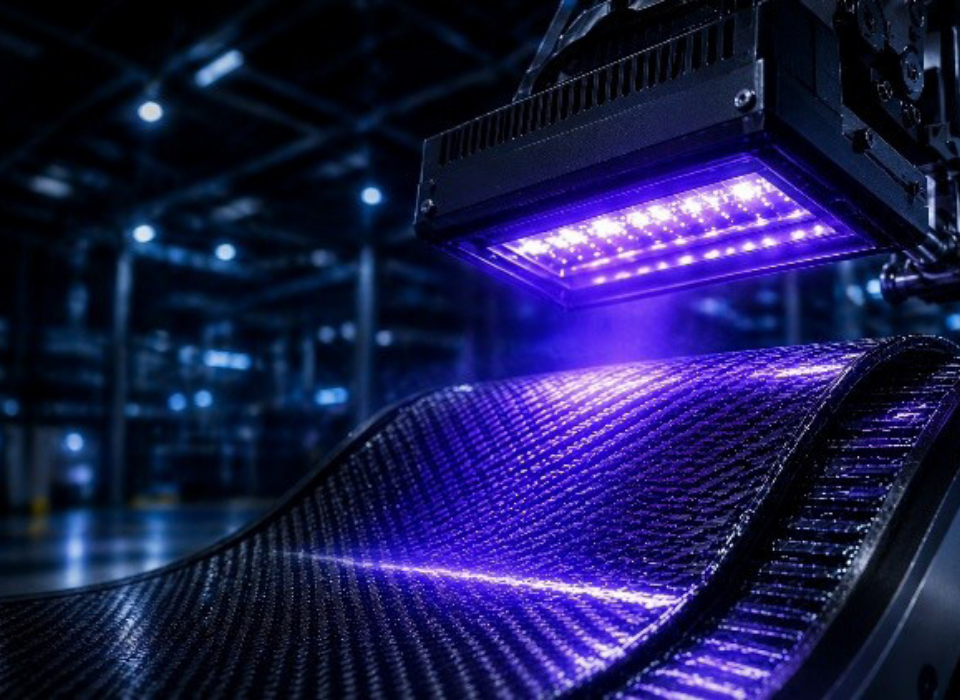
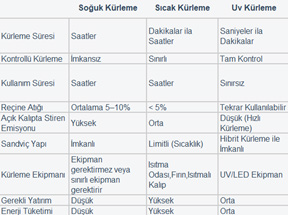
Ultraviolet (UV) curing is emerging as a strong alternative to conventional cold and thermal curing methods in the production of fiber-reinforced polymer composites. The replacement of classic peroxide-initiated curing mechanisms with UV-initiated photopolymerization offers manufacturers significant advantages.
Ultraviolet (UV) curing has emerged as a strong alternative to conventional cold and thermal curing methods in the production of fiber-reinforced polymer composites. The replacement of classic curing mechanisms initiated by peroxides with photopolymerization initiated by UV offers significant advantages to manufacturers.
In particular, combinations of the Omnirad series photoinitiators and Photomer series monomers and oligomers developed by IGM Resins have a significant impact on the efficiency and mechanical performance of UV curing systems.
Through this technology:
- Processing times are significantly reduced
- Curing time is fully controlled
- Energy consumption and emissions are reduced
- Mechanical performance of the final product is preserved
UV curing plays an important role, particularly in the transition toward sustainable production and efficiency-focused operations.
UV Curing in Composite Applications
UV curing is based on initiating the polymerization reaction by exposing the resin system to ultraviolet light. This technology can be integrated into many production methods:
- Wet lay-up
- Vacuum infusion with UV-transparent membranes
- Filament winding
- Prepreg processing
- Pultrusion
- Open mold and hand lay-up
- Cured-in-place pipe systems (CIPP)
The most critical requirement in this process is for UV light to reach the resin. This can be achieved directly or through a UV-transparent barrier. Common UV sources include mercury arc lamps and UV LED systems. UV LED technology offers advantages in curing thick and reinforced composites due to its longer wavelengths.
Curing Mechanisms and Technical Approach
UV-curable systems contain photoinitiators that absorb light and create reactive species. Two fundamental mechanisms exist:
- Radical polymerization (vinyl ester, acrylate and unsaturated polyester systems)
- Cationic polymerization (epoxy systems)
Common challenges encountered in radical polymerization with UV curing composites include:
- Achieving complete cure in thick laminates
- Equivalent mechanical performance to peroxide systems
- Oxygen inhibition (particularly on the surface)
- Homogeneous light distribution in three-dimensional parts
Experimental Study and Systems Used
IGM Resins examined the performance impact of different photoinitiator combinations such as Omnirad TPO-L, Omnirad 819, Omnirad 2100, and Omnirad 2022 in their studies.
Resins tested:
- ISO NPG resin
- Vinyl ester resin
- Styrene-free vinyl ester resin
Tests performed:
- Pure resin castings (4 mm) → Barcol hardness and mechanical verification
- Laminate production (~4 mm, vacuum infusion) → ILSS measurement
- Cure depth tests (up to 15 mm)
Conclusions and Assessment
When sufficient UV energy is delivered to the resin:
- Peroxides such as MEKP and BPO can be replaced with photoinitiators
- Mechanical properties achieved with UV curing can be equivalent to traditional systems
- Hybrid systems enable broader application areas
Overall, UV curing in the composites sector is:
- Faster
- Cleaner
- More controlled
Results demonstrate that UV and UV LED curing methods achieve the mechanical performance of conventional methods while reducing processing times from 20 minutes to just a few seconds.
By presenting a production model, it holds a strong position among the technologies of the future.
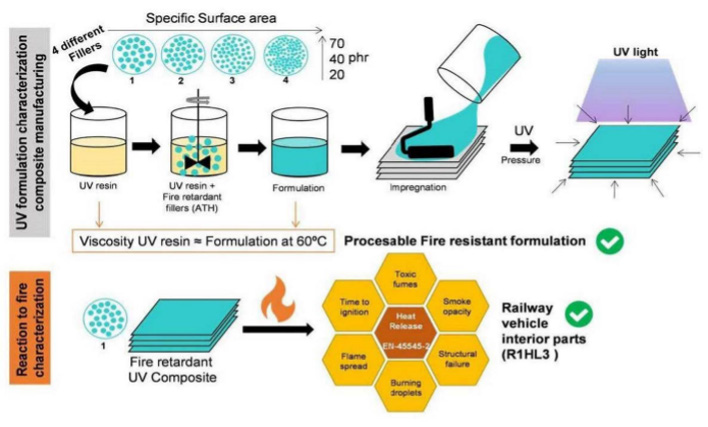
UV curing technology represents a significant transformation in composite manufacturing in terms of speed, energy efficiency, and process control. Today, thanks to advanced photoinitiator and energy-cured resin technologies, UV systems can achieve mechanical performance levels competitive with traditional peroxide-based curing methods. The development of UV LED technology in particular provides significant advantages to composite manufacturers with low energy consumption, low heat load, and high process speeds.
In this transformation, IGM Resins, one of the world's leading suppliers in the energy curing field, positions itself among the companies guiding the sector with the Omnirad®, Photomer®, and Omnipol® product groups it has developed. In particular, Omnirad products that provide high deep-cure performance in thick-section and pigmented composite structures offer high process reliability in UV composite applications.
Omnirad 2022, which is LED-compatible and has high reactivity, stands out with balanced surface and deep cure performance in pigmented systems and thick laminate applications, while Omnirad 2290 delivers effective results particularly in composite formulations requiring high reactivity and low yellowing. For transparent and low-coloration systems, Omnirad 1000 is preferred due to its fast cure performance and process compatibility.
Additionally, IGM Resins' Photomer product family contributes to the development of high-performance formulations in filament winding, pultrusion, and continuous composite production lines by providing high mechanical strength, chemical resistance, and low viscosity balance in composite applications. Through next-generation photoinitiator and oligomer solutions fully compatible with UV LED systems, energy consumption and VOC emissions are reduced while production speeds and process efficiency are increased significantly.
Evaluating all these developments, UV curing technology is becoming not just an alternative production method in the composites sector, but one of the core technologies of sustainable, fast, and highly efficient manufacturing. IGM Resins' innovative product portfolio and technical expertise position it as an important solution partner in the transition of composite manufacturers to higher-performance and environmentally friendly production processes.
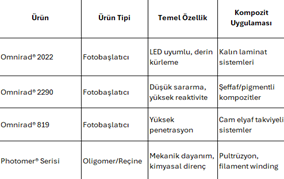
Table 1: Featured IGM Resins Products for Composite Applications
Sources
IGM Resins, "Unique photoinitiator combinations for UV curing composites," 2025. [Online]. Available: https://www.igmresins.com/en/news-events/unique_photoinitiator_combinations_for_uv_curing_composites
Gallery