Despite its long-established position in the coatings, adhesives, sealants and elastomers (CASE) sector, regulatory pressure on polyurethane chemistry is steadily increasing: permissible workplace exposure limits for isocyanates are being lowered, solvent-free alternatives are being sought, and many raw materials and additives are being banned. This is driving demand for new technical solutions, particularly hardeners with ultra-low monomer content and even isocyanate-free systems. VOC limits and enforcement continue to push the shift toward high-solids and water-based systems, though these options often involve trade-offs in viscosity, spreadability and curing. While raw material variability and the introduction of bio-based feedstocks offer new options, for many formulators they can also mean sacrificing simplicity, clarity and performance.
Introduction
Despite its well-established and entrenched position in the coatings, adhesives, sealants and elastomers (CASE) sector, regulatory pressure on polyurethane chemistry is mounting steadily: permitted workplace exposure limits for isocyanates are being lowered, solvent-free alternatives are being sought, and many raw materials and additives are being banned. This situation is driving demand for new technical solutions in particular, such as hardeners with ultra-low monomer content and even isocyanate-free systems. VOC limits and sanctions continue to drive the shift toward high-solids and water-based systems, though these preferences often entail trade-offs in terms of viscosity, leveling and cure. While raw material variability and the introduction of bio-based raw materials offer new options, for many formulators this can mean sacrificing simplicity, clarity and performance.
Technical innovation in coatings often focuses, for example, on better understanding and designing the interface between the coating material and substrate. Hybrid network structures, combining urethane/urea segments with other polymer backbones, such as siloxane or silane, generally improve the retention of adhesion strength under UV, moisture and thermal cycle conditions. The goal is to provide long-term adhesion to metals, mineral substrates and low-surface-energy plastics without sacrificing core film properties. Moreover, better control of catalysis and co-crosslinking is another key element in developing safer and more innovative products and technologies. Amine crosslinkers—such as polyaspartic amines and silane-modified amines—are promising auxiliary resin components for tailoring pot life, cure profile, surface properties and resistance to chemicals and water.
Another area of active research is finding suitable alternatives to low-molecular-weight fluorocarbon additives (PFAS), on which regulatory bodies worldwide have imposed bans and restrictions. Strategies for developing solutions to replace PFAS focus on polysiloxane chemistry designed with specialized secondary functional groups. Chain structure and functionality are tailored to provide low friction, easy cleanability, as well as hardness and chemical resistance, while preserving strong substrate adhesion and outdoor weatherability.
No single solution encompasses all systems, so selection and validation for each application remain critical, but it is now quite clear that the flexibility of solutions and formulation components will play an increasingly important role in the sector's future trends and solutions.
Siloxene – A Unique Multi-Functional Platform of Innovative Tools for Formulators:
Siloxene AG is a Swiss technology company introducing a unique category to the market consisting of new chemical building blocks called "Q–T polysiloxane hybrid resins." Offering a wholly unique technological approach to regulating interface chemistry and crosslinking at the molecular level, this platform enables the creation of custom-designed interfaces by linking silicate–siloxane backbones with conventional resin chemistries. This allows formulators to make much finer adjustments to adhesion, wettability, surface free energy, crosslink density and cure rate. Rather than imposing a choice between ease of manufacturing and application versus performance, Siloxene's chemistry can combine multiple properties into a single raw material; considerable benefits emerge across the polyurethane value chain—coatings, adhesives, sealants and elastomers.
In short, the hybrid Q–T polysiloxane building blocks expand the formulation window; thereby enabling durability, adhesion and surface functionality with fewer trade-offs. Below, we present three independent technical solutions for the polyurethane sector; we will introduce the main products and their specific benefits and applications.
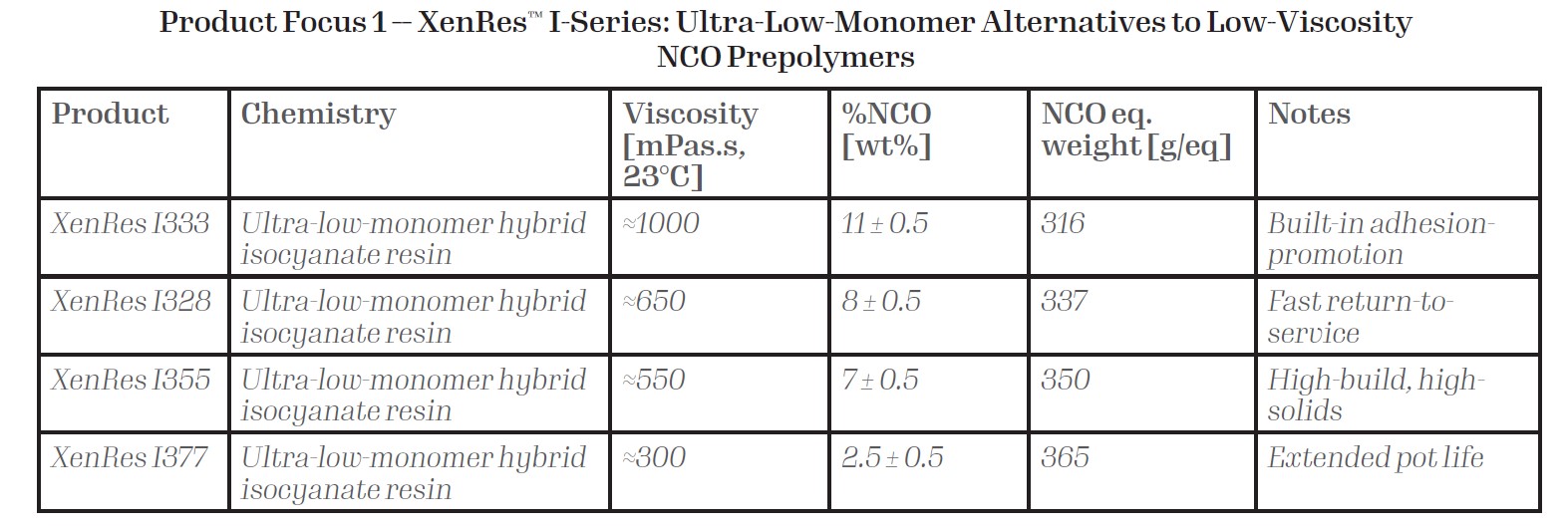
Product Focus 1—XenRes™ I-Series: Ultra-Low-Monomer Alternatives to Low-Viscosity NCO Prepolymers
What is it?
XenRes I-Series hybrids are NCO-functional silicate–siloxane resins; polyisocyanate-derived Q–T polysiloxane materials designed as ultra-low-monomer alternatives with built-in secondary properties for formulators needing the highest-performing, low-viscosity NCO prepolymers. Easy process integration and safer use combine with high solids content, low viscosity and an embedded adhesion-promoter package. When used on mineral or metal substrates, this supports rapid strength development of the substrate bond and excellent water resistance.
Why is it Important for Formulators?
As permitted workplace exposure limits for free monomers tighten, the market's need is for hardeners that reduce risk and do not compromise on ease of use. The I-Series directly closes this gap: while behaving like a prepolymer in the can, it creates a hybrid urethane–siloxane network structure in the film.
The result is reliable spray and roller application, strong early hardness development and long-term durability profiles that match or exceed existing systems; it also points toward a path to reducing free monomer levels and simplified regulatory compliance.
Typical Applications:
-2K PU varnishes, DTM coatings for steel and aluminum,
-Coatings over mineral and ceramic substrates,
-Coatings for pipeline and tank interiors and concrete structures and flexible sealants,
-Hybrid adhesive/sealant systems with very high water and weathering resistance properties.
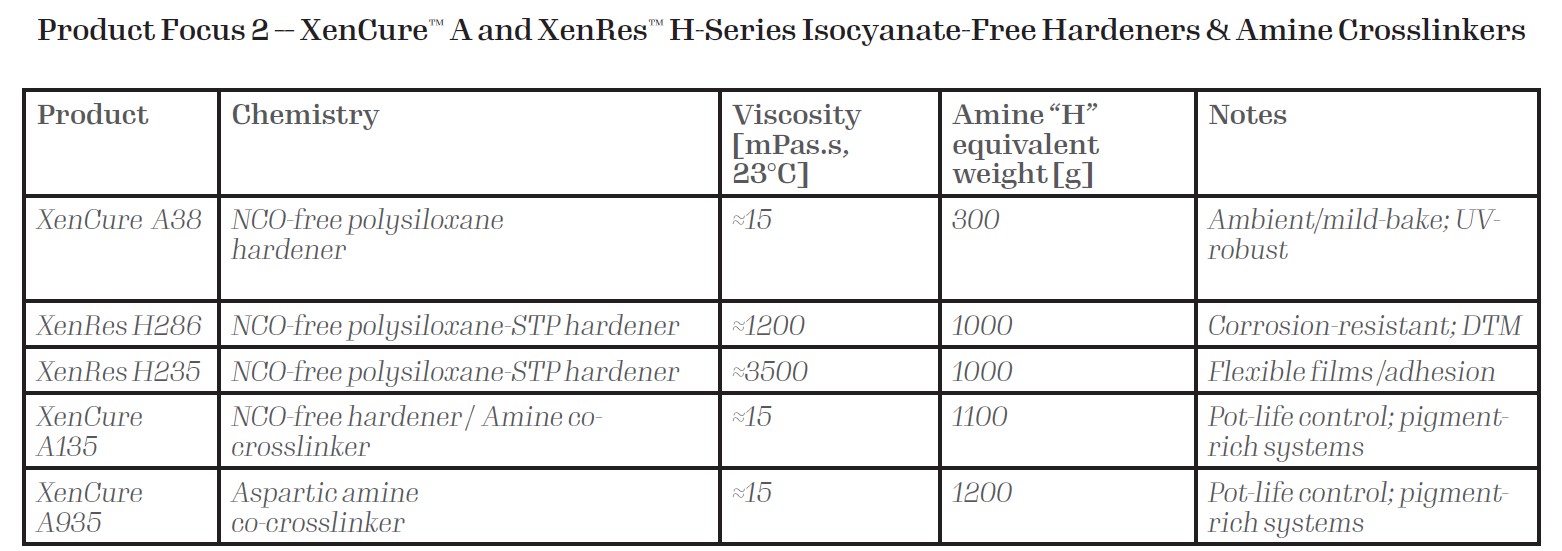
Product Focus 2 — XenCure™ A and XenRes™ H-Series: Isocyanate-Free Hardeners and Amine Crosslinkers
What is it?
Siloxene's isocyanate-free hardeners (XenCure A and XenRes H series) establish siloxane–silicate condensation networks with hydroxyl-functional polyols, creating dense and UV-resistant films without using any NCO hardeners. The same resins (particularly XenCure A polyaspartic resins) can also be used as co-crosslinkers in PUA/PU systems.
On the one hand, it enables coating manufacturers to formulate isocyanate-free 2K coatings; on the other hand, it enables fine-tuning of pot life, rheology and concurrent development of multiple properties in standard isocyanate-based formulations.
Why is it Important for Formulators?
Beyond obvious advantages such as labeling and ease of use, our isocyanate-free systems offer an attractive alternative to isocyanate-based coating products without using costly organic cyclic carbonates like classical isocyanate-free polyurethane chemistry. In addition, XenCure A / XenRes H hardener chemistry delivers not only superior adhesion and surface properties, but also hydrolysis and outdoor weatherability resistance.
When used as a co-crosslinker, these products allow fine-tuning of cure and improve pigment and filler compatibility and tolerance. Both approaches are designed to fit into conventional 2K workflows. Components and processing steps (e.g., mix ratios, equipment use, fixation and final cure) are compatible with existing workflows; this guarantees easy integration.
Typical Applications:
-DTM (direct-to-metal) coatings, primers,
-Coil and metal can coatings, topcoats, protective coatings, surface finishes,
-OEM (original equipment manufacturer) parts with complex geometries,
-Architectural and exterior facade coatings,
-Various 2K or pseudo single-component (1K) adhesives.
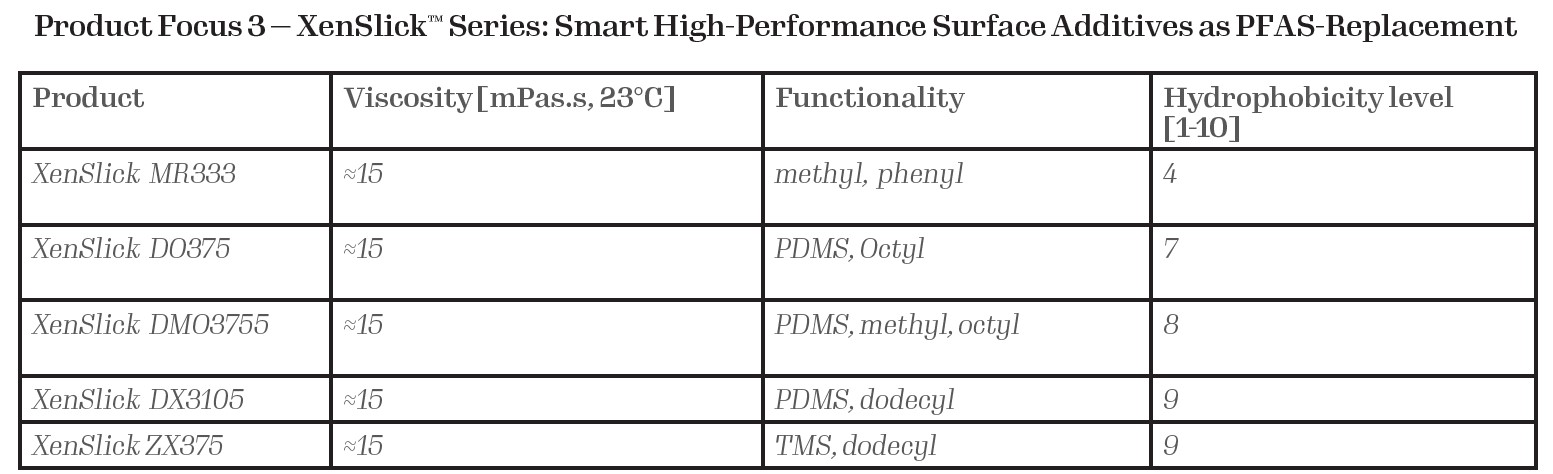
Product Focus 3 — XenSlick™ Series: Smart High-Performance Surface Additives Developed to Replace PFAS
What is it?
The XenSlick™ surface additive series comprises alkyl/aryl and silicone-functionalized Q–T polysiloxanes designed to replace PFAS-based surface additives in a wide range of applications. These products target hydrophobic and oleophobic behavior, low friction, adjustable surface free energy along with abrasion and chemical resistance. These additives can be customized to integrate seamlessly into any binder chemistry (PU, epoxy, STP, UV-curable); they can even be modified to bind covalently to the binder.
Why is it Important?
As the sector gradually moves away from persistent "forever chemicals," formulators need reliable alternatives that come as close as possible to previous PFAS. XenSlick™ surface additives meet this need by providing durable and smart alternatives that offer high flexibility in fine-tuning properties. These are available across a broad range of formulations and chemistries and can be customized to best suit your specific requirements.
Typical Applications:
-MRO (maintenance, repair and overhaul) coatings and protective coatings
-Concrete protection and architectural coatings
-Floor topcoat finishes
-Sealants and elastomers
-Polyurethane foams
Discover the Siloxene Platform
Siloxene's value proposition is not a single product or solution, but a high-value-added platform technology. By tuning the multi-functional Q–T polysiloxane backbone and combining it with embedded resins, hardeners or additives, entirely new solution approaches become possible. A team of experienced experts and engineers, in the early stages of this innovation, ensure understanding and regulation of wettability, adhesion, cure and other properties related to performance at the molecular level. This unique knowledge base translates into greater freedom in formulation: use ultra-low-monomer hybrid isocyanates where manufacturing and application ease and performance are critical, choose an NCO-free solution path where exposure risks are high, or simply enhance your product with a PFAS-free surface additive. Siloxene delivers fewer unnecessary trade-offs, rapid integration and first-class R&D support to help you reach your objectives.
The sector is focusing on sustainable and non-toxic alternatives, products and solutions. Do not fall behind; contact our experts today for samples, technical consulting or custom development requests.
Siloxene AG · Zürichstrasse 38 · CH-8306 Brüttisellen · Switzerland
ARA Kimya · Ataşehir · Istanbul · Turkey
Exclusive Distributor MENA Region
[email protected] · www.arakem.com

Gallery