
A dispersing agent is a paint raw material used to prevent the flocculation of pigments and fillers, stabilizing the suspension of solid particles in the paint medium. The choice of dispersing agent will significantly affect the quality of the dispersion's grinding time, viscosity, color strength, hiding power, gloss and stabilization properties. Dispersants function by reducing the attraction between solid particles such as pigments, fillers or additives. This prevents the solid particles from clumping together or settling.
Introduction
A dispersing agent is a paint raw material used to prevent flocculation of pigments and fillers, and stabilizes the suspension of solid particles in the paint medium. The selection of dispersing agent will significantly affect the grinding time of the dispersion, viscosity, color strength, opacity, gloss and stabilization properties. Dispersants function by reducing attraction between solid particles such as pigments, fillers or additives. This prevents agglomeration or breakdown of solid particles.
At this point, Add Dispers RC 40A stands out as a high-performance dispersing agent, optimized especially for systems with high PVC ranges of 80–85%, with its polyacrylic acid-based advanced structure.
Function of the Dispersing Agent
When solid particles are added to any liquid medium, they tend to attract each other due to intermolecular forces. All commercially used pigments and fillers have an agglomerate structure. During the grinding process in construction paint production, mechanical energy converts agglomerates into physically smaller particles. Upon completion of the grinding stage, agglomerates have transformed into primary pigment particles. These particles have a high tendency to revert to agglomerates. To become stable, the system tends to shift from high-energy to low-energy state. For this reason, dispersing agents are used to prevent flocculation formation and achieve stabilization.
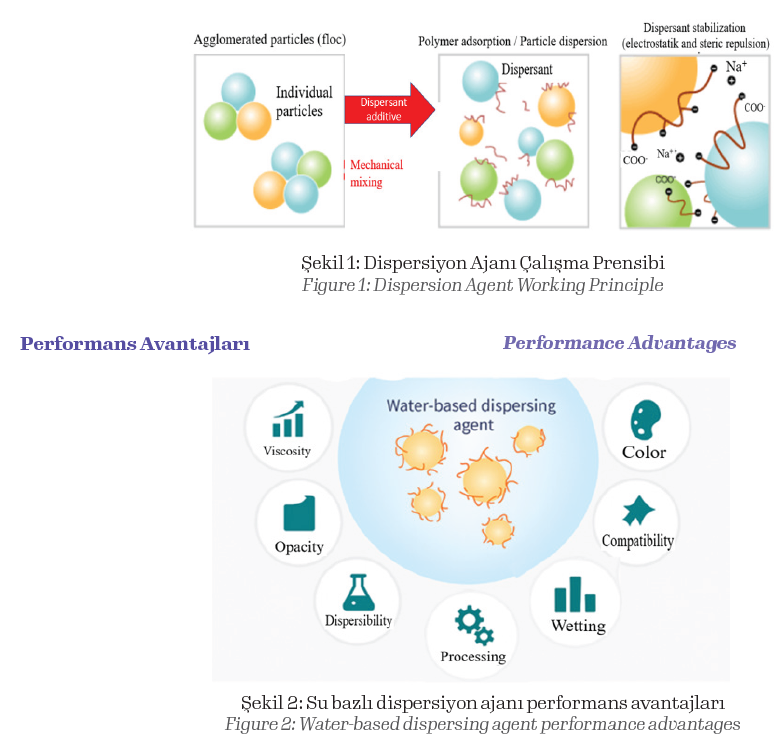
Figure 2 summarizes the technical advantages of water-based dispersing agents in construction paint applications. Add Dispers RC 40A contributes to achieving high color strength and opacity by ensuring homogeneous distribution of pigments and fillers. Viscosity control increases stability and reduces the system's sedimentation tendency.
Additionally, good wetting and dispersibility properties enable better particle spreading on the surface and preservation of film integrity. Compatibility property optimizes interaction with resin and additives, while processability advantage facilitates the production process and reduces energy consumption. In this way, Add Dispers RC 40A enables obtaining high-performance paint films in environmentally friendly systems.
Dispersing Agent Characterization Techniques: FTIR Analysis
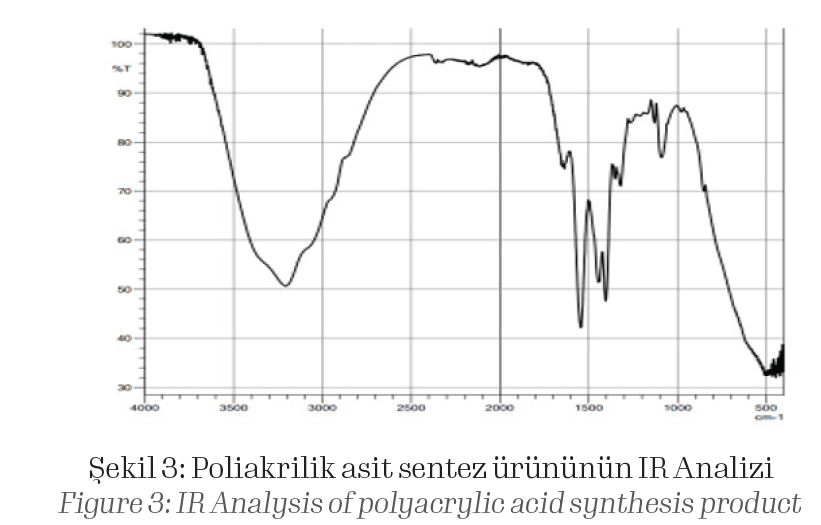
The chemical structure of polyacrylic acid was examined by FTIR spectroscopy (Figure 3). In the obtained FT-IR spectra, characteristic absorption bands at 1651 cm−1 wavenumber specific to carboxylic acid salts correspond to C-OH deformation vibrations, while two bands at 1559 cm−1 and 1324 cm−1 wavenumbers (symmetric stretching vibrations of carboxylic anions -COO−) emerge.
Dispersing Agent Characterization Techniques: GPC Analysis and Effect of Molecular Weight on Paint
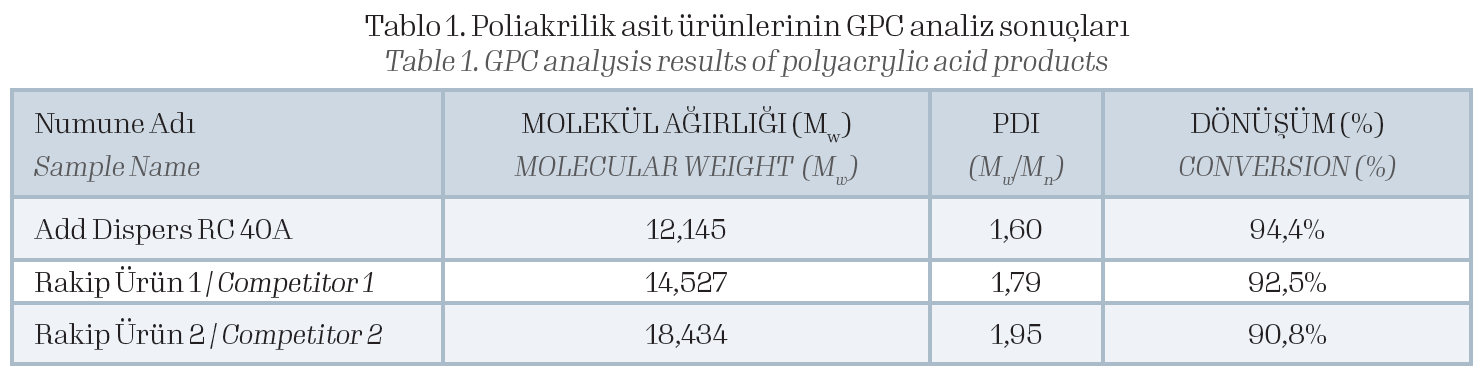
Among polymeric dispersing agents are polyacrylate, polyester, polyether or polyurethane-based systems. Classification of polymeric-type dispersing agents is based on chemical structure (polyacrylic, polyurethane, copolymer…) and molecular weight. Dispersing agents with approximate molecular weight of 5,000–30,000 g/mol are the most commonly used in industrial paints. When products with this molecular weight are used, they provide superior performance to paint with excellent wetting power, reduced dispersion time, long-term stabilization and steric hindrance prevention properties.
Gel Permeation Chromatography method is used to determine molecular weight. As a result of our studies, the molecular weights of the dispersing agents we synthesized were determined in Table 1 and served as a guide in evaluating the performance of the dispersing agents within paint. Thus, in accordance with characterization analyses, dispersing agents with a range of 5,000 and 15,000 g/mol positively affect viscosity change after stabilization, particularly when used in paint formulations with high PVC ratios. The aim is to contribute to the circular economy with high-performance functional polymeric dispersants.
Effect of Dispersing Agent on Paint Performance
In water-based construction paints, the dispersing agent increases colloidal stability of the system by ensuring homogeneous distribution of pigment and filler particles. The dispersing agent adsorbs on particle surfaces creating electrostatic or steric effects, thereby preventing flocculation. This prevents sedimentation and phase separation that may occur over time, extending the paint's shelf life. Competitor 2 underwent phase separation after stabilization due to high viscosity change, as observed in Figure 4. Additionally, through homogeneous distribution, surface smoothness and color consistency improve during film formation. Consequently, using an appropriate dispersing agent significantly increases both the physical stability and application performance of the paint.
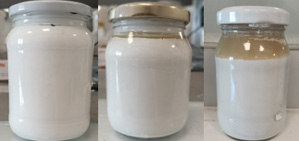
Paint formulations with our Add Dispers RC 40A product and competitor dispersing additives at 0.5% ratio and 80–85% PVC value were tested and stabilization tests were determined. Our Add Dispers RC 40A product, as specified in Table 2, resulted positively in terms of long-term stabilization with a viscosity change rate of 4.02% and was confirmed by characterization techniques.

Conclusion
In water-based paints, dispersing agent is used with the objectives of reducing viscosity, shortening dispersion time, increasing color and coverage strength, and preventing sedimentation and flocculation. Water-based paints are accepted to have a maximum viscosity change rate of 15–20% when stored at high temperature (52±2°C) for 30 days. As a result of our studies, after Add Dispers RC 40A was used in the paint formulation, the viscosity change after stabilization was observed to be better than competitor products and was confirmed by characterization techniques. Add Dispers RC 40A aims to support the circular economy with a high-performance functional polymeric dispersing agent.
Kübra Güler
Research and Development Specialist
Reaction Chemistry
Gallery