Advantages of Innovative Quality Control Devices
Fast Sample Dryers, Bucket Test System and Further
One of the problems encountered in paint production is the long drying times of coating samples taken from production for color measurement. The drying times of solvent-based coatings may take hours and curing of powder coatings takes approximately 10-15 minutes. Another problem is determining whether packages have sufficient mechanical strength before filling. Here we will discuss new equipment and techniques developed to solve these problems. Long drying times of paint and similar coating materials can increase downtime in the manufacturing process, cause stoppage of manufacturing machines and reduce worker productivity. In order to speed up this process, eMEDa designed emok for solvent-based coatings and etok for powder coatings. emok reduces drying times of coating samples from hours to minutes without deteriorating their chroma, hue and gloss properties. This equipment has three radiation sources. The temperature of the film should be controlled during drying; the heat transfer for solvent evaporation or reaction energy should be transmitted to the material by radiation.The wavelength and intensity, as well as the duration and interval of radiation, are important for finding the fastest program. For example, water-based products are rapidly affected by microwaves.
When microwave is applied with suitable wavelength, angle, filters and intervals, it can separate water from the film in seconds almost like a molecular sieve. But such a fast program can deteriorate the film. Therefore microwave should be combined with other radiation sources and the power of these sources should be adjusted properly. Moreover, the rotary table should pass the samples through the sources to dry them evenly. emok is precisely designed and developed to fulfill the optimum conditions for fast drying of paint samples. It can dry some industrial paints in 20 minutes. Luxury and enamel-style coatings can be dried in 8 minutes and water-based coatings can be dried in 2-3 minutes. High-textured water-based coatings can be dried in 6-7 minutes, and plasters a few millimeters thick can be dried in 10-12 minutes. Thanks to its user-friendly software, drying times can be optimized for the product and product groups easily, and the drying process can be made independent of the laboratory assistant. 10 to 60 watts of energy is required for drying a film and approximately 2,400 watts of energy should be absorbed and vented out as harmless hot air. This process is especially necessary for the microwave. Additionally, harmful gases that may occur during drying should be vented out through a separate flue. This is an important point to ensure occupational health and safety. emok is a novel equipment and standards have not yet been set for this type of device. Due to its multiple radiation sources, it can be used as a weathering device as well as a fast dryer. There are no comparable results yet, but test methods can be created similar to the standard tests of weathering devices and provide faster test opportunities.For example, the UV strength of a new type of pigment or resin/binder can be accurately tested in a few hours. It can provide preliminary information before long-term weathering tests which take days or months.
Essentially, emok devices are produced to decrease production downtime, but they can be useful in research, product development and improvement projects. They can also be used in the food, ceramics and other chemistry sectors. The most common problem in packaging is the unwanted cost of low-strength buckets. They are usually stacked on top of each other and the lowest buckets must constantly carry the load. They also need to be durable against heat, cold and impacts. If the strength of the lowest bucket is insufficient, the lid or plastic wall of the bucket can break. The strength of the handle is also important. Other packaging problems include dust accumulation on buckets due to electrostatic effects, breaking when dropped, and leaking from the lid. Packing manufacturers have now begun testing their products to improve quality and decrease the rejection rate of non-conforming products. Manufacturers usually test their products when they change the design or formulas of raw materials. Some packaging users also take a few buckets and test them before deciding to accept or reject the goods. Companies that use packaging may need more such tests because they tend to demand different packages from different suppliers. ekta is specially designed to test packaging and perform strength tests by applying controlled force to the materials. At reasonable speeds (e.g. 5 mm/s), the maximum load that a plastic package with a volume of 20 liters can withstand is 750 kg. A plastic container of approximately 3 liters can resist a maximum load of 300 kg. Metal packagings of similar volume can be 20-50% more resistant than plastic. Handles can withstand loads up to 30 kg in 3-liter containers and up to 65 kg in 20-liter plastic packagings at similar speeds. Metal handles have a resistance of over 100 kg, while recently manufactured plastic handles are resistant to over 80 kg. The speed of applied force for the test is 5 mm/s, which is similar to the virtual speed (holding the bucket by hand or impacts during transportation).In the plastics industry, material testing speeds may vary, but since standards are not developed for these tests, each organization has to set its own criteria, as in weathering tests. Such tests should be perceived as technical quality control tests, not as scientific R&D studies.
While air pressure is a method of applying force, it is almost impossible to adjust the speed and the repeatability of results is low since air is a compressible fluid. Pressure fluctuations in the plant's air lines may adversely affect repeatability.
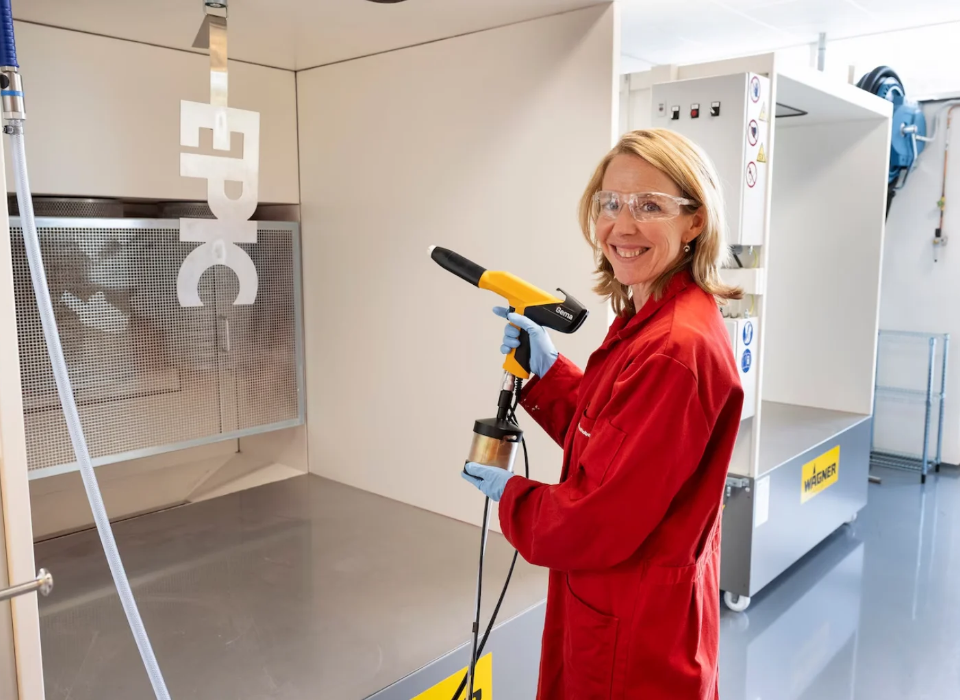
An electrically operated mechanism provides more reliable results and operates stably. Thanks to its servo motors, ekta has speed and ramp identification capabilities. Therefore, the test can be performed independently of the laboratory technician. Conventional tension and compression devices and their apparatus are highly expensive. ekta, which is specially designed for this test and much more cost-effective, can be preferred. As buckets are used in the food industry for packaging, the device can be useful in this sector. Stack strength tests on cardboard packages or routine strength tests of different adhesives with suitable apparatus can also be performed with ekta. Our customers who benefited from the advantages of emok in reducing the drying times of wet paints stated that a device which could also shorten drying times of powder coatings would be beneficial. In line with this demand from our customers, we designed a device named etok. Infrared and ultraviolet sources are used in etok like in our other device emok, and induction technology is also utilized. etok can shorten curing time from 10-15 minutes to 3-5 minutes by reducing it by 70%. This shortens the production process and reduces costs by allowing rapid sample testing during powder coating production. Additionally, it can be useful in research, product development and improvement projects. Furthermore, our device can be useful for sectors other than powder coating manufacturers. For the above-mentioned innovative devices, numerous tests have been conducted and models have been developed over many years. In the new model of ekta which we designed specifically for bucket tests, we are conducting studies to add the measurability of resistance against dust accumulation, i.e. the anti-static status of plastic material. We also continue studies to reveal the advantages of detecting correlations among standard weathering test device results with emok fast film dryer, which has multiple, programmable resources. Finally, all eMEDa products are designed for safe use in compliance with CE directives. Hasan Hüseyin Engin Chemical Engineer, M. Sc. Owner and Director eMEDaAdvertisement
Ad Space728 × 90