Abstract
Flexible polyurethane (PU) foams are widely used in the mattress industry as comfort and support layers. Fluctuations in the costs of petroleum-based raw materials (polyol, isocyanate) are leading manufacturers to explore alternative fillers. This study investigated the effects of stearic acid (StA)-coated calcite (CaCO₃) and stearic acid-coated dolomite (CaMg(CO₃)₂) on the morphology, mechanical strength, and thermal comfort properties of viscoelastic PU foams in the presence of diethanolamine (DEA) nucleating agent. The findings showed that StA-coated minerals improved compatibility with the polymer matrix, ensuring homogeneous cell distribution and reducing the compressive deformation value from 9.5% to 4.8%. With the cross-linking effect of DEA, the rebound elasticity decreased from 42% to 9% (viscoelastic character became dominant), and air permeability improved by 109%. Cost analysis revealed a saving of approximately 18% in total raw material costs. The results demonstrate that coated mineral fillers and DEA-based systems offer a strategic solution for reducing production costs without compromising mattress quality.
Keywords: Polyurethane foam, stearic acid coated calcite, dolomite, diethanolamine, viscoelastic mattress, cost optimization.
1. Introduction
Approximately one-third of human life is spent sleeping, and sleep quality directly affects individuals' physical and psychological health. The need for mattress systems, especially those providing orthopedic support and microclimatic comfort, has become a significant research topic in materials science [1]. Flexible polyurethane (PU) foams constitute the basic material of the mattress industry due to their high deformation capacity, impact absorption, and pressure distribution capabilities [2]. The global flexible PU foam market is estimated to be around USD 72 billion by 2025, with the mattress industry accounting for 18% of this market [3]. However, the volatility of raw material prices, particularly for toluene diisocyanate (TDI) and polyethylene glycol (PEG) based polyols, is forcing manufacturers to develop cost-effective alternative formulations [4]. One of the most effective strategies for cost reduction is the integration of mineral fillers (calcite, dolomite, talc, etc.) into the polymer matrix. However, pure mineral particles with a hydrophilic structure tend to agglomerate within hydrophobic polyol systems, leading to dispersion problems and decreased mechanical strength [5]. Stearic acid coating is one of the leading surface modification techniques developed to overcome this problem. Stearic acid (C₁₇H₃₅COOH) reduces the interfacial tension with the polymer by forming a hydrophobic layer on the mineral surface through chemisorption and significantly improves the dispersibility of the filler [6]. On the other hand, one of the critical parameters in viscoelastic (memory) foam production is the control of cell morphology. Diethanolamine (DEA, C₄H₁₁NO₂) stands out as a dual-function additive in this context. DEA promotes the formation of a fine and uniform cell structure by creating homogeneous nucleation points (nucleating agent) during the foaming reaction, while reacting with isocyanate to increase the cross-linking density of the polymer network via urea bonds [7].
The aim of this study is to develop a new generation technical foam formulation containing stearic acid-coated calcite and dolomite, stabilized with a DEA nucleating system, and to comparatively investigate its physico-mechanical properties, thermal comfort parameters, and cost-effectiveness with a conventional formulation.
2. Materials And Methods
2.1. Raw Material Supply and Characteristics
The raw materials used in the study were of industrial grade, and the technical data sheets of the suppliers were referenced. A base polyether polyol (OH Value: 48 mg KOH/g, functionality: 3, water content <0.05%) was selected as the main polyol, and a graft polyol based on styrene-acrylonitrile copolymer with 40% solids (OH Value: 20 mg KOH/g) was also included in the formulation to increase the load-carrying capacity. The isocyanate system was formed from a mixture of TDI 80/20 (mixture of 2,4- and 2,6- TDI isomers) and polymeric MDI (NCO content 31.5%), and adjusted to an NCO/OH index of 105. Deionized distilled water was used as a chemical foaming agent. Diethanolamine (DEA, purity >98%) acted as the nucleating and crosslinking agent. Two different surface-modified minerals were used as fillers: stearic acid-coated calcite (StA-CaCO₃) with an average particle size (d₅₀) of 2.4 µm and a stearic acid coating ratio of 2.0% by weight, and stearic acid-coated dolomite (StA-Dolomite) with an average particle size (d₅₀) of 4.8 µm and a coating ratio of 1.8%. The catalyst system was determined as an amine catalyst (Dabco 33LV) for the gel reaction and tin-octoate (T-9) for the urea/CO₂ (foaming) reaction. Polysiloxane-polyether copolymer was used as a surfactant to promote cell stabilization and open cell morphology. A melamine-based powder with a particle size <10 µm was added to the formulation as a flame retardant additive.
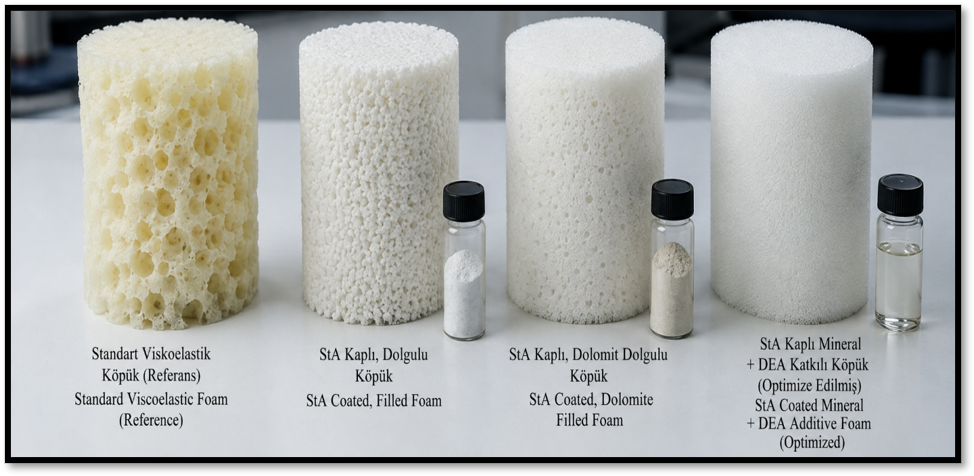
Figure 1. Comparison of standard viscoelastic foam and StA-coated, mineral-filled, and DEA-added foam samples.
2.2. Experimental Prescription Design
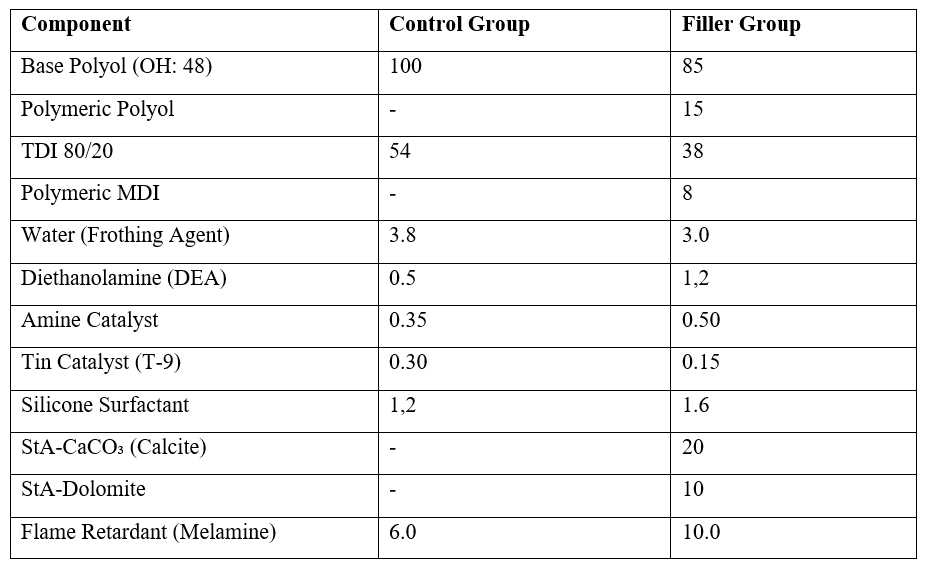
Two different formulations were prepared for comparative analysis: (i) a conventional control sample without any filler and (ii) a new generation filler-added sample containing StA-CaCO₃ and StA-Dolomite. The formulations are given in Table 1 in parts by weight (pbw).
Table 1. Experimental PU Foam Recipes (pbw)
2.3. Production Process
Samples were produced by hand-casting using a laboratory-scale high-shear mixer (3000 RPM). The polyol mixture (base polyol, polymeric polyol, DEA, pure water, catalysts, surfactant and fillers) was homogenized at 23±1 °C for 5 minutes at 2000 RPM, then the isocyanate mixture (TDI/MDI) was added to the polyol mixture and mixed at 3500 RPM for 10 seconds. The mixture was poured into an open steel mold with dimensions of 30x30x15 cm and allowed to rise freely. The block foam was cured in an oven at 40 °C for 6 hours and rested for 24 hours under standard atmospheric conditions (23±2 °C, 50±5% relative humidity). Test samples were prepared in accordance with DIN EN ISO 3386 and ASTM D3574 standards [8, 9].
2.4. Characterization Methods
Apparent density was measured according to DIN EN ISO 3386-1, compressive stress (40% compression) was measured at a speed of 50 mm/min using a Devotrans CKS-III testing machine, and compressive permanent deformation (CS) was determined according to ASTM D3574-D standard at 70% compression for 22 hours at 70 °C. Rebound elasticity was measured using the ASTM D3574-H (Ball Rebound) method, and air permeability was measured according to ASTM D3574-G at a pressure difference of 125 Pa. Cell morphology was examined using a scanning electron microscope (FEGSEM, QUANTA FEI FEG450), while the phase change heat of the PCM additive was determined using a Differential Scanning Calorimeter (DSC, Hitachi DSC7000X) at a heating rate of 5 °C/min in the range of 25-40 °C.
3. Results And Discussion
3.1. Morphological Characterization
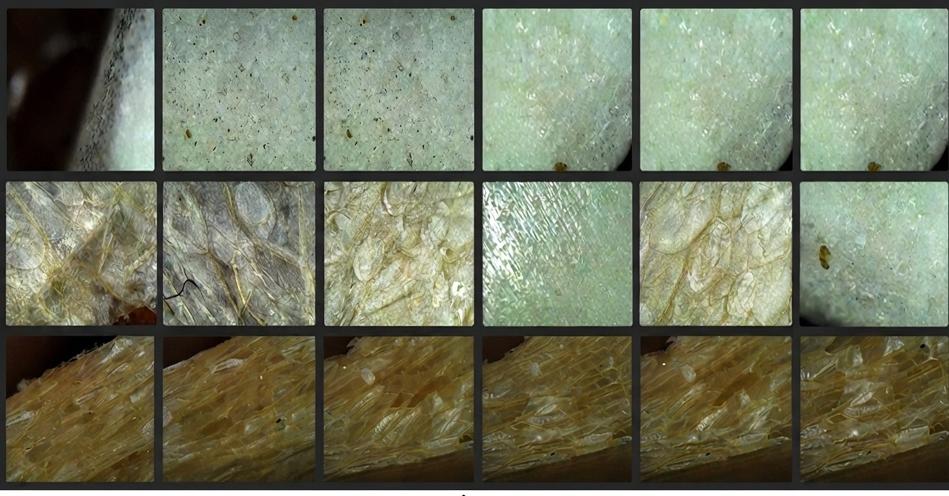
FEGSEM analyses showed that the control group exhibited a heterogeneous and irregular cell size distribution. In contrast, in the foam with filler additives containing StA-CaCO₃ and StA-Dolomite, the cells were observed to be finer, nearly spherical, and homogeneously distributed. This improvement is attributed to the stearic acid-coated mineral particles acting as heterogeneous nucleation points and DEA regulating surface tension during cell formation. The stearic acid coating increased the dispersion ability in the polyol by making the particles hydrophobic and prevented agglomeration. This finding is consistent with reports in the literature that the use of coated calcite improves dispersion [5, 6].
Figure 2. Microscope images of the productions.
3.2. Physico-Mechanical Properties
The results of the physical and mechanical tests are summarized in Table 2 .
Table 2. Physico-Mechanical Properties of Control and Filler Additive Foams.
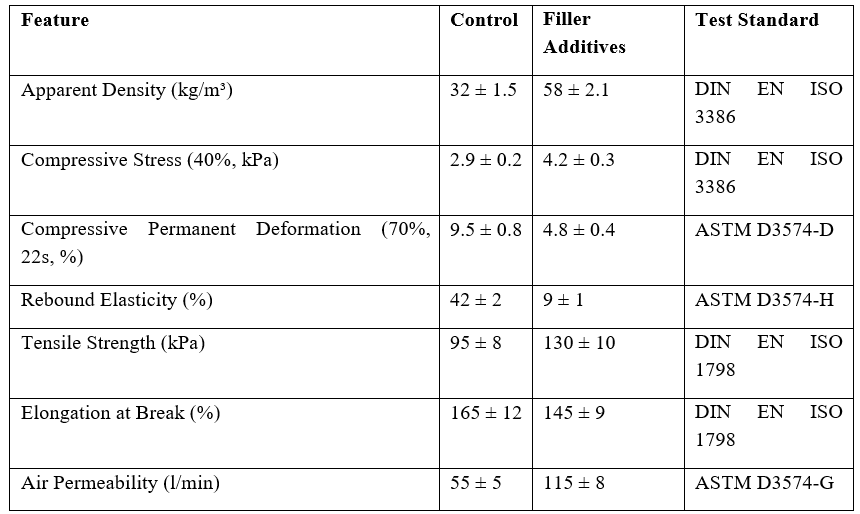
The reduction in compressive permanent deformation value to 4.8% in the filler-added foam indicates a significant increase in the post-compression recovery ability of the polymer matrix. This improvement is a result of the additional urea bonds (increased cross-linking density) created by increasing the DEA amount from 0.5% to 1.2% and the damping effect of the filler particles on the deformation energy [7, 10]. The significant decrease in rebound elasticity (42% → 9%) proves that the material has acquired a viscoelastic (memory) character. This means that a large part of the energy is dissipated as heat when pressure is applied (high hysteresis), which is a desirable property in the mattress industry in terms of body contouring performance [2]. The 109% increase in air permeability (55 → 115 l/min) is attributed to the stearic acid-coated minerals forming micropores in the cell walls and promoting open cell morphology. This is a critical improvement in terms of reducing night sweats and heat accumulation problems.
3.3. Thermal Comfort Parameters
In the DSC analysis of Phase Change Material (PCM) microcapsules (5% by weight) added optionally to the prescription, the latent heat storage capacity was measured as 18 J/g in the range of 28-32 °C. This value contributes to thermal homeostasis during sleep by buffering the bed surface temperature against environmental fluctuations [11].
3.4. Cost-Effectiveness Analysis
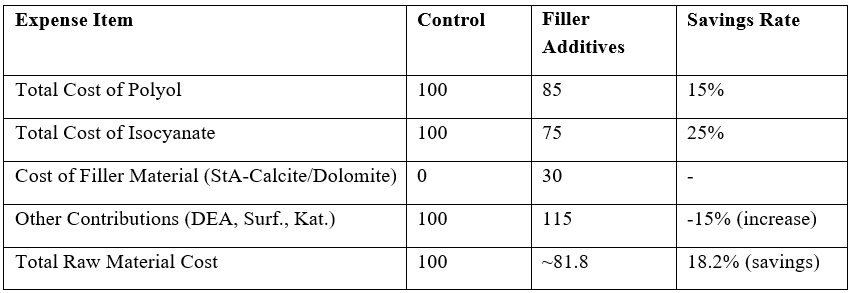
Calculations based on raw material inputs that directly affect production costs are given in Table 3. Considering the high volatility in polyol and isocyanate prices under market conditions (average prices of 2025-2026 Q2 are used as a reference), the use of stearic acid coated mineral fillers provides a direct saving of approximately 18.2% in the total recipe cost [4].
Table 3. Comparative Cost Analysis Per Bed Core (Normalized Values)
4. Conclusion And Recommendations
This study comprehensively investigated the effects of integrating stearic acid-coated calcite and dolomite fillers, along with a diethanolamine nucleating system, into flexible PU foams used in the mattress industry on physico-mechanical performance and cost. Based on the findings, the following key conclusions were reached:
Performance Improvement: Stearic acid-coated minerals enhanced compatibility with the polymer matrix, promoting the formation of a more homogeneous, fine-celled, and open-pored morphology. This resulted in a reduction in compressive deformation from 9.5% to 4.8%, and a 109% improvement in air permeability. The reduction in rebound elasticity to 9% confirmed that the material has acquired advanced viscoelastic properties.
Cost-Effectiveness: Replacing high-cost polyol and isocyanate inputs with low-cost StA-CaCO₃ and StA-Dolomite resulted in an 18.2% saving in total raw material costs. This represents a significant competitive advantage for producers.
The Critical Role of DEA: The dual function of diethanolamine as a nucleating and crosslinking agent directly contributed to increased mechanical strength (tensile strength) while maintaining polymer integrity in the presence of fillers.
Future Studies
the obtained formulation with bio-based polyols (e.g., CO₂-based or castor oil-derived polyols) on the carbon footprint using life cycle analysis (LCA). Optimization of the stearic acid coating ratio (range 1.0% - 3.0%) and investigation of its effect on foam flame retardant performance (LOI index) are proposed. Artificial intelligence-assisted simulation studies will be conducted on modeling the rheology and flow behavior of the filler-added formulation in industrial-scale continuous production (slabstock) lines.
5. References
[1] Latinwo, G. K., Ogunleye, O. R., Agarry, S. E., Dada, E. O., & Tijani, I. A. (2018). Effect of stearic acid and titanate coupling agent modified calcium carbonate on mechanical properties of flexible polyurethane foam. Int. J. Compos. Mater, 8, 91-96.
[2] Prisacariu, C. (2011). Polyurethane elastomers: from morphology to mechanical aspects. Springer Science & Business Media.
[3] Manni, K., Högel, H., Saastamoinen, M., Frondelius, L., & Huuskonen, A. (2023). Report on bedding materials: Analysis of the current bedding material situation and assessment of the near-future development outlook in Finland.
[4] Покровский, С. Я., Пигас, А. В., & Зверева, О. В. Современное состояние и тенденции развития мирового и российского рынков полиуретанов. Успехи в химии и химической технологии: сб. науч. тр. Том XXXIX, 73.
[5] Uçurum, M., & Malgır, E. (2017). Stearik asit çeşidinin kalsit kaplama verimi üzerine etkisi. Çukurova Üniversitesi Mühendislik-Mimarlık Fakültesi Dergisi, 32(2), 137-144.
[6] Usman, M. A., Adeosun, S. O., & Osifeso, G. O. (2012). Optimum calcium carbonate filler concentration for flexible polyurethane foam composite. Journal of Minerals & Materials Characterization & Engineering, 11(3), 311-320.
[7] Kaushiva, B. D., & Wilkes, G. L. (2000). Influence of diethanolamine (DEOA) on structure–property behavior of molded flexible polyurethane foams. Journal of applied polymer science, 77(1), 202-216.
[8] Lancaster, D. C., Makarov, D. M. V., Joachim, A., Rouhani, E., Naeem, R., Ronnachatchai, T., ... & Bagheri, Z. S. (2026). Valorization of Mattress Waste into Thermoplastic Polyurethane (TPU)‐Based Composites for Footwear Midsoles and Outsoles. Macromolecular Materials and Engineering, 311(7), e70297.
[9] Albuquerque, R. Q., Meuchelböck, J., & Ruckdäschel, H. (2024). A unified approach for evaluating mechanical compression tests for polymer bead foams. Journal of Polymer Science, 62(6), 1034-1043.
[10] Luo, Y., Zou, J., Li, J., Zou, H., & Liang, M. (2018). Effect of crosslinking agent on properties and morphology of water‐blown semirigid polyurethane foam. Journal of Applied Polymer Science, 135(42), 46753.
[11] Mondal, S. (2008). Phase change materials for smart textiles–An overview. Applied thermal engineering, 28(11-12), 1536-1550.