1.What are mineral fillers?
Mineral fillers are fine particles added to paints, varnishes, or coatings to improve their physical and functional properties. Unlike color pigments, fillers primarily affect mechanical performance, surface smoothness, opacity, viscosity, and thermal or chemical stability. The right filler can improve application, reduce material costs, extend the lifespan of coatings, and even contribute to a lower carbon footprint. They are used in a wide variety of applications, from interior wall paints to protective coatings for industrial surfaces, magnetic paints for whiteboards, and fire-resistant coatings.
2.Classification of mineral fillers
Fillers have a wide range of applications, a diverse variety of types, and various classification methods. They are divided into three categories according to their material composition:
· Organic fillers,
· İnorganic fillers, or mineral fillers and
· Synthetic fillers.
Mineral fillers are classified in three ways:
i. Classified according to the geometric form of the filler. Particles are in the form of fillers, and the shape of the particles is not very regular, but the geometric shapes of different fillers have significant differences. The particle shape of different fillers has a significant impact on the performance of the product.
ii. Classified according to the chemical composition of the filler. In filler modification, the chemical composition of the filler determines the essence of the filler, especially when the material is given functionality, the chemical composition of the filler plays a decisive role. American scholar Hurlbut divides the chemical composition of fillers into four categories: oxide, salt, elemental substance and organic matter.
iii. Classified by filler application. There are many kinds of minerals that can be used as mineral fillers, and they have a wide range of uses. According to the application fields of fillers, they can be divided into more than 10 types of fillers such as plastic fillers, rubber fillers, paper fillers, and paint fillers.
3.The role of fillers in coatings
The role of mineral fillers in coatings is as follows:
-Play the role of skeleton and filling in the paint, increase the thickness of the paint film, and make the paint film plump and solid.
-It can adjust the rheological properties of the coating.
-Improve the mechanical strength of the paint film, such as improving abrasion resistance and durability.
-Adjust the optical properties of the coating and change the appearance of the coating film, such as matting.
-The film-forming substance undergoes a chemical reaction to make it into a whole, so that the coating film can effectively block the penetration of light, improve its water resistance and weather resistance, and extend the service life of the coating film.
-As a filler in coatings, it can reduce the amount of resin and reduce production costs.
-It assists the chemical properties of the coating film, such as enhancing anti-rust, moisture resistance, flame retardancy, etc.
4.Role of mineral fillers in paint formulations
Mineral fillers serve multiple functions in paint systems, making them indispensable for modern paint manufacturing:
Primary functions:
-Cost reduction: Replace expensive titanium dioxide and other pigments
-Coverage improvement: Enhance paint opacity and hiding power
-Rheology control: Improve paint flow and application properties
-Durability enhancement: Improve weather resistance and film integrity
Secondary benefits:
-Improved workability: Better brush and roller application
-Enhanced adhesion: Better substrate bonding
-Reduced shrinkage: Minimize cracking and film defects
-Better leveling: Improved surface finish and appearance
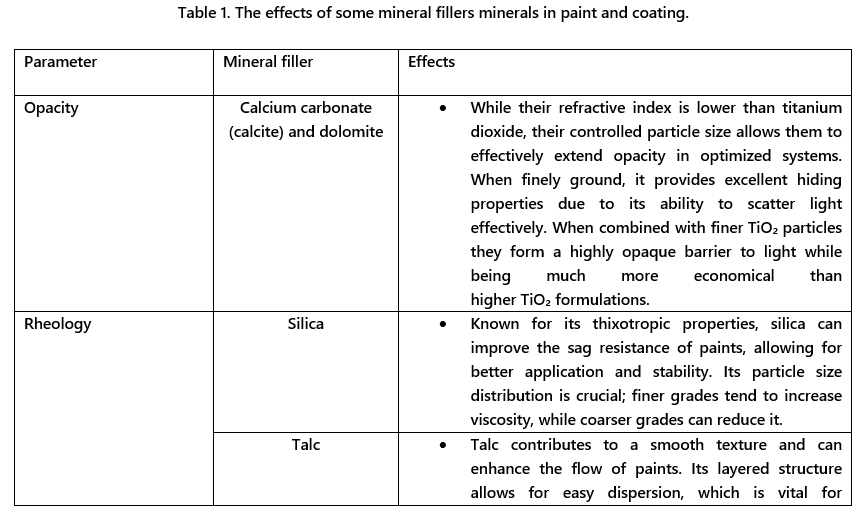
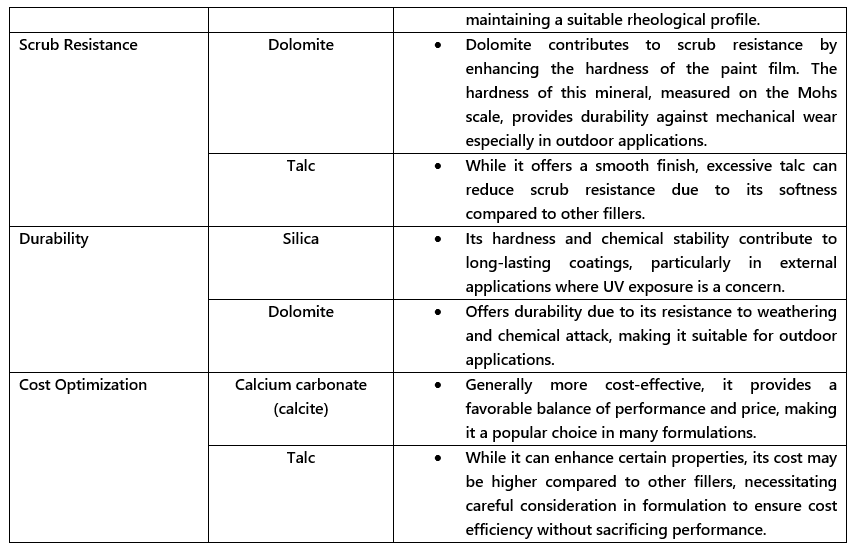
Mineral fillers are fundamental to modern paint formulation. Beyond cost reduction, materials such as calcium carbonate, dolomite, silica and talc (Table 1) significantly influence opacity, rheology, scrub resistance, durability and long-term coating performance. Understanding how these mineral fillers interact within a paint system allows manufacturers to optimize both technical performance and formulation efficiency.
4.1. Opacity
Opacity, or hiding power, is a crucial property for paints, determining how well a coating can conceal the substrate beneath. The effectiveness of mineral fillers in enhancing opacity largely depends on their refractive index and particle size distribution. Although they cannot entirely replace TiO₂ they serve to supplement the refractance while being economical.
4.2. Rheology
Rheology refers to the flow and deformation behavior of the paint under applied stress. The incorporation of mineral fillers can significantly alter the viscosity and flow characteristics of paint formulations.
4.3. Scrub resistance
Scrub resistance is an important measure of a coating’s ability to withstand abrasion and cleaning without degrading. The choice of mineral filler can significantly impact this property.
4.4. Durability
Durability encompasses the lifespan and performance of the paint under environmental stressors. Mineral fillers can enhance or detract from durability based on their chemical and physical properties.
4.5. Cost optimization
The inclusion of mineral fillers not only affects performance but also impacts the overall cost of paint formulations.
5. Key properties of mineral fillers
5.1. The importance of controlled mineral sourcing
Consistent paint performance depends not only on filler type, but also on controlled mineral sourcing and processing. Variations in chemical composition, impurity levels, moisture content, and particle morphology can significantly influence dispersion behaviour, oil absorption, and long-term coating stability. For example, uncontrolled carbonate deposits may contain trace silica, iron oxides, or clay contaminants that affect colour, abrasivity, or binder demand.
Controlled milling and classification processes enable predictable rheological response, packing efficiency, and film formation in both decorative and industrial coatings. This level of consistency supports formulation stability, reduces batch-to-batch variability, and allows manufacturers to optimise opacity, scrub resistance, durability, and cost efficiency with greater technical certainty.
5.2. Particle size distribution
The distribution of particle sizes influences not only the opacity and rheology but also the overall performance of the paint. A well-graded filler can improve packing efficiency and reduce voids in the film, leading to enhanced performance characteristics.
5.3. Mineral hardness
The hardness of the filler material affects the durability and scrub resistance of the paint. Harder fillers contribute to more robust films, while softer fillers may reduce performance in high-abrasion situations.
5.4. Oil absorption
Oil absorption is a measure of how much binder a filler can absorb. Fillers with high oil absorption can affect the viscosity and application properties of the paint. For example, talc has a high oil absorption rate, potentially requiring more binder to maintain a desirable consistency.
5.5. Dispersion behaviour
Effective dispersion of fillers in the paint matrix is essential for achieving uniform performance. Fillers with good dispersion characteristics facilitate a smoother application and enhance the overall stability of the paint.
6. Future trends in paint fillers
Emerging technologies:
-Nano-fillers: Enhanced properties at lower loadings
-Surface treatment: Improved dispersion and compatibility
-Functional fillers: Multi-functional properties for advanced applications
-Sustainable materials: Bio-based and recycled fillers
Market trends:
-High-performance paints: Enhanced durability and protection
-Cost optimization: Higher filler loadings for cost reduction
-Environmental compliance: Low-VOC and sustainable formulations
-Smart coatings: Functional and intelligent paint systems
7. Result
Mineral fillers, added to formulations to improve the physical and functional properties of paints and coatings, unlike color pigments, primarily affect mechanical performance, surface smoothness, opacity, viscosity, and thermal or chemical stability. Parameters such as particle size distribution, hardness, oil absorption rate, and dispersion properties are prominent in terms of application performance. Nano-applications, functional properties, and bio-based fillers are promising technologies, and high-protection, cost-optimized, environmentally friendly, and smart paints and coatings are the trends that will determine the future of the market.
References:
[1] O. Y. Toraman, 2022. Boya Formülasyonlarında İdeal Dolgu Özellikleri, Turkcoat, Nisan-Mayıs 2022, Yıl: 17, Sayı: 99, s.20-24.
[2] O. Y. Toraman, 2023. Astar Boyalar için Mineral Dolgu Seçimi, Turkcoat, Haziran-Temmuz 2023, Yıl: 18, Sayı: 106, s.14-18.
[3] O. Y. Toraman, 2023. Sonkat Boyalar için Mineral Dolgu Seçimi, Turkcoat, Ağustos-Eylül 2023, Yıl: 18, Sayı: 107, s.14-18.
[4] O. Y. Toraman, 2025. Boyalar ve Kaplamalar İçin Yüksek Performanslı ve Fonksiyonel Mineral Dolgu Maddeleri, Turkcoat, Nisan-Mayıs 2025, Yıl: 20, Sayı: 117, s.38-48.
[5] IKAB Minerals, 4.11.2025, https://www.lkabminerals.com/news/mineral-fillers-paints-and-coatings-benefits/
[6] ALPA Powder, Mineral fillers and their role in coatings, 02/11/2021, https://www.alpapowder.com/112877/
[7] Mineral Fillers in Paint Industry: Complete Guide, 10.10.2025, https://www.shikharmicrons.com/blog/mineral-fillers-paint-industry/
[8] Omega Fine Products, The Role of Mineral Fillers in Paint Formulation and Coating Performance, 18.2.2026,
https://omegafineproducts.co.za/the-role-of-mineral-fillers-in-paint-formulation-and-coating-performance/